Introduction
Digital advertising fatigue is real. 51% of US desktop users now run ad blockers, while organic reach on Facebook pages has collapsed to approximately 2.6%, Instagram sits at roughly 4%, and LinkedIn company content occupies just 2% of users' feeds. For B2B marketers trying to reach senior decision-makers, reaching them at all has become the core challenge.
One channel still cuts through: executive newsletters. 94% of C-suite executives use email newsletters for daily news, and nearly 75% rely on them as their primary information source. These newsletters are among the few places where senior leaders give undivided attention. That makes them a direct line for brand awareness campaigns.
Placing an ad in a newsletter doesn't guarantee results. Results vary dramatically based on audience fit, creative execution, timing, and how campaign goals are defined. This article covers the complete setup process and what separates campaigns that build genuine recall from those that disappear without trace.
Key Takeaways
- Use executive newsletters to build brand recall with senior decision-makers—awareness, not conversion, is the goal here
- Select newsletters based on verified readership and editorial quality, not subscriber count alone
- Write tight, context-aware copy that reads as a value signal, not a sales pitch
- Secure above-the-fold placement and commit to 4-6 consecutive issues minimum
- Newsletter ads reach inboxes directly, bypassing ad blockers and platform algorithms entirely
How to Run a B2B Awareness Campaign in an Executive Newsletter
Step 1: Define Your Campaign Goal and Audience Fit
Brand awareness operates on a different timeline than demand generation. While demand gen programs drive conversions within a single sales cycle, brand investments build over quarters and years. The cost of regaining lost market share from brand budget cuts requires $1.85 for every $1.00 saved, according to Boston Consulting Group research.
Understanding this distinction matters because executive newsletter campaigns require a longer view. The objective is making decision-makers recognize and trust your brand before they enter active buying mode—not generating immediate pipeline.
Audience profile requirements:
- Job title range: C-suite, SVP, VP, or director-level roles with purchasing authority
- Industry vertical: Specific enough that your solution directly addresses their challenges
- Geographic focus: Aligned with your sales territory and service capabilities
- Reading behavior: Executives who consume curated news daily are in a fundamentally different mindset than social media scrollers
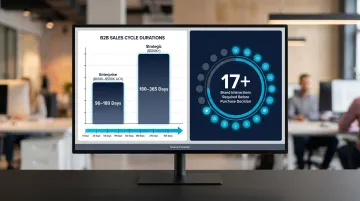
B2B sales cycles have lengthened 22% since 2022, with enterprise deals ($100K-$500K ACV) taking 90-180 days and strategic deals ($500K+) requiring 180-365 days. Buyers need 17+ brand interactions before purchasing, per Forrester. Newsletter awareness campaigns contribute to this exposure baseline.
Step 2: Choose the Right Executive Newsletter
Selection criteria determine campaign outcomes more than creative execution. Prioritize these factors over subscriber volume:
- Editorial credibility: Verify that content is human-written and fact-checked, not algorithmically aggregated. Editorial quality signals audience quality.
- Niche specificity: A newsletter reaching 20,000 verified CFOs will outperform a general business publication with 200,000 mixed subscribers. Segmented email campaigns achieve 100.95% higher clicks than non-segmented campaigns, according to Mailchimp's research across 11,000 campaigns.
- Verified open rates: Request authenticated open rate data over the past 90 days, not just list size. B2B email open rates average 36-42%, with business and finance segments reaching 31-39%.
- Audience alignment: Confirm readership matches your buyer persona by role, industry, and geography.
That segmentation logic is what separates purpose-built newsletter networks from general media buys. House of Summary, for example, operates distinct publications for global executives (Presidential Summary), policy professionals (Geopolitical Summary), and city-specific business communities in Dubai and London. Each audience selects into the newsletter deliberately — which is why the network reports click-through rates 4x higher than Google AdWords benchmarks, including in high-net-worth markets like Dubai where programmatic display consistently underperforms.
Questions to ask publishers before booking:
- What is your verified open rate over the past 90 days?
- Can you provide subscriber demographic breakdowns by job title and industry?
- What percentage of your list actively engages (opens 3+ issues per month)?
- Do you offer editorial calendar visibility for timing alignment?
Step 3: Craft Your Ad Creative and Messaging
Newsletter readers are in reading mode, not browsing mode. This context demands different creative approaches than display or social advertising.
Copy principles:
- Open with a specific claim or data point — not a brand tagline
- Keep body copy under 50 words; brevity outperforms in this format
- Write your first sentence knowing it competes directly with editorial content the reader chose to open
- Mirror the newsletter's tone — formal, data-driven, or conversational — rather than importing standard ad language
Format considerations:
Text-based placements with clear headlines, one or two supporting lines, and a single call-to-action consistently outperform image-heavy formats in professional newsletter environments. A/B testing shows text-based emails outperform image-heavy designs in click rates, with experts recommending a minimum 60% text to 40% image ratio. Text aligns with editorial flow; image-heavy ads trigger banner blindness even in email, where readers apply the same cognitive filters they use on display ads.
Message-to-audience alignment example:
A cybersecurity firm advertising in a geopolitical newsletter would lead with risk language tied to international conflict trends, not product features. The copy might read: "As state-sponsored cyberattacks increase 47% year-over-year, protecting critical infrastructure requires purpose-built defense architecture." This positions the brand within the newsletter's subject matter before mentioning solutions.
The same firm advertising in a CFO-focused newsletter would pivot to financial impact: "The average data breach now costs enterprises $4.45M in recovery and regulatory fines—exceeding the annual cybersecurity budget for 68% of mid-market companies."
Step 4: Coordinate with the Publisher on Placement and Timing
Placement position within the newsletter significantly affects visibility and engagement.
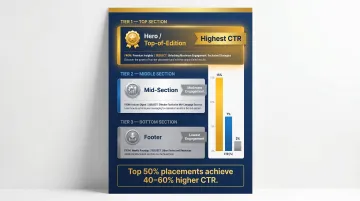
Position hierarchy:
- Top-of-edition/Hero placement: Highest engagement, appearing before primary content
- Mid-section: Moderate engagement, positioned between editorial items
- Footer: Lowest engagement, appearing after main content
Ads placed in the top 50% of newsletters consistently outperform lower placements, with automated placement optimization delivering 40-60% higher CTR than static positioning. Nielsen Norman Group research shows 57% of viewing time is spent above the fold—a principle that applies to email as much as web design.
Timing alignment:
Coordinate campaigns with relevant moments when target buyers think about your category:
- Budget seasons: US B2B buying windows concentrate in Q2-Q3; UK budgets peak in Q1 (Feb-Apr); DACH regions plan spend in Q3-Q4 of the prior year
- Industry events: Major conferences, earnings seasons, or regulatory deadlines
- News cycles: Geopolitical developments, economic reports, or sector-specific announcements
Communicate timing requirements to publishers early. Ask whether editorial calendars are available and whether special positioning is offered around tentpole content.
Step 5: Track Performance and Optimize
Newsletter awareness campaigns require different success metrics than direct-response advertising.
Core metrics:
- Click-through rate: Well-optimized newsletter placements achieve 2-5% CTR, well above display advertising benchmarks
- Branded search lift: Monitor search volume for your brand name during campaign periods
- Direct traffic spikes: Track website visitors entering your URL directly or via bookmarks
- Open rate context: Understand the newsletter's baseline engagement to calibrate expectations
Campaign structure:
A single placement rarely builds measurable awareness. Brand recall increases linearly through 8+ exposures, according to meta-analysis by Schmidt and Eisend in the Journal of Advertising. Maximum brand attitude is reached at approximately 10 exposures.
For B2B contexts, LinkedIn recommends 8-20 exposures spread over 30-90 days, aligned with extended buying cycles.
Optimization approach:
- Run 4-6 consecutive issues minimum to establish baseline performance
- Test two creative variants across the series
- Adjust messaging based on which value proposition drives higher engagement
- Consider expanding to additional newsletters in the publisher's network if initial results prove strong
When Should You Advertise in an Executive Newsletter for B2B Awareness?
Executive newsletters fit a narrow set of campaign goals well. Knowing which scenarios they serve — and which they don't — prevents wasted budget.
Ideal use cases:
- Introducing a new product category: Repeated exposure in trusted editorial environments builds recognition faster than display ads. 77% of B2B purchase influencers factor brand awareness into trust decisions, per Forrester's Business Trust Survey.
- Account-based awareness in specific verticals: Niche newsletters let you concentrate presence where it counts. A fintech platform targeting CFOs can dominate finance-focused publications; a B2B brand targeting Dubai executives can reach city-specific readers that Western programmatic channels miss entirely.
- Repositioning an existing brand: Consistent editorial placement reinforces a new market identity. The repetition frequency newsletters provide is hard to replicate in other channels.
Poor-fit scenarios:
- Products aimed at broad consumer audiences, not business decision-makers
- Campaigns that depend on video, animation, or interactive formats — newsletter placements support text, static images, and links
- Situations requiring measurable pipeline this quarter — demand generation channels are built for short-cycle conversion; newsletters are not
What You Need Before Launching
Most campaigns underperform not because of the newsletter — but because the brand wasn't ready. Without clear messaging and matched assets, you're paying for placements readers scroll past.
Publisher and Placement Requirements
Confirm these details before committing:
- Which ad formats are available: text native, display banner, sponsored content, or full-issue takeover
- Whether single-issue or multi-issue packages are offered (multi-week commitments typically carry 15–30% discounts)
- Creative submission deadlines — most publishers require assets 3–7 days before send
- Any editorial restrictions: category exclusions, tone requirements, or competitor exclusivity clauses
Once you know what the placement requires, your creative has to match it exactly. Pull these together before you confirm the booking:
Creative and Brand Readiness
- A finalized headline — 60 characters or fewer for reliable display across email clients
- A supporting description under 50 words, built around a single value statement (not three)
- A destination URL with UTM parameters for accurate traffic attribution — for example:
utm_source=newsletter_name&utm_medium=email&utm_campaign=awareness_q1 - Consistent brand identifiers — logo, tagline, or value statement — that carry through every placement in the run
Key Parameters That Affect Campaign Results
Newsletter advertising outcomes aren't random. They're driven by specific controllable variables that most B2B brands overlook when treating newsletter placements as passive media buys.
Audience Specificity vs. Scale
Why it matters: A newsletter with 20,000 verified CFOs outperforms a general business publication with 200,000 mixed subscribers for campaigns targeting finance leaders. Relevance-to-reader drives engagement quality, not list size.
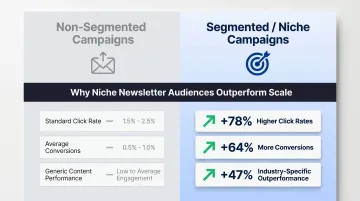
Impact on quality: Research on segmented B2B campaigns shows the gap clearly:
- Advanced segmentation drives 78% higher click rates compared to non-segmented sends
- Segmented emails generate 64% more conversions
- Industry-specific campaigns outperform generic content by 47%
This data explains why niche professional newsletters with verified, role-specific subscriber bases structurally outperform large, undifferentiated business publications. Publishers demonstrating subscriber verification methodology—double opt-in confirmation, periodic re-engagement campaigns, professional domain validation—deliver superior advertiser ROI.
Placement Frequency (Number of Issues)
Brand awareness builds through repetition. A single placement creates a weak signal. Four to six placements over consecutive issues generate sufficient exposure for unaided brand recall.
Herbert Krugman's 1972 research argued three exposures are sufficient: one for awareness ("What is it?"), two for evaluation ("What of it?"), three for action. More recent meta-analysis shows this understates actual requirements. Viewers seeing ads 5-7 times are up to 8 times more likely to convert than those seeing an ad once.
The effective frequency range for lasting brand recall: 8-12 total exposures across a campaign period. For weekly newsletters, this translates to 8-12 consecutive issues. For daily newsletters, concentrate placements within a 4-6 week window rather than spreading too thin.
Message Relevance to Editorial Context
Ads that feel native to a newsletter's topic and tone are perceived as more credible and less disruptive. Readers of a geopolitical newsletter respond differently to brand messaging than readers of a general marketing newsletter—and misaligned copy creates negative associations that outlast the campaign.
Before writing a single word of ad copy, do this:
- Read 3-5 recent editions to identify recurring themes and vocabulary
- Match the newsletter's level of formality (analytical vs. conversational)
- Mirror sentence structure patterns, not just topic
- Lead with insight rather than promotion—useful content earns attention
When your ad reads like a natural extension of editorial content, engagement rates increase substantially. When it doesn't, readers notice immediately.
The Inbox Advantage (No Blockers, No Algorithm)
Unlike display ads or social campaigns, newsletter ads land directly in the reader's inbox—no algorithmic suppression, no competition for feed placement. This is a structurally different attention environment.
Email inbox placement rates sit at 56-60% for verified senders with established domain reputation, according to GlockApps Q1 2025 deliverability data. Compare that to social organic reach of 2-4%. Even accounting for email deliverability challenges, newsletters reach 15-20x more of their intended audience than social organic posts.
Ad blockers—used by 51% of US desktop users—don't affect email newsletter content. Browser-based blocking technology can't filter advertisements embedded within email body content that subscribers explicitly opted to receive.
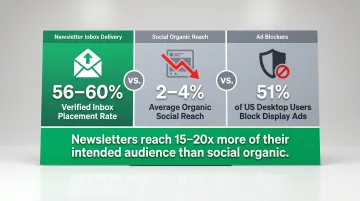
This immunity is a structural advantage over display and programmatic channels, where blocking rates continue rising year over year. It's not unique to any single publisher—it's a category-wide benefit of the inbox channel itself, and one reason executive newsletter placements consistently outperform equivalent spend on display or social.
Common Mistakes When Running B2B Awareness Campaigns in Executive Newsletters
Treating the Newsletter Slot Like a Display Ad
Copy written for banner ads or Google Ads—short punchy taglines, heavy brand color usage, image-first design—tends to underperform in text-forward newsletter environments. These formats trigger banner blindness even in email, regardless of how well the creative is built.
Tonal alignment matters more than visual design here. A short editorial paragraph mentioning your brand within relevant industry context will outperform a colorful display banner with identical messaging.
Skipping Audience Verification
Booking placements based solely on subscriber count claims wastes budget. Publishers inflate numbers by including inactive subscribers, counting total signups rather than engaged readers, or failing to remove bounced addresses.
Questions that verify audience quality:
- What is your 90-day rolling average open rate?
- What percentage of subscribers opened 3+ issues in the past month?
- How frequently do you clean your list of inactive subscribers?
- Can you provide reader profession data, not just subscriber count?
- What is your unsubscribe rate trend over the past year?
Rising unsubscribe rates signal audience dissatisfaction; static or declining open rates point to list quality problems. Publishers who are confident in their audience share this data without hesitation.
Expecting Immediate Conversion Metrics
Brand awareness campaigns operate on different time horizons than demand generation. Forrester explicitly states brand must be measured over "quarters and years," not within a single sales cycle.
Looking for lead form completions or direct sales after a single placement misreads the channel's role entirely. Two realities define awareness in the B2B funnel:
- Purchase decisions typically require 17+ interactions before a buyer acts
- Campaigns measured as direct-response vehicles get cancelled before they deliver value
Awareness placements build the recognition that makes later touchpoints convert.
Conclusion
Running a B2B awareness campaign inside an executive newsletter works when three conditions align: the audience matches your buyer persona, the creative respects the editorial environment, and the campaign runs with sufficient frequency to build genuine recall.
Most failed newsletter campaigns stem from misaligned expectations—treating awareness as a short-term conversion play—poor audience fit, or under-investment in creative. Brands that establish these foundations correctly gain access to a channel where readers are attentive, ad blockers are irrelevant, and the inbox delivers direct access to decision-makers.
The channel's structural advantages are real: 94% of executives rely on email newsletters for daily information, inbox delivery bypasses algorithmic suppression, and readers engage with newsletter content by choice rather than habit. The brands that benefit most treat it accordingly — as a precision tool, not a broadcast one.
Frequently Asked Questions
How is advertising in an executive newsletter different from display or social ads for B2B?
Newsletter ads land directly in the reader's inbox with no algorithm filtering or ad blocking. The audience is a verified professional segment actively reading curated content. The format rewards editorial-style copy over visual-heavy creative, and engagement rates structurally exceed display channels.
What's a realistic budget to start a B2B awareness campaign in an executive newsletter?
Entry costs vary by newsletter size and audience specificity, ranging from $500–$5,000 per placement in niche publications to $10,000+ in large-circulation executive newsletters. Multi-issue commitments typically offer 15–30% discounts over single placements, lowering cost-per-impression.
How do you write effective ad copy for a newsletter audience?
Keep body copy under 50 words. Lead with a specific insight or claim relevant to the reader's world, not generic brand language. Mirror the newsletter's editorial tone. Make it feel like a recommendation, not a pitch. One strong value statement beats multiple weak ones.
How many placements does it take to build brand awareness through a newsletter?
Most awareness-building requires 4–6 exposures at minimum, with 8–12 delivering optimal brand recall. Multi-issue campaigns running 6–12 consecutive weeks outperform one-off buys.
Can a small or mid-size B2B brand run a newsletter awareness campaign effectively?
Yes—smaller brands often benefit more from niche, high-specificity newsletters than large general publications. The cost is lower, audience match can be tighter, and standing out in a focused publication is easier than competing for attention in broad-reach channels.
How do you track ROI from a newsletter awareness campaign?
Use UTM-tracked links for click measurement, monitor branded search volume trends during campaign periods, and track direct website traffic spikes. Full ROI attribution requires longer measurement windows than demand gen, typically 90–180 days to capture downstream conversion impact.