The stakes are real: the global native advertising market hit $106.9 billion in 2024 and is projected to reach $399.79 billion by 2034, according to Market.us research published in August 2025. Brands that figure out the right execution model early will compound that advantage over time.
So: agency or in-house? This article breaks down the genuine trade-offs, not the theoretical ones — covering cost structure, performance expectations, and where specialist publishers fit into the picture.
Key Takeaways
- Agencies offer scale, publisher access, and multi-channel expertise — at a higher cost and slower brand ramp-up
- In-house teams give you brand control and institutional knowledge, but creative stagnation and skill gaps are real risks
- Hidden costs make in-house more expensive than it appears; agency fees pause when campaigns do
- Specialist publishers like House of Summary provide direct placements in engaged editorial audiences without full-agency overhead
- Your best model depends on content volume, internal bandwidth, and how niche your native placements need to be
Native Advertising Agency vs In-House: Quick Comparison
Five dimensions separate the two models in practice. The table below shows where each approach has a structural advantage — and where it doesn't.
| Dimension | Native Advertising Agency | In-House Team |
|---|---|---|
| Cost Structure | Retainer or project-based; scales up or down with campaign volume | Fixed headcount costs plus tools, training, benefits — ongoing regardless of output |
| Expertise & Specialisation | Access to strategists, copywriters, media buyers, and analysts under one contract | Depends heavily on who you hire; specialist native skills are difficult to retain |
| Brand Knowledge | Takes time to build; team works across multiple clients | Deep institutional knowledge; team lives inside the brand culture |
| Scalability | High — can ramp content and distribution quickly | Limited by headcount and internal bandwidth |
| Speed to Launch | Fast once onboarded; established publisher relationships accelerate placement | Slower — building publisher access from scratch takes months |
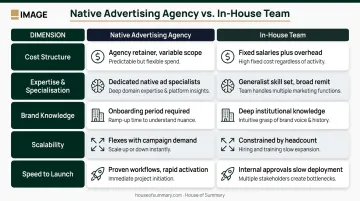
If campaign frequency is low and brand consistency is the priority, in-house wins. If you need fast distribution, specialist skills, and volume flexibility, an agency has the structural edge.
What Is a Native Advertising Agency?
A native advertising agency is a third-party firm that plans, creates, and distributes ads designed to match the look, feel, and tone of the editorial environments where they appear. As defined by the IAB Native Advertising Playbook 2.0, native ads are paid placements that are cohesive with page content, assimilated into the design, and consistent with platform behaviour. Formats include in-feed ads, content recommendation units, sponsored editorial content, and newsletter placements.
The core value proposition is access to a full team of specialists — strategists, copywriters, media buyers, analytics experts — under a single contract. You're not hiring and managing each function separately; you're buying a coordinated capability.
Types of Native Advertising Agencies
The category is wider than it first appears:
- Full-service agencies — handle end-to-end campaign management, from strategy through creative production to media buying and reporting
- Niche channel specialists — focus on specific formats such as programmatic native, newsletter placements, or content studio work
- Publisher-direct programs — owned editorial environments that offer native placements integrated within their own publications (the IAB publisher content studio directory listed over 60 member companies when launched)
- Content marketing agencies — create branded content assets that get distributed across native networks; recent Clutch data puts average rates at $100–$149 per hour
One structural advantage agencies hold over in-house teams is established publisher relationships and platform access. Getting meaningful placements on quality editorial properties takes months of relationship-building — agencies arrive with those connections already in place.
Use Cases for a Native Advertising Agency
Agencies deliver the clearest advantage when:
- Your brand is launching native advertising for the first time with no internal expertise
- You're running campaigns across multiple platforms simultaneously and need coordinated execution
- Content volume requirements exceed what your internal team can produce without sacrificing quality
Specialist publisher networks occupy a distinct position here. House of Summary, for example, offers direct editorial placements across four newsletters — Presidential Summary, Geopolitical Summary, Dubai Summary, and London Summary — reaching 500,000+ subscribers including executives, decision-makers, and high-net-worth professionals.
The results can be concrete. BSH Hausgeräte reported click-through rates 4x higher than Google AdWords from their Dubai Summary campaign — a figure that reflects what happens when audience quality and editorial context are closely matched.
What Is In-House Native Advertising?
In-house native advertising means a brand builds or designates an internal team to conceive, produce, place, and measure its own native ad content. This ranges from a single content marketing hire to a full branded content studio.
The Real Advantages
- Brand immersion: Internal teams understand tone, product nuance, and institutional history from the inside out
- Message control: No external interpretation of brand guidelines or creative briefs
- No agency markup: Media spend goes directly to publishers without a margin layer
- Faster iteration: Revisions and approvals move through fewer parties
The Trade-offs Specific to Native
The challenges become sharper with native advertising specifically. Writers working on one brand continuously develop creative blind spots — the editorial freshness that makes native advertising work degrades over time. Specialist skills like native platform optimization, A/B testing at scale, and content distribution are also difficult to maintain internally without dedicated training investment.
That training investment adds up fast, and so does headcount. A content strategist earns an average of $109,060 annually (Glassdoor, 2026). Add benefits — the BLS reports private-industry benefit costs at 29.9% of total compensation as of December 2025 — and that single hire costs roughly $140,000 loaded before accounting for tools, onboarding, or management overhead.
CMI's 2025 B2B research found that 45% of B2B marketers lack a scalable model for content creation and 43% struggle to differentiate their content. Both are structural problems most common in in-house setups.
Use Cases for In-House Native Advertising
In-house teams perform best when:
- Content output requirements are consistently high enough to justify dedicated headcount
- The brand has a strong existing editorial identity that's genuinely difficult to transfer externally
- The industry is heavily regulated (healthcare, financial services) and all content must pass internal legal and compliance review before distribution
- The organisation already has a media-company-like content operation, such as a publisher running native for its own products
Agency vs In-House: Which Delivers Better Results?
"Better results" in native advertising means higher engagement, lower cost-per-engagement, and content that earns genuine reader trust. There's no clean published benchmark directly comparing agency-managed versus in-house native campaign performance — the ANA, CMI, and IAB haven't produced that specific comparison. What does exist is useful context.
ANA data from 2023 shows that 82% of ANA members now operate in-house agencies (up from 42% in 2008), yet 92% still work with external agencies for specialized capabilities or additional bandwidth. That's not contradiction — it's the industry arriving at a hybrid conclusion through trial and error.
The Hidden Cost Problem
In-house consistently looks cheaper until you fully load the cost:
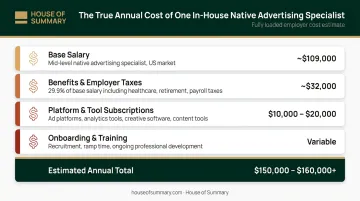
- Content strategist salary: ~$109,000
- Benefits (29.9% of compensation): ~$32,000
- Native platform subscriptions, analytics tools, design software: $10,000–$20,000/year
- Onboarding, training, management time: significant but rarely counted
- Total loaded cost: $150,000–$160,000+ for one specialist
Agency retainers for comparable content marketing output run significantly lower on a per-project basis — Clutch reports typical project costs under $10,000, with hourly rates of $100–$149. Agency fees stop when campaigns pause. Salaries don't.
Cost alone doesn't settle the question. The right model depends on where you are in your native advertising journey.
Situational Recommendations
| Situation | Recommended Model |
|---|---|
| Launching native for the first time | Agency or specialist publisher |
| Scaling across multiple platforms simultaneously | Agency |
| Consistent high-volume campaigns, mature editorial team | In-house |
| Regulated industry requiring internal review | In-house with external distribution |
| Premium audience targeting, limited internal bandwidth | Specialist publisher-direct |
The hybrid model — in-house teams setting brand strategy and managing owned content, while specialist publishers or agencies handle placement, distribution, and performance optimization — consistently outperforms either extreme for brands with ongoing native needs. Brands that split responsibilities this way keep strategic control without paying full-time salaries for capabilities they only need part of the time.
Conclusion
There's no universal answer here. The better model is the one that matches your content capabilities, campaign goals, and budget structure — and the most effective advertisers rarely commit to either extreme exclusively.
What's worth holding onto: in native advertising, execution quality is inseparable from results. A well-written piece placed in a misaligned environment underperforms. A compelling concept executed without editorial discipline fails to build reader trust.
Ground the decision in where your brand can sustainably maintain content quality over time. That might mean building in-house, partnering with an agency, or working directly with publishers whose audiences already trust the editorial voice carrying your message. The right answer is the one your team can actually execute — consistently.
Frequently Asked Questions
Agency or in-house: which is better for native advertising?
Neither is universally better. Agencies offer expertise, publisher access, and scale; in-house teams offer brand depth and message control. The right choice depends on your content volume, internal bandwidth, and how specialized your placements need to be.
What does a native advertising agency actually do?
Agencies handle strategy, content creation, media buying, publisher placement, and performance tracking, all oriented around ads that blend naturally into the editorial environment where they appear.
How much does it cost to run native advertising in-house vs. through an agency?
In-house costs typically run $150,000+ loaded for one specialist (salary, benefits, tools, training). Agency rates average $100–$149/hour, with many project costs under $10,000, and fees scale back when campaigns pause — unlike fixed headcount.
What is the biggest disadvantage of using a native advertising agency?
Agencies take time to absorb brand voice and often work across many clients simultaneously. Your campaigns may not receive the editorial depth or dedicated attention that a fully embedded in-house team can provide.
Can small businesses run native advertising in-house effectively?
It's possible with a strong content writer, but most small businesses lack the publisher relationships needed to reach meaningful audiences. At smaller scales, working directly with a specialist publisher or newsletter network usually delivers better reach per dollar spent.
Is there a hybrid approach to native advertising that combines both models?
Yes — many brands use in-house teams to manage brand voice and campaign strategy while specialist publishers or agencies handle placement, distribution, and performance optimization. In practice, this means your team controls the message while external partners handle the reach.