
Introduction
The average professional receives 121 business emails daily, with executives fielding 150 to 200+ messages. Yet most still struggle to feel genuinely informed.
Knowledge workers now spend 28% of their workweek — roughly 11 hours — just managing email, and 82% report missing important information buried in cluttered inboxes.
AI-generated daily newsletters have emerged as one answer to this overload. The category spans an enormous quality range — from sophisticated editorial products where AI assists human editors, to fully automated content farms publishing hundreds of identical newsletters with no human verification. Most readers can't tell them apart, and most publishers aren't transparent about which they're running.
This guide covers how AI newsletters actually work, what genuine benefits they offer, where real risks emerge, and what to look for when choosing one that serves serious readers rather than just filling inboxes.
TLDR:
- AI newsletters use language models to collect, summarize, and deliver news with minimal or no human authorship
- Models range from fully automated pipelines to hybrid approaches where humans verify AI drafts
- Benefits include speed, consistency, and the ability to monitor thousands of sources simultaneously
- Risks include factual errors, lack of original reporting, and transparency gaps about AI involvement
- Check a newsletter's editorial verification process before relying on it
What Are AI-Generated Daily Newsletters?
AI-generated newsletters are publications where artificial intelligence—typically large language models—handles content collection, summarization, and formatting with minimal or no human authorship involved in each edition. Who holds final editorial control determines everything about what readers actually get.
Three models exist, though marketing often blurs the lines:
- Fully automated: AI writes and publishes everything without human review
- AI-assisted: AI drafts content, but trained editors verify facts and make final editorial decisions
- Traditionally curated: Humans write content while AI handles only backend tasks like scheduling
The Spectrum from Automated to Editorial
Fully automated newsletters operate at massive scale. Networks like Good Daily deployed 337 independently verified editions across 47 U.S. states—each generated from the same AI pipeline applied to local data sources. The model demonstrates both the scale and the risks: one engineer can run a newsletter network that would otherwise require an entire editorial team.
The distinction between AI-generated and AI-assisted matters enormously to readers. Fully automated systems prioritize volume; human-edited ones prioritize judgment. According to Reuters Institute research, 62% of the public is comfortable with human-led news assisted by AI, but only 12% trust fully AI-generated news.
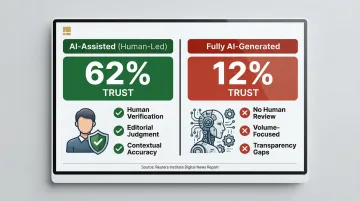
That trust gap has real consequences. Many publishers obscure which model they use through vague language or skip disclosure entirely—leaving readers to assume editorial oversight that may not exist.
How AI Creates Newsletter Content Every Day
AI newsletter production follows a multi-stage pipeline that runs continuously — often without a single human touching the output.
The process typically breaks into two phases:
- Source collection: Systems crawl RSS feeds, news APIs, press releases, government databases, and social signals at scale. Meltwater monitors over 270,000 global news sources; News API aggregates more than 150,000 worldwide.
- Automated summarization: Large language models compress articles into a fixed format — headline, summary, context — applied consistently regardless of story complexity. The standardization speeds production but often strips nuance that a human editor would preserve.
Personalization and Delivery
AI platforms like Rasa.io add a personalization layer by analyzing reader click behavior and topic preferences. Content filtering recommends articles based on past reading history; collaborative filtering surfaces what similar readers engaged with. The result: two subscribers to the same newsletter can receive noticeably different content.
Once content is assembled, automated systems handle formatting, subject line generation, scheduling, and distribution through email service providers. A single engineer can manage what would traditionally require a full editorial team. That cuts costs significantly, but it also removes the judgment call — the instinct a seasoned editor uses to decide what actually matters to a specific audience.
The Real Benefits for Time-Pressed Readers
AI newsletters deliver genuine advantages for busy professionals who need reliable information habits.
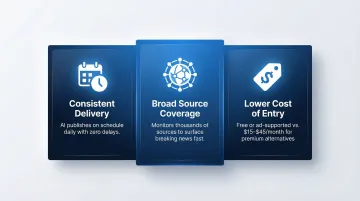
Three advantages stand out for time-pressed readers:
- Consistent delivery — AI newsletters publish on schedule every day, with no sick days, editorial bottlenecks, or publishing delays. For professionals who depend on a daily briefing, that reliability matters.
- Broad source coverage — AI can monitor thousands of sources simultaneously and surface relevant developments faster than any human team, making it useful for tracking breaking news across multiple sectors or regions at once.
- Lower cost of entry — Reduced production overhead means many AI newsletters are free or ad-supported. While premium human-authored publications like the Financial Times charge $45/month and Stratechery charges $15/month, AI alternatives expand access to specialized daily briefings for readers priced out of premium subscriptions.
The time savings are also substantial. Reading 12 newsletters individually can take well over an hour; an AI digest covering the same ground typically takes minutes. That efficiency is genuinely useful — though it comes with a tradeoff: speed and breadth don't always substitute for the depth and editorial judgment that specialized human writers bring to complex topics.
Limitations and Quality Red Flags to Watch
AI newsletters carry meaningful risks that readers must understand before trusting them for important decisions.
Accuracy and Hallucination Risk
Research on LLM performance in news summarization shows that AI models can misstate facts, merge unrelated stories, omit critical context, or confidently present outdated information. A study by Tam et al. (2023) found that LLMs struggle with factual consistency, particularly when inconsistent summaries contain verbatim text from source documents—making errors difficult to detect.
Real-world failures illustrate the problem:
- Nota News copied local reporting without credit and introduced errors, including shortening "Georgia O'Keeffe" to "Ga. O'Keeffe" and spelling "K-9" as "K-nine"
- Peter Vandermeersch, a senior European journalist, apologized for using AI tools that fabricated quotes attributed to real experts in his newsletter
- King Features syndicated an AI-generated summer reading list that recommended nonexistent books by famous authors
AI newsletters summarize and repackage content that already exists. They do not conduct interviews, file FOIA requests, verify primary sources, or break news. Readers relying solely on AI newsletters for geopolitical or business intelligence will miss the full picture.
Transparency and Editorial Judgment
Most readers never get the chance to calibrate their trust appropriately: 94% of audiences want AI disclosure, yet only 19% report seeing AI labels daily. When the editorial process is hidden, readers cannot assess what they're actually reading.
That gap matters because AI lacks the contextual judgment to determine why one story matters more than another at a specific moment. Models optimize for pattern-matching — not the kind of reasoning that weighs geopolitical context, historical precedent, and conflicting expert interpretations. That requires human expertise.
The benchmark worth holding AI newsletters to: trained editors verifying facts, selecting stories with intent, and applying domain knowledge before content reaches readers. Newsletters that meet this standard consistently outperform automated pipelines on accuracy, trust, and usefulness.
When evaluating any newsletter — AI or human — look for explicit editorial processes, named authors with relevant expertise, and clear disclosure about how content is produced.
How to Choose the Right Daily Newsletter for You
Choosing wisely requires matching newsletter type to your actual information needs and evaluating transparency rigorously.
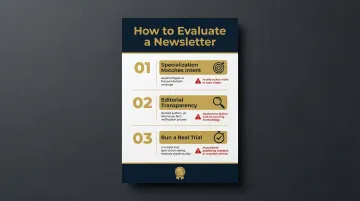
Three criteria separate newsletters worth keeping from those worth deleting:
- Specialization matches your intent. A general AI digest and a focused newsletter on geopolitics, finance, or regional affairs serve entirely different needs. Decide whether your goal is broad awareness or deep domain tracking before subscribing. Specialized publications written by people who know their field deliver higher signal quality than automated aggregators — House of Summary's network is built on exactly this principle.
- Editorial transparency is non-negotiable. Look for newsletters that clearly state who produces content, whether AI is involved, and how facts are verified. If the "about" section or masthead can't answer those questions, that's a serious warning sign. Publications that hide their editorial process shouldn't inform important decisions.
- Run a real trial before committing. Subscribe to two or three candidates for two to four weeks. Spot-check stories against independent sources. Notice whether the tone respects your time. Unsubscribe from anything that prioritizes volume over accuracy.
These standards matter most for readers who use newsletters to make real decisions. Nearly 75% of executives rely on email newsletters as their primary information source — and they consistently favor tightly focused, high-signal publications over broad aggregators. Brevity, verified facts, and direct relevance to high-stakes decisions are what separate newsletters they read from ones they ignore.
Frequently Asked Questions
What are the best daily newsletters?
The "best" depends entirely on your goals. For business and global news, curated specialist newsletters that verify their content tend to outperform general AI digests. Quality markers include editorial transparency, topical focus, and a consistent track record of accuracy rather than volume.
What newsletters do CEOs read?
Senior executives favor tightly focused, high-signal newsletters covering geopolitics, finance, and business rather than broad aggregators. The common thread is brevity, verified facts, and direct relevance to high-stakes decisions — newsletters for quick updates, deeper reports for analysis.
What is the 3/2/1 newsletter?
The 3/2/1 newsletter is a weekly format popularized by James Clear, sent every Thursday. It features 3 short ideas from the author, 2 quotes from others, and 1 question for readers to ponder.
What is the 3 email rule?
The 3 email rule is an inbox management principle suggesting that if an email exchange has gone three rounds without resolution, a call or meeting is more efficient. It's a productivity guideline, not a newsletter concept, though focused newsletters can reduce information-seeking emails by giving teams shared context upfront.
Are AI-generated newsletters accurate?
AI newsletters vary in accuracy. Fully automated pipelines carry meaningful risks of factual error and missing context, while AI-assisted newsletters with human editorial review perform significantly better. Readers should always check whether a newsletter discloses its verification process before trusting it for important decisions.
What is the difference between an AI-generated and an AI-assisted newsletter?
AI-generated means the AI produces final content with no meaningful human review before publishing. AI-assisted means AI supports human editors who retain final judgment over accuracy, selection, and tone — making it the more trustworthy format, since editors can verify facts and apply context that AI alone cannot.