Introduction
Pharmaceutical companies spent $10.1 billion on direct-to-consumer (DTC) advertising in 2024, placing brand and product information in front of everyday patients rather than restricting promotional efforts to physicians. This practice transforms how millions of Americans learn about prescription medications—shaping doctor–patient conversations, prescribing patterns, and public health outcomes on a massive scale.
When a patient asks their doctor about a drug they saw during primetime TV, they are participating in a marketing dynamic legal in only two countries—one that has generated fierce debate since its rapid expansion in the late 1990s.
This article covers what DTC advertising is, how it became legal, and the regulatory framework governing it. It also examines the benefits proponents cite, the risks critics document, and the significant regulatory tightening underway in 2025—as the FDA closes longstanding loopholes and extends oversight to influencer content, AI-generated health material, and algorithm-driven social media campaigns.
TLDR:
- DTC advertising markets prescription drugs directly to patients, not just doctors—legal only in the US and New Zealand
- FDA's 1997 guidance let broadcast ads skip full risk disclosures, fueling a now $10.1 billion industry
- Patients who request advertised drugs are 17x more likely to receive them—raising concerns about inappropriate prescribing
- The FDA is now closing the "adequate provision" loophole and cracking down on influencer and AI-generated health content
- Spend is shifting from TV ($5.15B in 2024) to digital, with pharma digital ad spend forecast at $24.77B in 2025
What Is Direct-to-Consumer Advertising?
Direct-to-consumer advertising refers to marketing and promotional campaigns for prescription pharmaceuticals—and sometimes medical devices or financial services—communicated directly to end consumers rather than to intermediaries like physicians, financial advisors, or pharmacists. While the term applies broadly across industries, it dominates public discourse in pharmaceuticals because patients with limited medical training are exposed to persuasive messages about powerful drugs they cannot buy without a prescription.
DTC advertising inverts the traditional referral model. Instead of a physician independently deciding which medication best suits a patient's needs, the patient arrives at the appointment already primed to request a specific brand. This shifts the traditional medical authority relationship and introduces commercial influence into clinical decision-making.
Although financial services firms and device manufacturers also use DTC approaches, pharmaceutical DTC advertising generates the most intense scrutiny—and the highest spending. In industries where expert intermediaries traditionally controlled purchase decisions, DTC strategies aim to pull demand through the channel by building consumer awareness and preference.
Types of DTC Pharmaceutical Ads
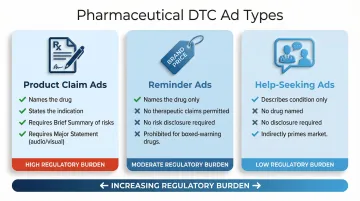
The FDA recognizes three distinct categories of pharmaceutical DTC advertising, each carrying different regulatory requirements:
Product Claim Ads name the drug, state its approved use (indication), and present both benefits and risks. These ads must include a "brief summary" of side effects, contraindications, and effectiveness.
Broadcast versions must also feature a "major statement" covering serious risks and direct viewers to additional sources—websites, toll-free numbers, or print materials—for complete safety information. Product claim ads face the strictest regulatory oversight because they make explicit health claims.
Reminder Ads build brand recognition by mentioning the drug's name without stating what it treats or how it works. Because they avoid therapeutic claims, reminder ads are not required to include risk disclosures. However, the FDA prohibits reminder ads for drugs carrying boxed warnings—the agency's most serious safety alert.
Help-Seeking Ads raise awareness of a medical condition or symptom without naming a specific drug. These campaigns encourage patients to "ask your doctor" about treatment options, effectively priming the market for a branded product without triggering the disclosure requirements that apply to product claim ads.
Pharmaceutical companies strategically choose formats to balance promotional impact against regulatory burden. Reminder and help-seeking ads allow brands to maintain visibility while sidestepping the detailed risk disclosures required for product claim advertising.
A Unique Global Position
Only the United States and New Zealand permit full direct-to-consumer advertising of prescription medications. Virtually every other country—including the entire European Union, the United Kingdom, Canada, and Brazil—prohibits or heavily restricts DTC prescription drug advertising.
European regulations allow disease awareness campaigns and approved vaccination promotions, but companies cannot reference specific branded prescription products. Canada permits reminder ads (naming the drug, price, and quantity only) and help-seeking messages, but not product claim advertising.
This global divergence reflects a persistent international consensus that the public health risks of DTC advertising outweigh its benefits—a judgment the US has not shared, though recent regulatory moves suggest that position may be shifting.
How DTC Advertising Became Legal: A Brief History
The Early Regulatory Vacuum
From the 1700s through the early 20th century, patent medicine advertisements ran freely in US newspapers, making extravagant health claims with no regulatory oversight. The 1938 Food, Drug, and Cosmetic Act granted the FDA authority over drug labeling and required manufacturers to demonstrate safety before marketing, but did not address advertising content or enforce fair balance between benefit and risk messaging.
The regulatory framework tightened in 1962 when the Kefauver-Harris Amendments transferred jurisdiction over prescription drug advertising from the Federal Trade Commission to the FDA and required proof of effectiveness, not just safety. The amendments mandated that drug ads provide "fair balance" and include a "brief summary" of risks—standards that applied primarily to physician-targeted advertising in medical journals.
The Turning Point: From Physician-Only to Consumer-Facing
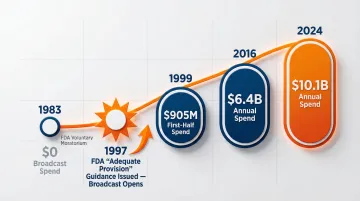
Before the mid-1980s, drug advertising focused almost exclusively on physicians. As patient autonomy movements gained momentum and pharmaceutical companies explored new revenue opportunities, a handful of companies began running consumer-directed print ads. This shift alarmed regulators, prompting the FDA to impose a voluntary moratorium on DTC advertising in 1983 while the agency studied its public health implications.
The moratorium ended without a formal ban. But strict disclosure requirements kept broadcast DTC advertising impractical:
- Television and radio ads had to include the full "brief summary" of risks
- That summary often ran to multiple pages of dense medical text
- A 30- or 60-second spot couldn't accommodate it financially or logistically
The 1997 Guidance That Changed Everything
In August 1997, the FDA issued draft guidance clarifying the "adequate provision" standard for broadcast ads. Instead of reading the entire brief summary on air, companies could:
- State the drug's major risks clearly
- Direct viewers to four alternative sources for complete risk information: a toll-free number, a website, a print advertisement, or a healthcare provider
This regulatory interpretation—intended to balance consumer access to information with practical broadcasting constraints—drove a sharp acceleration in DTC spending. It rose from $905 million in the first half of 1999 to $6.4 billion by 2016 and $10.1 billion in 2024.
That single guidance document effectively opened primetime television to prescription drug promotion—a channel that had belonged almost entirely to physicians for the previous three decades.
How DTC Advertising Is Regulated
The FDA's Office of Prescription Drug Promotion
The FDA's Office of Prescription Drug Promotion (OPDP) oversees DTC advertising for prescription drugs and biologics. OPDP reviews promotional materials to ensure they are truthful, balanced, and accurately communicate both benefits and risks.
Ads may not promote a drug for unapproved (off-label) uses, and companies must provide fair balance — meaning risk information must receive roughly equal emphasis as benefit claims.
The Federal Trade Commission (FTC) retains authority over health product advertisements that do not make specific drug claims, including over-the-counter medications, dietary supplements, and devices. This division of labor sometimes creates jurisdictional ambiguity, especially with help-seeking ads that reference conditions without naming products.
What "Adequate Provision" Requires in Practice
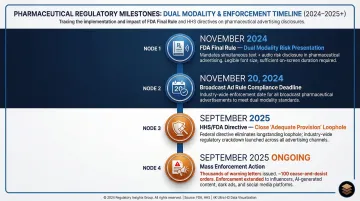
Under the 1997 guidance, broadcast ads must clearly state major risks in both audio and visual formats. The FDA strengthened this in its November 2024 final rule, which mandates dual modality presentation (text and audio simultaneously) with sufficient duration, legible font size, appropriate contrast, and no interfering audio or visual elements.
Print ads must include a more complete risk summary, typically displayed on a separate page. Drugs carrying FDA boxed warnings (the agency's most serious safety alert) must reproduce those warnings prominently in all advertising materials.
The Enforcement Problem
Despite these requirements, FDA enforcement letters dropped dramatically from over 130 per year in the late 1990s to just three in 2023. This happened even as pharmaceutical companies shifted billions in spending to social media platforms, influencer partnerships, and algorithm-driven targeted advertising — channels the FDA's existing oversight framework was never designed to monitor.
The 2025 Regulatory Crackdown
In September 2025, the Trump administration and HHS directed the FDA to close the "adequate provision" loophole and expand enforcement aggressively. The FDA launched a crackdown, sending thousands of warning notices and approximately 100 cease-and-desist letters across the pharmaceutical industry.
The directive explicitly extends FDA oversight to:
- Social media influencer partnerships
- Algorithm-driven targeted advertising
- AI-generated health content
- Dark ads and platform-specific promotional tactics
For brands running DTC campaigns, this means digital channels now carry the same compliance obligations as traditional broadcast and print — with active enforcement to back them up.
Pre-Approval: Not Required, But Common
Given the new enforcement climate, the pre-approval question matters more than ever. Pharmaceutical companies are not required to obtain FDA pre-approval before launching a DTC campaign — they must submit promotional materials (via Form FDA 2253) at the time of initial dissemination, and campaigns can run immediately.
Even so, many companies voluntarily seek early FDA review through the agency's advisory process. With cease-and-desist letters now a real possibility, avoiding costly post-launch corrections is worth the extra step.
The Case For DTC Advertising: Key Benefits
Education and Awareness
Proponents argue that DTC advertising informs consumers about conditions they may not know they have and treatment options their physicians haven't raised. About a third of Americans report talking to a doctor about a specific drug after seeing an ad, and many patients say ads prompted them to seek information about undiagnosed symptoms.
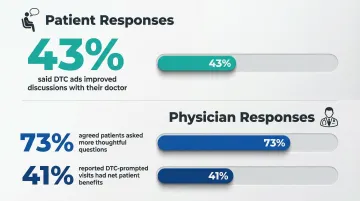
The FDA's own 2004 survey found measurable benefits across both patients and physicians:
- 43% of patients said DTC advertising helped them have better discussions with their doctors
- 73% of physicians agreed that patients asked more thoughtful questions because of DTC exposure
- 41% of physicians reported that DTC-prompted encounters had net benefits for the patient interaction, citing greater awareness and more engaged conversations
Patient Empowerment and Stigma Reduction
DTC advertising can reduce stigma around conditions such as mental illness, sexual dysfunction, or addiction by bringing them into mainstream public conversation. Campaigns that normalize discussions of depression, erectile dysfunction, or opioid dependence may encourage patients to seek help who otherwise would have suffered in silence.
Beyond initial help-seeking, DTC exposure may also improve adherence for patients already on medication — reinforcing the importance of their therapy and sustaining engagement with treatment over time.
Market Competition and Innovation
Some economists argue that DTC advertising enlarges the total market for a therapeutic category, increases competition among manufacturers, and can stimulate research and development investment by signaling commercial viability for new treatments. However, available research does not establish a direct link between DTC advertising and increased pharmaceutical R&D spending — a claim that remains contested.
Broader DTC Principle: Direct Access to Engaged Audiences
In any industry where intermediaries stand between a brand and its end customer, communicating directly with that customer can strengthen brand relationships and increase purchase intent. The same principle applies beyond pharmaceuticals: brands that reach audiences directly — rather than through social algorithms or programmatic ad exchanges — tend to generate stronger engagement and clearer attribution. House of Summary's newsletter network applies this logic directly, placing brand messages in readers' inboxes where there are no ad blockers, no competing content, and no algorithm deciding who sees what. Readers who subscribe have already chosen to engage — making the attention genuinely earned, not borrowed.
The Risks and Criticisms of DTC Advertising
Inappropriate Prescribing Pressure
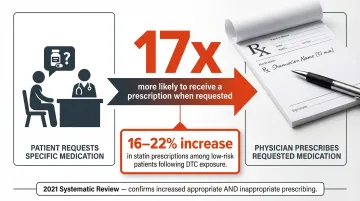
Research consistently shows that physicians are far more likely to prescribe medications specifically requested by patients, even when those prescriptions are not clinically optimal. Patients requesting an advertised drug were nearly 17 times more likely to receive a new prescription, and brief exposure to statin commercials raised the odds of low-risk patients being diagnosed with high cholesterol and starting statins by 16-22%.
A 2021 systematic review in the Journal of General Internal Medicine confirmed that DTC advertising increases prescription requests, increases the likelihood of prescription, and increases both appropriate and inappropriate prescribing. While some patients benefit, others receive medications they don't need or that carry risks disproportionate to potential benefits.
Disease Medicalization and "Disease Mongering"
Critics argue DTC advertising "medicalizes" normal human conditions, turning everyday symptoms into treatable disorders and promoting diagnoses not previously recognized as medical conditions — effectively creating markets for drugs rather than serving genuine health needs. One documented area of concern is ADHD: DTC campaigns have been linked to measurable misdiagnoses and clinically unnecessary use of stimulant medications.
The "disease mongering" critique contends that pharmaceutical companies construct or exaggerate disease categories to expand their addressable markets, blurring the line between genuine pathology and normal variation in human experience.
Drug Safety Risks and Post-Market Surveillance Gaps
DTC campaigns typically begin within a year of a drug's market approval, before post-marketing surveillance can detect rare but serious adverse effects. The Vioxx case is the clearest illustration: Merck spent over $100 million per year advertising Vioxx directly to consumers before withdrawing the drug in 2004 due to an excess risk of myocardial infarctions and strokes.
Millions of patients were exposed to a heavily advertised drug later found to carry significant cardiovascular risks — exposure that accelerated precisely because of DTC spend.
Financial Harm: Driving Demand Toward Expensive Branded Drugs
DTC advertising drives consumer demand toward expensive branded drugs even when cheaper generics or lifestyle interventions may be equally effective. The Congressional Budget Office estimates that a 10% increase in DTC advertising expenditures is associated with a 1.0% to 2.3% increase in prescription drug spending.
The top pharmaceutical companies spend billions annually on advertising:
- Pfizer: $3.7 billion (2023)
- AbbVie: $2.2 billion (2023)
This spending creates financial pressure on patients, insurers, and the healthcare system, often without corresponding improvements in health outcomes.
Information Quality: Emotional Appeals Over Facts
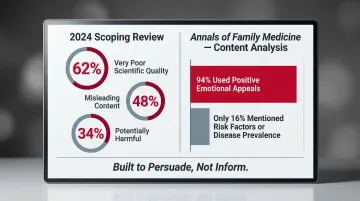
A 2024 scoping review in the Journal of Pharmaceutical Health Services Research found that 62% of DTC video ads were rated "very poor scientific quality," 48% were misleading, and 34% were potentially harmful.
A separate content analysis in the Annals of Family Medicine found that 94% of DTC ads employed positive emotional appeals, while only 16% presented risk factors or disease prevalence. The pattern is consistent: DTC advertising is built to persuade, not inform. When nearly all ads lead with emotion and fewer than one in six mention disease risk, the gap between "consumer education" and marketing is hard to close.
The Evolving Landscape: Digital DTC and What's Changing
The Shift From TV to Digital and Social
Pharmaceutical and other DTC advertisers have migrated billions in spending from traditional television and print to social media platforms, influencer partnerships, and algorithm-driven targeted ads. Healthcare and pharma digital ad spending is forecast to reach $24.77 billion in 2025—a 13.3% year-over-year increase—while linear TV ad spend, though still substantial at $5.15 billion in 2024, is growing more slowly.
Between July and November 2020 alone, the pharmaceutical industry spent $198.3 million on Facebook and $151.5 million on Instagram. The FDA's existing oversight framework, built for broadcast and print, was not designed for these formats, creating enforcement gaps that companies exploited.
The 2024–2025 Regulatory Developments
Those gaps triggered a wave of regulatory action. In September 2025, HHS and FDA announced rulemaking to close the "adequate provision" loophole, requiring full safety disclosures in all broadcast ads rather than directing viewers to external sources. The FDA simultaneously launched an industry-wide crackdown, sending thousands of warning letters and approximately 100 cease-and-desist orders.
Enforcement now explicitly covers:
- Influencer-sponsored health content
- AI-generated medical or drug promotional material
- Dark ads and paid targeting tactics on social platforms
- Platform-specific promotional formats not covered by broadcast rules
The FDA's intent is clear: digital DTC advertising will face the same scrutiny broadcast campaigns have faced for decades.
In November 2024, the FDA issued a final rule requiring clearer, consumer-friendly risk disclosures in broadcast ads. The rule mandates dual modality presentation—text and audio concurrently—with sufficient duration, legible font size, appropriate contrast, and no interfering elements. Compliance became mandatory on November 20, 2024.
Global Contrast: The US vs. The World
While the US is tightening oversight, most of the world—Europe, Canada, the UK, Brazil—has maintained or strengthened bans on prescription DTC advertising. This global divergence reflects persistent international consensus that the public health risks outweigh the benefits.
For multinational pharmaceutical brands, this creates complex regulatory environments: a campaign legal in the US may be prohibited in the EU, requiring separate strategies for each market. The US remains the last major economy to permit prescription DTC advertising, and the 2025 enforcement actions signal a policy trajectory moving toward international standards — a shift with direct implications for how global brands plan their advertising strategy.
Frequently Asked Questions
What is direct-to-consumer advertising in pharma?
Pharmaceutical DTC advertising means drug companies market prescription medications directly to patients through TV, print, online, and social media, rather than directing all promotional efforts at physicians. The goal is to encourage consumers to ask their doctors about specific treatments.
When did direct-to-consumer advertising become legal?
While some print DTC ads appeared as early as the 1980s, the FDA legitimized the practice in the US when it issued new broadcast advertising guidelines in 1997. That guidance — allowing companies to list only major risks and refer viewers to external sources for full safety information — caused DTC spending to surge.
Is direct-to-consumer drug advertising banned?
DTC advertising of prescription drugs is only fully legal in the United States and New Zealand. Virtually every other country, including all European nations, Canada, and the UK, prohibits or heavily restricts direct-to-consumer prescription drug advertising.
Can pharmaceutical companies sell directly to consumers?
No. Advertising directly to consumers is legal in the US, but selling prescription drugs directly to consumers without a physician's prescription is not permitted. DTC advertising encourages patients to ask their doctor for a drug, but actual dispensing still requires a prescription and a licensed pharmacy.
Who regulates direct-to-consumer advertising in the US?
The FDA's Office of Prescription Drug Promotion regulates DTC advertising for prescription drugs and biologics, while the Federal Trade Commission oversees health product ads that do not make specific drug claims. Both agencies share oversight responsibility, with each governing a distinct category of health marketing.