Introduction
In September 2025, the FDA sent approximately 100 cease-and-desist letters to drug advertisers and announced a broader crackdown on deceptive pharmaceutical advertising. The letters cited misleading risk-benefit presentations, undisclosed paid influencer promotions, and creative elements—including song lyrics and visual imagery—that downplayed serious side effects.
Medical device companies watching from the sidelines would be making a costly mistake. FDA's enforcement authority doesn't stop at drugs — it extends directly to device manufacturers through rules on misbranding, intended use, and digital content.
What the September 2025 drug advertising action demonstrates is how aggressively FDA can move when it prioritizes a product category. Device manufacturers have no reason to assume they're next in line — and every reason to act before that assumption is tested.
This article covers how FDA oversees device advertising, what the core compliance rules require, where companies are most exposed, and what to do before enforcement reaches your doorstep.
Key Takeaways
- FDA does not pre-approve most device advertising, but enforces strict rules on truthfulness, on-label claims, and fair risk-benefit presentation.
- "Labeling" under FDA rules covers websites, brochures, apps, social media posts, and any material that accompanies or supplements a device.
- The FDA's 2025 drug advertising crackdown signals tighter enforcement—device companies should treat it as a direct warning.
- Violations can trigger warning letters, criminal misbranding charges, DOJ prosecution, and FTC or state-level enforcement, regardless of intent.
How the FDA Oversees Medical Device Advertising
The Legal Foundation
Device advertising compliance sits on a specific statutory base. Three provisions do most of the work:
- 21 U.S.C. § 331 — Prohibits introducing adulterated or misbranded devices into interstate commerce
- 21 U.S.C. § 352 — Defines misbranding, including false or misleading labeling
- 21 CFR Part 801 — Device labeling rules covering intended use, misleading statements, prominence, and UDI requirements
Unlike prescription drug advertising, FDA generally does not require pre-approval of device promotional materials before publication. There is no submission requirement comparable to OPDP review for most device ads. Instead, FDA enforces reactively — through warning letters, injunctions, and criminal referrals — and the consequences of getting it wrong are serious.
What "Labeling" Actually Means
This is where most companies underestimate their exposure. FDA's definition of "labeling" under the FD&C Act extends well beyond the physical label on a device package. It includes:
- Company websites and product pages
- Promotional brochures and sales aids
- Instructional videos and webinars
- Social media posts
- Mobile applications
- Sales training materials
The 2019 Surgisil warning letter illustrates this directly: FDA cited the company's website, an instructional video, and a surgeon training checklist as evidence of off-label promotion and misbranding. Any material your sales or marketing teams create, distribute, or publish falls within this definition and is subject to enforcement.
Strict Liability Exposure
One detail that surprises many executives: misbranding under the FD&C Act carries strict criminal liability at the misdemeanor level. Under 21 U.S.C. § 333, this exposure has two critical features:
- No intent required — The government does not need to prove a company intended to misbrand a device
- Personal liability applies — Individual executives can face prosecution under the Responsible Corporate Officer doctrine, regardless of direct involvement in creating the offending material
Device Classification and Advertising Implications
How a device is classified determines what claims a manufacturer can legally make—and where the compliance lines are drawn.
| Class | Standard | Key Advertising Implication |
|---|---|---|
| Class I | General controls sufficient | Claims must still be truthful, non-misleading, and within intended use |
| Class II | General + special controls | 510(k) clearance and special-control boundaries define permissible claim scope |
| Class III | Premarket Approval (PMA) required | Claims must stay strictly within PMA-approved labeling and conditions |
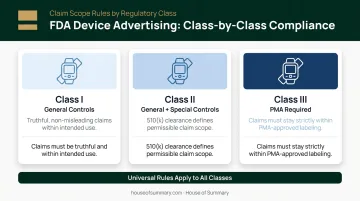
Regardless of class, two rules apply universally:
Cleared ≠ Approved. Under 21 CFR § 807.97, representing a 510(k)-cleared device as "FDA approved" is a misbranding violation. Surgisil was cited for using "FDA approved" language on its website for a cleared device. This is one of the most common—and most preventable—compliance errors in device marketing.
Off-label promotion is prohibited, even when framed as education. While healthcare providers may use devices off-label within their clinical judgment, manufacturers may not promote off-label uses. FDA's January 2025 guidance on Scientifically Valid Information and Unapproved Uses (SIUU) addresses firm-initiated scientific communications about unapproved uses. That guidance sets four strict conditions—such communications must be:
- Truthful and non-misleading
- Kept separate from promotional materials
- Accompanied by clear disclosures that the use is unapproved
- Based on scientifically valid evidence
Core FDA Advertising Compliance Rules
Fair and Balanced Risk-Benefit Presentation
All promotional materials must present both benefits and risks accurately. Risks cannot be minimized through wording, imagery, voiceover tone, or even background music.
FDA's 2025 drug advertising letters went line by line through creative elements — including jingles and visual sequences — to identify misleading impressions. Device companies should apply the same scrutiny to their own materials.
The standard isn't just about the words. Reviewers examine the full impression: if a video shows a patient effortlessly performing activities post-procedure while risks appear in small text for two seconds, that presentation fails regulatory review.
Risk-benefit balance extends directly to the claims being made. Overstating what a device can do is as problematic as downplaying what it risks.
Evidence-Supported Performance Claims
Every efficacy or outcome claim must be backed by valid scientific evidence. Claims that exceed what the device's cleared or approved data supports are violations. Key rules:
- Performance claims must match the evidence in the 510(k) or PMA submission
- Superiority claims over competing devices require head-to-head substantiation
- Labeling a claim "unsubstantiated" is grounds for enforcement action and Lanham Act litigation — not a footnote concern
Required and Prohibited Elements
Must appear in materials:
- Manufacturer's name and place of business
- Device trade or brand name
- Any applicable CE marking or certification numbers (for international markets)
Must never appear:
- "FDA approved" language for 510(k)-cleared devices
- Claims implying a new clinical application beyond the authorized intended use
- Unsubstantiated comparative or superiority claims
Enforcement Risks and How to Avoid Them
The Enforcement Spectrum
FDA has a range of tools available, and they are not always used in escalating order:
- Untitled letters — Informal notice; no public record
- Warning letters — Formal, public, and on the FDA website
- Seizure — Physical removal of products under 21 U.S.C. § 334
- Injunction — Court order to cease operations under 21 U.S.C. § 332
- Criminal prosecution — Corporate and individual liability under 21 U.S.C. § 333
According to King & Spalding's 2025 enforcement review, 32 enforcement letters targeted medical device marketing violations in 2025 alone. Device marketers operating without documented compliance processes are exactly who those letters find.
Multi-Agency Exposure
Those FDA tools don't operate in isolation. A single problematic ad can trigger action from multiple agencies simultaneously — compounding reputational and legal exposure well beyond an FDA letter:
- FTC pursued Willow Curve (light therapy) and Quell (electrical nerve stimulation) for deceptive device advertising in 2020
- NAD (BBB National Programs) challenged unqualified pain relief claims for Dr. Ho's Circulation Promoter
- Lanham Act litigation allows competitor companies to sue for false advertising damages—Masimo Corp. v. True Wearables being a notable example from 2022
Building a Defensible Compliance Process
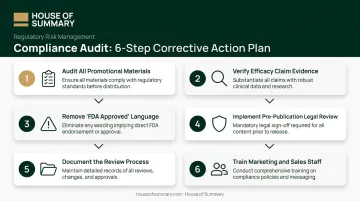
The companies that fare best when enforcement comes typically have documentation showing they took compliance seriously before the problem arose. A practical audit checklist:
- Audit all existing promotional materials — websites, brochures, social media, third-party content, and sales training decks
- Verify every efficacy claim has supporting evidence that matches cleared or approved data
- Remove "FDA approved" language for any 510(k)-cleared device — this is one of the most common and easily avoided violations
- Implement legal and regulatory review before any new materials are published
- Document the review process — this is a meaningful mitigating factor if enforcement proceedings begin
- Train marketing and sales staff specifically on FDA promotion requirements, including what off-label promotion looks like in practice
Digital Advertising and Social Media: The High-Risk Zone
Reposting and the Adoption Problem
FDA's guidance on third-party internet content is clear: a company is responsible for content it owns, controls, creates, influences, adopts, or endorses. When a company executive reposts a customer testimonial, or an official brand account shares a news article making clinical claims, FDA treats that content as if the company authored it.
Third-party authors—customers, journalists, patients—are rarely aware of what a device's clearance actually covers. That ignorance does not transfer to the company once the content is adopted.
Influencer Campaigns
Influencer marketing is not explicitly prohibited, but it carries substantial risk for device companies. Influencers are typically unfamiliar with:
- The specific cleared intended use of the device they are promoting
- FDA's requirements for risk-benefit presentation
- The prohibition on implying off-label applications
When an influencer makes a claim that overstates benefits, omits risks, or implies a use beyond the cleared indication, FDA can attribute that content to the manufacturer. FTC's endorsement disclosure rules add a separate layer of obligation—manufacturers remain accountable even when the influencer, not the brand, published the claim.
Newsletter Advertising: A Controlled Distribution Alternative
For regulated industries, newsletter-based advertising offers a structurally different environment from social media. Platforms like House of Summary, which operates a network of specialized newsletters for executives and decision-makers, distribute content directly to opted-in inboxes rather than through algorithmic feeds.
Newsletter advertising does not involve algorithmic amplification. A compliant, reviewed message reaches its audience exactly as written, with no risk of being reshared, recontextualized, or stripped of regulatory context by third parties.
Placements appear directly in inboxes as part of content subscribers chose to receive. That bypasses ad blockers and the uncontrolled reposts that make social platforms difficult for regulated industries to navigate.
For device marketers whose compliance teams need full message control, the newsletter environment allows reviewed, approved copy to reach a targeted professional audience without the layered risks of platform distribution.
Frequently Asked Questions
What are the FDA regulations for medical device advertising?
FDA regulations require all device promotional materials to be truthful, non-misleading, and consistent with the device's authorized intended use. The governing framework is the FD&C Act and 21 CFR (particularly Parts 801 and 807), with FDA enforcing through warning letters, misbranding charges, and other actions.
How do you promote a medical device compliantly?
Compliant promotion requires discipline at every step:
- Confirm the device is properly classified and cleared or approved
- Keep all claims within the authorized intended use
- Present risks and benefits accurately and in balance
- Route all materials through regulatory and legal review before publication
- Choose channels where you maintain message control throughout distribution
Do medical device ads need FDA pre-approval?
Unlike prescription drug advertising, most device promotional materials do not require pre-approval before publication—except for Class III and restricted devices. Post-market enforcement is active, however, and violations carry serious consequences including criminal liability.
What happens if a medical device company violates FDA advertising rules?
Enforcement options include:
- Untitled letters, formal warning letters, seizure, and injunction
- Criminal misbranding charges and DOJ prosecution
- FTC enforcement actions
- Lanham Act litigation brought by competitors seeking damages
Both companies and individual executives can face personal liability.
Can influencers be used to promote medical devices?
Influencer marketing is not prohibited but carries high regulatory risk. Influencers are typically unfamiliar with FDA requirements and the specific conditions of a device's clearance—and FDA attributes their posts to the company. Any influencer campaign requires thorough vetting and clear, written guidelines before launch.
What is the difference between FDA device labeling and advertising?
FDA defines "labeling" broadly to include any written, printed, or graphic material that accompanies or supplements a device—covering websites, apps, brochures, and videos. The line between labeling and advertising is effectively eliminated under FDA's framework, and the same compliance standards apply to both.