
Introduction
Organic social reach has collapsed. Search costs keep climbing. And third-party platforms control access to your audience through algorithms you can't see or influence. For brands that built their growth on rented channels, the math no longer works.
Direct-to-consumer advertising offers a different path — one where brands own the relationship, control the message, and reach audiences without paying a platform tax every time they want to be seen.
The real business value shows up in measurable outcomes: consumer engagement, conversion rates, and brand trust built over time. This guide breaks down those benefits through outcomes that marketing decision-makers can track and act on.
Key Takeaways
- DTC advertising lets brands communicate directly with consumers, bypassing intermediaries and controlling the full message
- The biggest advantages are audience ownership, measurable response data, and relationships that don't depend on a platform's goodwill
- Newsletter advertising is among the strongest DTC channels: inbox placement bypasses ad blockers and delivers CTRs up to 4x higher than paid search
- Brands ignoring DTC risk over-dependence on third-party platforms, algorithm changes, and losing ownership of audience data
- The brands seeing the strongest returns treat DTC as a long-term system, not a one-off campaign
What Is Direct-to-Consumer (DTC) Advertising?
DTC advertising is when a brand communicates its message directly to the end consumer without relying on a retailer, distributor, or third-party media gatekeeper to carry that message. Unlike traditional advertising that depends on intermediaries—TV networks, retail shelf space, or platform algorithms—DTC puts the brand in direct contact with its audience.
Where DTC advertising applies today:
- Email and newsletter placements
- Brand-owned content and blogs
- Podcasts and audio sponsorships
- Direct mail campaigns
- SMS and mobile messaging
Inbox-based channels have become particularly valuable as social and search algorithms grow less predictable. Platform dependency carries a real cost: organic reach on social media has plummeted as platforms prioritize paid content, while Google Ads CPCs rose 41% year-over-year in Q3 2021 due to intense auction competition.
The core goal of DTC advertising is control over the consumer relationship. Who sees the message, when they see it, and in what context all remain in the brand's hands—not subject to a platform's algorithm update or ad policy shift.
Key Benefits of Direct-to-Consumer Advertising
The advantages below are grounded in what brands actually track: audience quality, engagement rates, conversion, trust, and ROI—not theoretical reach or impression counts.
Benefit 1: Direct Access to High-Intent, Engaged Audiences
DTC advertising places brand messages in front of consumers who have actively opted in or sought out the channel, rather than passively scrolling past ads in a feed they didn't choose. This shifts the advertiser from bidding for passive attention to reaching consumers who chose the channel themselves.
Instead of bidding for attention alongside competitors in an algorithmic auction, the brand message arrives in a context the consumer controls and trusts: their inbox, their newsletter subscription, their podcast queue.
Why this matters:
High-intent audiences convert at measurably higher rates than passive audiences. Email marketing delivers 2.8% conversion rates for B2C and 2.4% for B2B, significantly outperforming display ads at 0.7% and 0.3% respectively.
Click-through rates tell a similar story:
| Channel | Average CTR |
|---|---|
| Owned Email | 2.62% |
| Google Search Ads | 6.11%–6.66% |
| Facebook Newsfeed | 1.11% |
| Programmatic Display | 0.06%–0.46% |
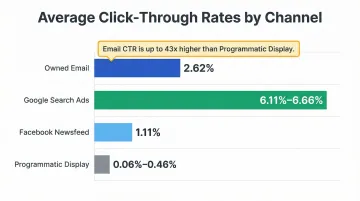
While search ads maintain the highest CTR due to active query intent, email and newsletter advertising drastically outperform passive programmatic display and social media feeds.
Higher conversion rates from a smaller, more qualified audience can outperform broader, cheaper impressions that generate low engagement. This translates to cost efficiency: you're paying for attention that converts, not just impressions that vanish.
KPIs impacted:
- Click-through rate
- Cost per acquisition
- Conversion rate
- Return on ad spend
When this benefit matters most:
Particularly valuable for brands targeting professional or niche audiences (finance, luxury, B2B) where attention is scarce and audience quality matters more than volume. Premium newsletter platforms like House of Summary demonstrate this advantage clearly: ads appear alongside verified, high-quality editorial content read by global executives and business professionals, delivering undivided attention in the inbox without competing with algorithmic feeds or visual clutter.
Benefit 2: Measurable Consumer Response and Behavioral Impact
DTC advertising creates a direct, traceable link between brand message and consumer action. Unlike broad awareness campaigns where attribution remains vague, when a consumer clicks a newsletter ad, requests product information, or makes a purchase, the brand knows exactly which message drove that behavior.
DTC channels generate first-party behavioral data: who clicked, what they engaged with, how they responded. This data doesn't disappear with cookie deprecation or platform policy changes. With 34.9% of US browsers blocking third-party cookies by default, first-party data has become the most resilient identifier for cross-channel targeting and measurement.
Why this matters:
This visibility into consumer behavior allows brands to refine messaging, optimize timing, and identify which audience segments respond most, creating a feedback loop that improves campaign performance over time.
Research on consumer behavior in trusted editorial environments shows that consumers exposed to ads in news contexts are more likely to visit the brand's website, search for more information, and recommend the brand. Interactive ad formats in premium environments deliver approximately 4X higher attention than standard display, leading to a 9% increase in purchase intent.
Marketing teams can justify budget allocation with clear performance metrics rather than estimated reach. AI-driven attribution models reveal that email's direct revenue contribution is often 30-40% higher than traditional last-click models indicate, capturing its assist value in longer customer journeys.
KPIs impacted:
- Response rate
- Attribution accuracy
- Cost per lead
- Audience segmentation quality
- Repeat engagement
When this benefit matters most:
Most impactful when brands need to demonstrate ROI clearly: performance-focused marketing teams, media buyers justifying spend, or campaigns with specific conversion goals.
Benefit 3: Stronger Brand-Consumer Relationships and Trust
DTC advertising builds a different kind of relationship than intermediated advertising, one where the consumer associates the message with a source they chose to engage with, rather than an ad that interrupted them.
Consistent, high-quality DTC messaging in editorial environments like newsletters creates brand familiarity and trust that compounds over time. The effect is strongest when the channel itself carries a credible, established editorial voice.
Why this matters:
Consumers who trust the channel tend to extend that trust to advertised brands. Ads placed in trusted news brands achieve 58% more attentive seconds and a 17% uplift in brand effects compared to low-attention generic display environments.
Contextual relevance amplifies this effect: placing an ad in a relevant editorial context increases attention by 31% and average viewing time by 28%. Trust is 1.5x higher when a brand advertises on a news brand website compared to a non-news site, as the ad inherits the publisher's credibility.
This trust translates directly to long-term brand value. Campaigns using news brands between 2018-2022 saw an 88% uplift in profit growth and increased pricing power, as ads in these environments signal editorial standards that consumers associate with quality. That credibility signal is difficult to replicate through programmatic or social placements at comparable scale.

KPIs impacted:
- Brand recall
- Customer lifetime value
- Net promoter score
- Repeat purchase rate
- Engagement per impression
When this benefit matters most:
Trust and credibility are prerequisites for conversion in luxury, financial services, and B2B categories. Editorial environments that maintain rigorous verification processes, like House of Summary's fact-checked newsletters, create placement opportunities where brand messages appear alongside content readers have already decided to trust.
What Happens When Brands Ignore DTC Advertising
Brands that rely entirely on third-party platforms—social algorithms, search auctions, retail shelf placement—are always one policy change or one algorithm update away from losing their audience.
Apple's App Tracking Transparency (ATT) in 2021 demonstrates this risk vividly. Roughly 80% of users opted out of tracking, severely impacting measurement, optimization, and sales conversions on platforms like Meta. Brands with no direct channel had no way to compensate for this lost visibility.
The Compounding Cost of No Direct Channel
Without owned or DTC-aligned audience touchpoints, brands face a three-way trap:
- No first-party data — audience insights stay locked inside platforms that won't share them
- No re-engagement path — lapsed customers can only be reached by paying again for the same eyeballs
- Rising acquisition costs — Meta CPMs now range from $8–$14, forcing brands to spend continuously just to hold visibility

Owned channels break that cycle. Email, for instance, generates an average ROI of $42 for every dollar spent by tapping into existing audience intent rather than renting attention from a third party.
Risk to Brand Consistency
Financial exposure is only part of the problem. When messaging is filtered through intermediaries, brands also lose control over context, placement quality, and the experience surrounding the ad. A message might appear next to competitor ads, low-quality content, or in environments that quietly undermine brand positioning. DTC advertising ensures the brand controls where and how consumers encounter the message — not the platform.
How to Get the Most from Your DTC Advertising Strategy
DTC advertising delivers its best results when brands choose channels where the audience is actively engaged and where the ad environment is editorially credible—not just channels with the highest raw reach.
Choose Quality Over Volume
- Prioritize channels with high engagement rates, not just subscriber counts
- Look for editorial environments with strong trust signals and verification processes
- Evaluate placement exclusivity—single-sponsor formats or limited ad slots deliver better attention than cluttered feeds
Show Up Consistently
DTC advertising builds trust and recognition over time. Brands that run one-off placements rarely see compounding returns, while those that show up regularly in the same trusted context build durable brand recall.
Seeing an ad once yields 9% spontaneous recall, while five exposures increase it to 56%. That compounding effect is why, for newsletter placements, a cadence of 1–2 sends per week strikes the right balance—enough frequency to reinforce recall without eroding engagement.
Measure What Actually Moves
Set clear KPIs before launching, track behavioral responses (not just impressions), and use the data to refine targeting, timing, and creative across subsequent campaigns.
Reliable KPIs for DTC inbox performance:
- Click-Through Rate (CTR): 2.3%–2.6% benchmark
- Click-to-Open Rate (CTOR): 10%–15%
- Conversion Rate: 0.5%–5%
- Subscriber Lifetime Value: 3:1 LTV-to-CPA ratio
- List Growth Rate: 2.5% net growth monthly
Note that open rate is intentionally absent from that list. Apple's Mail Privacy Protection pre-loads tracking pixels, which artificially inflates open rates and makes them unreliable as a primary signal. Click-through rates and downstream conversions give a far more accurate read on true engagement.
Conclusion
The value of DTC advertising lies in three compounding advantages: direct access to engaged audiences, clear behavioral measurement, and the brand trust that grows when consumers receive consistent messaging in contexts they chose.
DTC advertising should be treated as an ongoing strategy, not a one-time spend. The channels and partners a brand chooses determine whether these advantages are realized or wasted on low-intent audiences.
Newsletter advertising exemplifies this principle. Verified editorial content reaches opted-in audiences who pay attention, click through at rates that outperform passive channels, and build trust with brands that show up consistently.
Brands that ignore DTC advertising risk becoming perpetually dependent on platforms that control audience access, extract rising costs, and offer diminishing visibility. By contrast, those that invest in direct channels build first-party data, own the relationship, and compound their brand value over time.
Frequently Asked Questions
What does direct-to-consumer advertising mean?
DTC advertising is when a brand communicates its message directly to the end consumer without relying on a retailer or third-party media intermediary. Common formats include email, newsletters, podcasts, and owned digital channels where the brand controls the message and audience relationship.
What are the benefits of direct to consumer advertising?
Core benefits include direct access to high-intent audiences, measurable consumer response data, and stronger brand-consumer trust. Newsletter-based DTC placements, for example, consistently deliver click-through rates 4x higher than paid search — a measurable edge that compounds over time.
What are the 4 types of advertising media?
The four traditional categories are print, broadcast, digital/online, and out-of-home. DTC advertising spans multiple media types depending on the channel chosen—email and newsletters fall under digital, while direct mail is print-based, and podcast sponsorships are broadcast.
How is DTC advertising different from traditional advertising?
Traditional advertising routes messages through intermediaries—TV networks, retail distributors, publishers—who control reach and filter what consumers see. DTC advertising removes that layer entirely. The brand owns the channel, sets the message, and builds the audience relationship without a third party in between. The practical result: faster feedback, cleaner data, and no middleman taking a cut of your audience.
What are the main disadvantages of direct-to-consumer advertising?
DTC advertising requires upfront investment in building direct audience relationships, and poor channel selection or weak creative can lead to low engagement. Brands without an established audience also face a slower ramp-up period before campaigns generate meaningful results. Working with established channels that already have engaged subscribers reduces this timeline considerably.