Introduction
Most D2C health-tech brands follow the same playbook: celebrity athletes, performance stats, beads of sweat standing in for exertion. But when Oura Ring's CMO Doug Sweeny joined in late 2022, he made a deliberate pivot. Instead of selling sleep-tracking specs to biohackers, Oura repositioned around a single question: what does it mean to age well?
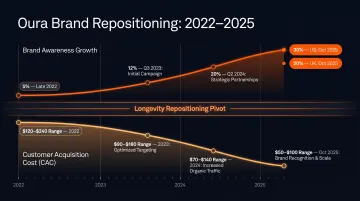
Oura Ring is a premium smart ring (priced at $499 for the latest Ceramic Collection) that tracks sleep, heart rate, and biometrics, paired with a $5.99/month membership. The Finnish company has sold over 5.5 million rings, doubled revenue two consecutive years to exceed $500 million in 2024, and is projected to hit $1 billion in 2025. Brand awareness in the US grew from 5% to over 30% in less than three years.
That growth didn't come from performance marketing alone. Oura's campaigns earned coverage in Ad Age, Marketing Dive, and Marketing Week because they rejected the standard D2C health-tech formula. This post unpacks Oura's core advertising philosophy, its flagship campaigns, where it advertises, and the specific lessons D2C marketers can steal.
TLDR:
- Oura repositioned from sleep tracker to longevity brand — selling an aspiration, not a spec sheet
- The "Give Us the Finger" campaign featured 40- to 70-year-olds living vibrantly, not athletes performing
- Oura invested in linear TV, OOH, and experiential activations — not just digital retargeting
- 50% of Oura customers discover the product through word-of-mouth, creating compounding organic growth
- D2C brands can replicate this by leading with aspiration and placing ads where attention is undivided
Why Oura Ring's Advertising Stands Out in D2C
The standard D2C health-tech playbook is predictable: young athletes mid-workout, celebrity endorsements, feature-first messaging. Oura deliberately rejected this approach.
The Longevity Positioning Shift
When Doug Sweeny joined as CMO in late 2022, Oura had 5% brand awareness in the US and an unclear positioning focused on sleep tracking for niche biohackers. Customer acquisition cost sat between $120-$240 — the company was losing money on every product sold. By October 2025, awareness hit 30% in the US and 20% in the UK, while CAC dropped as brand recognition grew.
Sweeny's positioning anchor: "Longevity is not just about the length of your life, it's about how well you are living your life." That single line shaped creative briefs across every channel. Instead of targeting performance-anxious millennials with heart rate variability stats, Oura sold a mindset: aging is inevitable, and getting older is a gift.
The Independent Agency Advantage
Oura partnered with independent creative shop nice&frank (not a large network agency) to execute this vision. Rob Stone, Creative Director at nice&frank, noted: "A lot of times you don't get really clear briefs, or sometimes the brief wants to try to do too much. Our team worked with them to come with a crystal clear brief that was really unique. The idea of longevity was there from the start."
That brief produced work that cut through the health-tech category. Where large agencies dilute ideas through layers of approval, nice&frank developed 80-100 vignette concepts for the "Give Us the Finger" campaign before narrowing to the strongest nine. The result: campaigns that earned trade press coverage typically reserved for major consumer brands.
The "Give Us the Finger" Campaign Decoded
Concept and Creative Execution
Launched in May 2025, "Give Us the Finger" is a double entendre: a reference to the ring's placement on the index finger and an irreverent provocation challenging fitness clichés. The campaign's tagline — "Live Fast, Die Old" — was conceived by Matt Kipper, Oura's Head of Creative, setting the tone before agency work began.
The 60-second TV spot was directed by Walid Labri of Love Song and shot using a continuous tunnel-like push-in visual style, moving from scene to scene and ending on each subject's finger. This created a hypnotic flow that kept viewers engaged while reinforcing the product's central placement.
nice&frank wrote 80-100 vignette concepts before selecting nine that felt visually interesting without being forced. As nice&frank creative director Stone put it: "Sometimes you're pushing it a little too far and it starts to feel a little too forced. You don't want to show a skateboarding grandma."
Casting Philosophy: Real Lives, Not Models
Oura cast real people in their 40s to late 70s who embodied vibrant aging:
- George Papoutsis: Viral NYC streetball trick shot artist
- Monica Romero and Omar Ocampo: World-renowned Argentine tango dancers who met in Buenos Aires over 40 years ago
- A Leonardo da Vinci painting: The 500-year-old Saint John the Baptist digitally shown wearing an Oura Ring
Settings ranged from gyms and diners to art galleries and bedrooms. Together, the settings and subjects communicated brand values faster than any copy line — real humans living fully, not actors performing youth.

Multi-Channel Amplification
The campaign extended beyond the 60-second spot:
- Linear TV: National airings to establish cultural legitimacy
- Out-of-home: Subway ads and placements in major cities
- Experiential: A New York City activation generating earned media
Rather than betting on a single viral moment, Oura stacked formats deliberately — each channel reinforcing the same message for the same audience. For D2C brands, that consistency across paid, physical, and experiential placements is what converts campaign awareness into brand recognition.
The Ceramic Collection: When Design Becomes the Message
Strategic Repositioning Through Color
In October 2025, Oura launched its Ceramic Collection — four nature-inspired colors (Tide, Petal, Cloud, Midnight) priced at $499. The accompanying "Ring True to You" campaign marked a strategic shift. Sweeny explained: "We've had a strategy of tech that blends in or disappears, and this was very much about tech that stands out."
This repositioned wearable health tech from invisible utility to fashion accessory. For a hardware company competing against Apple Watch and Fitbit, that dual credibility — wellness and fashion simultaneously — is how Oura carves out space neither competitor fully occupies.
Five Lifestyle Vignettes
That repositioning needed creative to back it up. The campaign delivered through five mini-vignettes, each linking a product feature to a specific cultural behavior:
- The Handshake: Two friends with choreographed handshakes wearing matching Tide rings
- The Routine: Focus on nighttime rituals and sleep tracking
- The Change-Up: Switching rings between activities, showing versatility
- The Wash: Self-expression through painting, pottery, and creativity (featuring Petal)
- The Look: Connecting the Midnight ring to ceramic artwork history
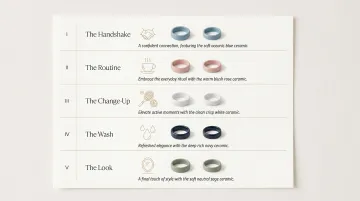
Each vignette embedded the product in real life rather than showcasing it in sterile product demos. This "show don't tell" execution made the ring feel like a natural extension of identity, not a tech gadget.
Campaign Scale and Reach
Sweeny described "Ring True to You" as Oura's "biggest campaign launched to date in scale," spanning:
- Linear TV and connected TV
- Live sports broadcasts
- Out-of-home in five global cities (Los Angeles, New York, London, Berlin, Helsinki)
- TikTok and Snapchat with a first-ever AR try-on lens
The AR try-on lens on Snapchat let users virtually sample ceramic colors before buying — a low-friction touchpoint that drove social sharing while keeping the premium aesthetic intact. What made the scale work wasn't the budget; it was the same creative logic running across every channel, from a Helsinki billboard to a Snapchat filter.
Where Oura Advertises: The Channel Mix
Oura's channel strategy reflects a deliberate bet: premium audiences respond to brand authority signals in premium environments, not cheap CPMs.
Linear TV and Live Sports
Oura runs national TV spots across linear and streaming, including live sports. iSpot.tv tracks 27 Oura creatives with 1,594 national airings. Recent spots include "Mission Impossible: Managing Stress" and holiday-themed ads. Linear TV provides broad reach and cultural legitimacy — signals that matter for a brand selling a $499 subscription product.
Out-of-Home in Wealth-Dense Cities
OOH placements appeared in Los Angeles, New York (including Brooklyn subways), London, Berlin, and Helsinki. These cities represent concentrated pockets of Oura's target demographic: health-conscious professionals in their 30s-60s with disposable income.
Seeing Oura ads in premium urban environments communicates brand legitimacy to audiences who associate physical presence with credibility. For a $499 wearable, that physical context carries real weight.
Experiential Activations
Oura launched a New York City experiential activation alongside its women's health campaign "Give Us the Finger" and opened a concept store in Harrods (London) in October 2025. Experiential marketing generates earned media, creates shareable moments, and builds community among early adopters who become brand advocates.
Social and Influencer Strategy
Oura's social strategy focuses heavily on TikTok and Snapchat, particularly targeting women's health content (cycle tracking, non-hormonal birth control). The AR try-on lens on Snapchat was a first for Oura, allowing users to sample ceramic colors virtually.
Oura creates content that educates and enables self-discovery, positioning the product as a tool for understanding your body rather than optimizing performance.
What D2C Brands Can Take From This
Oura's channel mix points to one consistent principle: reach the right audience with undivided attention rather than chasing scale. That same logic applies to newsletter advertising. Channels like House of Summary — which reaches 500,000+ subscribers, with 254,866 emails opened daily — put brand messages in front of decision-makers and high-income professionals in New York, London, and Dubai, the same cities where Oura runs OOH.

Newsletter placements arrive without ad blockers, algorithmic interference, or competing content. Sponsored content appears inline with editorial, which sidesteps banner blindness and keeps the reading experience intact. For D2C brands targeting professionals with premium products, that combination of focused context and verified audience mirrors exactly the channel logic Oura applies everywhere else.
What D2C Brands Can Learn from Oura's Advertising Playbook
Sell the Aspiration, Not the Feature
Oura barely leads with sleep-tracking specs. Instead, it leads with how you want to feel at 70. The product enables that aspiration rather than standing in for it.
Identify the emotional destination your customer is trying to reach and make that the center of every campaign — not the product attribute that gets them there. For a meal kit brand, the aspiration is feeling competent in the kitchen, not saving time. For a financial app, it's freedom from money anxiety, not a budgeting feature.
Build a Repeatable Brand Identity, Not a One-Off Campaign
Oura's campaigns look different visually but share the same underlying conviction: intentional aging, lived experience, community belonging. "Give Us the Finger" and "Ring True to You" reinforce the same core belief across different product launches.
D2C brands need a core belief that can anchor multiple campaigns across years and channels — not just a seasonal tagline. That belief should be defensible, specific to your category, and built to evolve without losing its center.
Write Briefs That Refuse to Do Too Much
nice&frank's creative director cited Oura's brief as unusually clear — one idea, one direction. Rob Stone: "The idea of longevity was there from the start. The idea that we're selling is you can get old, and Oura can help you get there."
Vague or overloaded briefs produce diluted creative. The best D2C campaigns start with one defensible point of view the entire team can rally around. If your brief needs a paragraph to explain itself, it's a wish list.
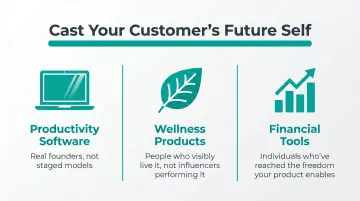
Cast Real People Who Look Like Your Best Customer's Future Self
Oura cast 40- to 70-year-olds who were living vibrantly — not celebrities doing product placement. Who you put on screen signals what kind of life your brand actually believes in.
Find people who already embody the life your product promises:
- Productivity software: founders who've built real companies, not models at staged desks
- Wellness products: people who visibly live it, not influencers performing it
- Financial tools: individuals who've reached the freedom your product enables
Go Where Your Audience Is Paying Attention
Oura chose TV and OOH over pure digital performance ads because its audience — high-intent, premium-minded adults — responds to brand authority signals in the right context.
Audit where your best customers are genuinely paying attention, not just where CPMs are cheapest. Premium newsletter placements, podcasts with loyal audiences, and brand-safe OOH environments often deliver stronger returns than retargeting ads competing for distracted clicks.
Frequently Asked Questions
Why is everyone getting an Oura Ring?
Oura's popularity stems from celebrity sightings (Prince Harry, Kim Kardashian, Jennifer Aniston), strong word-of-mouth within health and longevity communities, and viral social coverage. The ring form factor differentiates it from wrist-based wearables, appealing to people who want health tracking without wearing a smartwatch.
Does Jennifer Aniston use Oura Ring?
Jennifer Aniston is a documented celebrity user of Oura Ring. Reports indicate Jimmy Kimmel introduced her to the device and she became "obsessed" with it. There's no verified brand ambassador or paid relationship — she's a high-profile organic adopter.
Who sings on the Oura Ring commercial?
The "Give Us the Finger" TV spot features a track titled "Eros" by KO Music, according to available production credits. The Oura 4 commercial uses "Your Love" by Glass Animals, per available production credits.
What is the tagline of the Oura Ring?
Oura's campaign taglines include "Give Us the Finger" (the provocative double-entendre from the May 2025 campaign) and "Live Fast, Die Old" (conceived internally by Matt Kipper, Head of Creative). These lines reflect Oura's brand positioning around intentional aging and longevity rather than peak performance or fitness optimization.
How does Oura advertise to such a wide range of people?
Oura runs a multi-format strategy (TV, OOH, experiential, social) built around a single universal message — aging well — with casting and visual storytelling that makes different demographics feel represented. The Ceramic Collection targets younger audiences through TikTok and Snapchat, while TV and OOH reach established professionals.