Introduction
The paid acquisition playbook that built D2C brands in the 2010s is cracking under pressure. Social media CPMs rose 22% and search CPCs climbed 23% year-over-year by Q4 2021. Facebook CPMs surged another 37% in Q1 2022.
For brands operating on thin margins, rising costs are only half the problem. Apple's ATT privacy changes cost Meta roughly $10 billion in 2022 revenue, with 75–85% of users opting out of tracking — gutting the targeting precision D2C growth models were built on.
Programmatic native advertising isn't a new channel, but it's becoming an essential response to this pressure. It combines the automation and precision of programmatic buying with the engagement advantages of native formats — reaching audiences in context, without the disruptive placements users ignore or block. For D2C brands, that means lower effective CPMs, better engagement rates, and ad spend that isn't hostage to a single platform's auction dynamics.
This guide covers how programmatic native works, why it suits the D2C model, and how to evaluate whether it belongs in your media mix.
Key Takeaways
- Programmatic native advertising automates ad buying for placements that match the look and feel of surrounding content
- D2C brands gain ad-blocker resistance, stronger engagement than display, and a natural fit with first-party data strategies
- Common placements include in-feed units, newsletters, promoted listings, and recommendation widgets
- Getting started requires clear goals, strong creative, and continuous testing—not a massive team or budget
What Is Programmatic Native Advertising?
Native advertising refers to ads designed to match the look and feel of the platform or content they appear alongside—not disruptive banner-style units, but integrated placements that fit naturally into the user experience.
The format works because it aligns with user behavior: consumers view native ads 53% more frequently than display ads, with 18% higher purchase intent lift, according to a Sharethrough/IPG Media Lab eye-tracking study of 4,770 consumers.
Programmatic advertising is the automated, real-time buying and selling of ad inventory through technology platforms—demand-side platforms (DSPs) and supply-side platforms (SSPs)—rather than manual negotiations between buyers and sellers. Advertisers bid on individual impressions in milliseconds, using data to target specific audiences across thousands of sites simultaneously.
Programmatic native advertising combines both approaches: automated bidding technology buying and placing native-format ads at scale across diverse publisher environments. This isn't about tricking users—all native ads are clearly labeled as sponsored or promoted content. The real value is relevance, delivering brand messages within editorial contexts where users are already engaged and receptive.
Why D2C Brands Need to Rethink Their Digital Ad Strategy
D2C brands built their growth on Facebook and Instagram ads in the mid-2010s, but that playbook is under pressure. Rising CPMs, iOS privacy changes that reduced targeting precision, and increasing competition for the same audiences have eroded margins across the board. Meta's CFO confirmed that Apple's ATT changes would cost the company $10 billion in 2022 revenue. That loss translated directly into higher acquisition costs for advertisers as targeting accuracy declined and attribution windows shrank from 28-day click to 7-day click.
Banner blindness and ad fatigue present structural problems with traditional display advertising. Users have trained themselves to ignore ads that look like ads, meaning a growing share of ad spend generates zero attention. Standard display ad CTR ranges from 0.05% to 0.1% globally—meaning 99.9% of impressions produce no click, let alone a conversion.
D2C brands are particularly exposed to ad-blocker risk. Their customers tend to be digitally native, informed consumers more likely to run blocking software—32.8% of global internet users employ ad blockers, with the highest adoption among 25-34 year olds.
Native ads largely bypass this problem because they live within content rather than beside it, making them immune to most ad-blocking software. That structural advantage is one reason programmatic native aligns well with how D2C brands already operate.
Programmatic native fits naturally with how D2C brands already operate:
- Performance-driven campaigns with clear ROI targets
- Data-informed optimization at the impression level
- Continuous testing and iteration
- First-party data activation through customer lists and purchase histories
D2C brands own extensive first-party data—customer emails, purchase histories, browsing behavior on owned properties—which works effectively with programmatic native platforms that allow custom audience targeting and lookalike modeling without relying on cross-site tracking.
How Programmatic Native Advertising Works
The technical flow happens fast — and mostly out of sight:
- User visits a webpage → the publisher's SSP sends an ad request to an exchange
- Real-time auction begins → DSPs running on behalf of advertisers receive the request and analyze available data (user behavior, demographics, browsing context, device type)
- Bids are submitted → each DSP decides how much to bid based on how valuable that impression is to their advertiser
- Winner is selected → the highest bid wins, and the ad is assembled in the publisher's native template
- Ad displays → the user sees a seamlessly integrated native ad that matches the surrounding content
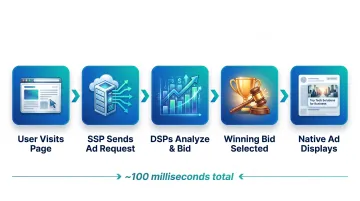
The entire process completes in approximately 100 milliseconds — faster than a page fully loads. That speed and automation is what makes programmatic buying viable at scale.
Targeting Logic and Buying Models
DSPs analyze user data to calculate bid amounts in real time. This means D2C brands pay to reach people already likely to be in-market — not broad audiences with no purchase intent. Programmatic buying operates through four main models:
- Open auction (RTB): Real-time bidding in open exchanges; cost-efficient but less control over placement quality
- Private marketplace (PMP): Invitation-only auctions with vetted publishers; better inventory quality with competitive pricing
- Preferred deals: Fixed-price, priority access to inventory before it goes to open auction
- Programmatic direct: Guaranteed impressions at a fixed price, closest to traditional direct buys
For D2C brands with limited budgets, open RTB keeps entry costs low. Once you've identified which audience segments convert, shifting toward PMP deals gives you higher-quality placements without giving up programmatic targeting.
The Native Ad Formats D2C Brands Should Know
In-Feed Native Ads
The most common format, appearing within content feeds on news sites, social platforms, and apps matching surrounding posts. For D2C brands, this format is high-value because it reaches users in a discovery mindset rather than a search mindset—better for building desire for new or unfamiliar products. Users scroll through content they've chosen to engage with, and native ads fit naturally into that flow.
Promoted Listings
Native ads embedded in e-commerce and marketplace search results, such as Amazon Sponsored Products. These target buyers at the moment of commercial intent . Amazon Sponsored Products achieve conversion rates of 10–15% with ROAS of 2.5x–5.0x. For D2C brands selling through any third-party platform or using comparison shopping environments, promoted listings deliver immediate purchase-intent traffic.
Content Recommendation Widgets
Sponsored content blocks that appear at the bottom of articles, labeled as "you might also like" or "recommended content." These placements work well for retargeting—reaching users who have already shown interest in relevant topics—and are cost-effective for driving traffic to D2C brand editorial content or landing pages. Think of them as a second chance to capture attention after the primary article has done its job.
Newsletter Native Advertising
Ads placed within editorial newsletters that mirror the newsletter's format and voice, reaching subscribers who have actively opted in to receive curated content. Newsletter audiences are among the most engaged in digital media, with no algorithmic filter between the ad and the reader.
For D2C brands targeting business professionals or informed consumers, this channel offers undivided attention that open-web placements rarely achieve. Key structural advantages set newsletter ads apart from standard digital formats:
- No ad blockers — ads are embedded in email content, not served via scripts
- No banner blindness — placements appear inline with editorial content subscribers chose to receive
- No algorithmic filters — messages reach the inbox directly, without platform intermediaries
Newsletter networks like House of Summary deliver CTRs significantly higher than standard digital ad benchmarks—up to 4x higher than Google AdWords—by matching advertiser messages with affluent, decision-making audiences in a brand-safe, high-attention inbox where readers are already primed to engage.
Why Programmatic Native Advertising Works for D2C Brands
Higher Engagement and CTR
Native ads generate dramatically more engagement than standard banners—consumers look at native ads 53% more frequently, and native ads drive 18% higher purchase intent lift. Users engage because the ad fits the context rather than interrupting it.
Native ad CTRs range from 0.08%–0.15%, compared to standard banner CTRs of 0.05%–0.08%—representing 60–188% higher performance depending on placement and vertical. The engagement advantage is even more pronounced in premium environments like newsletters, where readers have opted in and are already focused.
Ad-Blocker Resistance
Because native ads are embedded in content rather than served in separate containers, most ad blockers skip right past them. For D2C brands, this means a larger share of paid impressions actually reach the intended audience rather than being filtered before the page loads. With 32.8% of internet users running ad blockers, this immunity is significant.
Cost Efficiency and Real-Time Optimization
Programmatic buying allows D2C brands to set bid caps, adjust targeting in real time, and reallocate budget to top-performing placements automatically. This mirrors how D2C brands already manage performance campaigns and reduces the manual overhead of traditional media buying. When a placement underperforms, the system adapts without requiring human intervention at every step.
Privacy-Aligned Targeting Through Context
For budget-conscious D2C teams, that means broad distribution without custom negotiation overhead at every placement.
Best Practices for D2C Brands Running Programmatic Native Campaigns
Lead with Creative Quality
Programmatic can optimize placement, but the ad itself must earn attention. Write headlines and descriptions that sound like editorial content, not ad copy:
- Avoid promotional language; focus on value or story
- Use imagery that fits the visual style of target placements
- Don't repurpose social ad creatives directly—native formats require different visual and tonal approaches
- Test emotional telegraphing: choose images showing human emotion that match the headline's tone
Match Format to Funnel Stage
- In-feed native works well for upper-funnel awareness and discovery
- Promoted listings work for lower-funnel purchase intent
- Content recommendation widgets work well for retargeting audiences already familiar with the brand
- Newsletter placements work across the funnel but are particularly effective for consideration-stage audiences
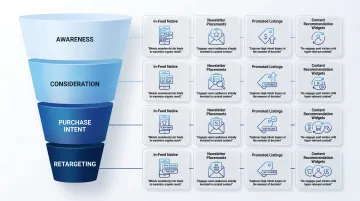
Each format targets a different moment in the buyer journey. Choosing the wrong one drains budget on impressions that never convert.
Test and Optimize Continuously
Programmatic native campaigns require active management:
- Set clear baseline KPIs before launch (CTR, cost per click, cost per acquisition)
- Run A/B tests on headlines and images
- Monitor which placements perform and exclude poor-performing sites or inventory sources
- Adjust bid strategies based on time-of-day and audience segment performance
Programmatic handles the distribution — but sharper creative, tighter targeting, and consistent iteration are what separate campaigns that scale from ones that stall.
Frequently Asked Questions
What are programmatic native ads?
Programmatic native ads combine automated, real-time bidding with ad formats designed to blend into surrounding content. The result is algorithmic buying efficiency paired with the user-friendly format of native advertising — reaching audiences at scale while matching the look and feel of each placement.
What are examples of programmatic ads?
Common examples include in-feed sponsored articles on news sites, promoted product listings on e-commerce platforms, sponsored content in newsletters, and recommendation widgets at the end of blog posts.
What are the 4 types of programmatic advertising?
The four main buying models are:
- Open auction (RTB): Advertisers compete in real-time across open exchanges
- Private marketplace (PMP): Invitation-only access to premium inventory
- Preferred deals: Fixed-price priority access before open auctions go live
- Programmatic direct: Guaranteed impressions at a fixed price, negotiated in advance
What is the difference between programmatic and native advertising?
Native advertising describes the ad format—ads that match surrounding content in look, feel, and tone. Programmatic advertising describes the buying method—automated, real-time bidding through technology platforms. Programmatic native advertising combines both, using automation to buy and place native-format ads at scale.
What is the difference between programmatic and endemic advertising?
Endemic advertising places ads in environments directly relevant to the product category — running shoe ads on a running magazine, for example. Programmatic advertising uses audience data to reach relevant users across many sites, regardless of content category.
What is the difference between programmatic and traditional advertising?
Traditional advertising relies on manual negotiations between buyers and sellers, with fixed rates and placements agreed in advance. Programmatic advertising automates this process through real-time bidding, enabling greater efficiency, precision targeting, and continuous optimization without human negotiation at each step.