Introduction
In digital advertising, every dollar can either be deployed by an algorithm in milliseconds or negotiated by a human over days — and both paths can win or waste budget depending on how they're used. Programmatic platforms promise scale and precision. Direct deals offer guaranteed placement and brand safety.
The stakes are real: programmatic digital display ad spending is projected to exceed $180 billion in the US by 2025, representing 92% of total digital display spending. Yet non-programmatic deals still command roughly 8% of the market, proving that direct buying retains strategic value for specific campaign goals.
The choice between automated and direct buying has real consequences: it shapes how precisely you reach your audience, how much control you keep over brand safety, and how quickly you can adjust when a campaign isn't working. This guide breaks down how each approach works, where each one wins, and how to decide which belongs in your media plan.
Key Takeaways
- Programmatic buys impressions automatically via real-time auctions; non-programmatic uses manual deals with fixed rates
- Programmatic delivers precision targeting, real-time optimization, and scale; non-programmatic offers placement control and brand safety
- CPMs are dynamic in programmatic; non-programmatic locks rates upfront through insertion orders
- Neither is universally superior — the right choice depends on goals, budget, audience, and control requirements
- Sophisticated marketers combine both: direct deals for premium placements, programmatic for reach and scale
Programmatic vs. Non-Programmatic Advertising: Quick Comparison
| Factor | Programmatic | Non-Programmatic |
|---|---|---|
| Buying Process | Automated real-time auction in ~120-400ms | Manual negotiation, insertion order, days to weeks |
| Targeting Capability | User-level targeting with behavioral, demographic, contextual signals | Context-level targeting by publication, section, or audience category |
| Pricing Model | Dynamic CPMs fluctuate with market demand | Fixed rates negotiated upfront |
| Optimization Speed | Real-time adjustments in minutes based on performance data | Manual adjustments require days or longer |
| Brand Safety Controls | AI filters and blocklists; fraud rates reached 10.9% in non-optimized campaigns (IAS Media Quality Report) | Explicit control over placement environment; verified publisher relationships |
| Reporting Depth | Log-level data, bid-stream transparency, impression-level tracking | Post-campaign reports; open rates, click-through rates, audience demographics |
| Scalability | Access to 600 billion+ bid requests daily across display, video, CTV, mobile | Limited to negotiated inventory; premium placements often exclusive |
Key takeaway: The right channel depends on what you're actually trying to control. Programmatic wins on scale, speed, and audience precision — but non-programmatic gives you something algorithms can't guarantee: a known environment, a verified audience, and placement that won't end up next to content you'd rather avoid.
What is Programmatic Advertising?
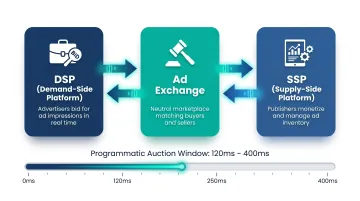
Programmatic advertising is the automated buying and selling of digital ad impressions through real-time auctions powered by algorithms. Each time a web page loads, a bid request is sent to an ad exchange where demand-side platforms (DSPs) compete in milliseconds — typically within 120 to 400 milliseconds — with the highest bid winning the right to show an ad to that specific user at that moment.
The ecosystem connects three core components:
- Demand-side platforms (DSPs): Tools advertisers use to bid on ad inventory across multiple exchanges
- Supply-side platforms (SSPs): Platforms publishers use to offer their inventory to buyers
- Ad exchanges: Digital marketplaces where DSPs and SSPs meet to conduct real-time auctions
This infrastructure enables advertisers to target individual users using behavioral, demographic, and contextual signals — rather than buying placement on a specific site. Programmatic buyers bid based on browsing history, device type, location, and purchase intent.
Real-time budget optimization shifts spend toward what's performing, and campaigns can access inventory across display, video, connected TV (CTV), and mobile from a single platform.
Primary benefits:
- Precise audience-level targeting using layered data signals
- Real-time optimization that reallocates budget to top-performing formats or segments
- Massive scale: SSPs process over 60 million bid requests per second during peak traffic
Key risks and limitations:
- Ad fraud exposure: Bot fraud increased 101% year-over-year in North America, with non-optimized campaigns reaching fraud rates of 10.9%
- Brand safety concerns: Ads can appear near low-quality content in open auction environments; global ad fraud losses are projected to reach $41.4 billion in 2025
- Ad blocker prevalence: 52% of consumers globally have installed or used an ad blocker, eroding actual reach on web and social channels
Use Cases of Programmatic Advertising
Programmatic fits best in performance-driven campaigns requiring retargeting, look-alike audience expansion, or large-scale multi-channel reach — particularly when speed of launch and real-time adjustments matter.
Ideal scenarios include:
- E-commerce retargeting campaigns that follow users across the web
- Multi-format campaigns spanning display, video, and CTV
- Performance campaigns optimizing toward specific conversion actions
- Audience discovery using look-alike modeling
These use cases play out at scale in practice. IKEA Canada partnered with The Trade Desk's Kokai platform to unify display, online video, and CTV into a single AI-optimized omnichannel strategy. The platform's AI steered impressions toward top-performing channel combinations mid-flight rather than maintaining fixed per-channel budgets. The outcome: a 17% reduction in cost per acquisition and a 37% increase in media channel overlap.
What is Non-Programmatic Advertising?
Non-programmatic advertising is the traditional, human-led method of buying ad placements through direct negotiation between advertiser and publisher. Deals are formalized through insertion orders (IOs) with fixed rates, guaranteed impressions, and predetermined placement details — with no auction or algorithm involved.
This approach gives advertisers full control over placement context, stronger brand safety guarantees, and direct publisher relationships that can unlock custom integrations. Non-programmatic buyers access premium inventory not available in open exchanges, such as homepage takeovers, sponsorships, and editorial integrations.
Primary benefits:
- Full control over placement environment and context
- Direct publisher relationships enabling custom content integrations
- Access to exclusive premium inventory unavailable in programmatic marketplaces
- Resilience to ad blockers: ads placed directly within editorial content, newsletters, or sponsored formats bypass the blocking technology that affects display and banner ads
Practical advantage for brand safety: Non-programmatic placements are verified upfront, eliminating the risk of ads appearing next to harmful content. In 2017, major brands including AT&T, Verizon, and Walmart pulled millions in advertising from YouTube after ads appeared next to extremist content — a brand safety crisis that direct placements inherently avoid.
Use Cases of Non-Programmatic Advertising
Non-programmatic works best when placement context matters as much as reach — when the wrong environment can damage the brand or the wrong timing can waste the budget.
Ideal scenarios include:
- Luxury brand campaigns requiring editorial alignment and premium context
- Financial services and pharmaceutical campaigns subject to compliance and placement restrictions
- Product launches needing guaranteed visibility on a specific date
- Niche B2B campaigns targeting decision-makers in specialized publications
Newsletter advertising as a concrete non-programmatic example:
Publishers like House of Summary deliver ads directly to engaged, opted-in readers in the inbox — no algorithms controlling distribution, no visual clutter competing for attention. Unlike web display ads, newsletter ads are embedded within editorial content rendered by email clients, making them unaffected by browser-based ad blockers.
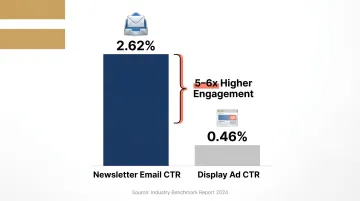
Engagement rates reflect this advantage: email click rates average 2.62% across industries, 5-6x higher than display ad CTRs, which average around 0.46%. For advertisers targeting high-income professionals and decision-makers, newsletter placements combine contextual precision with the focused attention readers bring to their inbox.
Key Differences: Programmatic vs. Non-Programmatic Advertising
Automation and Speed
Programmatic removes human bottlenecks entirely. Campaigns can launch in hours and adjust in minutes based on live performance data. Algorithms respond to conversion signals instantly, reallocating budget toward high-performing audiences or creative variants without manual intervention.
Non-programmatic requires planning calls, contract reviews, and trafficking steps that can stretch timelines by days or weeks. While this slower pace suits campaigns planned months in advance, it becomes a liability when campaign windows are tight or market conditions shift rapidly.
When speed matters: Product launches tied to specific dates, time-sensitive promotions, or rapid response to competitor moves favor programmatic's agility. Brand campaigns with long lead times and guaranteed placement needs favor non-programmatic's certainty.
Data and Targeting
Programmatic targets at the user level using layered data signals: browsing history, device type, location, and intent. This enables precise audience segmentation — for example, targeting users who visited a product page but didn't convert, or building look-alike audiences based on existing customers.
Non-programmatic targets at the context level — choosing a publication, section, or audience category. Instead of following individual users across the web, advertisers select environments where their ideal customers gather.
A luxury watch brand might sponsor the business section of a premium publication, confident that readers fit their demographic profile — no user-level tracking required.
Programmatic excels when audience data is rich and performance optimization drives decisions. Non-programmatic wins when contextual alignment and editorial credibility matter more than granular targeting.
Cost and Pricing Structure
Programmatic CPMs fluctuate with market demand. Advertisers bid in real time, meaning costs can drop during low-demand periods but spike when competition intensifies. This variability can deliver cost efficiencies at scale but makes budgeting unpredictable.
Non-programmatic locks in rates upfront through insertion orders. Advertisers pay a fixed CPM or flat sponsorship fee regardless of market fluctuations. This simplifies budgeting and eliminates auction competition — though fixed rates sometimes mean paying above-market prices for guaranteed access.
Only 43.9% of programmatic ad spend actually reaches consumers — the remaining 56.1% is consumed by intermediary fees. Platform take rates illustrate the range:
- Amazon DSP: 0% on programmatic guaranteed (owned media), 1% on open-web buys
- The Trade Desk: estimated take rate of approximately 20%
Meanwhile, The Trade Desk found direct buys were 50x more expensive on a CPM basis than programmatic buys in one APAC campaign study, though programmatic delivered 2x higher CTR. Direct deals command premium prices for guaranteed placement and brand safety, while programmatic offers scale at lower per-impression costs.
Scale doesn't guarantee quality. Programmatic accounts for 92% of US digital display spending, yet approximately $770 million went to made-for-advertising (MFA) publishers in Q2 2025 alone — waste hiding inside the dominant model.
Control, Brand Safety, and Transparency
Non-programmatic gives advertisers explicit control over placement environment, making it the preferred choice for brands with strict brand safety requirements or compliance obligations. Advertisers know exactly where their ads will appear before the campaign runs.
Programmatic offers post-campaign log-level reporting and bid-stream data, but real-time brand safety relies on AI filters and blocklists that aren't foolproof. Despite improvements — global brand suitability violation rates decreased 17% year-over-year to 5.8% — unprotected campaigns still had violation rates 150% higher than protected campaigns.

Notable brand safety failure: In 2017, Procter & Gamble cut $200 million in digital ad spending due to bot fraud and brand safety concerns. Despite the cuts, P&G increased its reach by 10%, demonstrating that a significant share of programmatic spend was wasteful.
Viewability rates offer another transparency metric: Global display viewable rates reached 71% in 2024, meaning nearly 30% of impressions weren't actually seen. Non-programmatic placements in email newsletters or sponsored content guarantee visibility within the editorial flow, eliminating viewability concerns entirely.
Conclusion
Programmatic is the stronger default for scale, performance campaigns, and real-time optimization. Its automation, data depth, and ability to reach audiences across channels make it indispensable for e-commerce, retargeting, and multi-format campaigns that optimize toward specific actions. That scale comes with real costs, though — fraud risks, brand safety concerns, and supply chain inefficiencies all require active management and verification tools.
Non-programmatic earns its place for guaranteed premium placements, brand-safe environments, and audiences too valuable or too niche for open auction. Luxury brands, regulated industries, and advertisers prioritizing context over scale benefit most from direct deals. Fixed pricing and manual timelines trade flexibility for certainty and control.
The best media plans often use both: locking premium placements directly while scaling reach programmatically. For brands targeting high-intent professional readers — without algorithmic uncertainty or ad blockers — direct newsletter advertising offers a reliable alternative. House of Summary's placements, for example, reach curated executive audiences in the inbox, where click-through rates run 4x higher than Google AdWords. Match your channel mix to your goals: use programmatic for reach and efficiency, and direct buying where context and audience quality matter most.
Frequently Asked Questions
What is the difference between programmatic and non-programmatic advertising?
Programmatic automates ad buying through real-time auctions and algorithms, while non-programmatic relies on manual deals between advertisers and publishers with fixed rates and guaranteed placements. The core difference is automation versus human negotiation.
What is non-programmatic advertising?
Non-programmatic advertising covers all ad buying done through direct, human-negotiated arrangements — including insertion orders with publishers, sponsorships, and premium placements — without software-driven auctions or automated bidding.
What is the difference between programmatic and RTB?
RTB (real-time bidding) is one specific mechanism within programmatic advertising — an open auction where impressions are sold to the highest bidder in milliseconds. Programmatic also includes private marketplace deals and programmatic direct, which bypass open auctions but still use automated technology.
Is Google Ads considered programmatic?
Google Ads uses automated bidding and algorithm-driven delivery, but operates within Google's own closed ecosystem — Search, Display Network, and YouTube — rather than through an open ad exchange. It shares programmatic characteristics but functions as a self-serve platform, not a traditional DSP.
Is Google Ads considered a DSP?
Google Ads is not a traditional DSP — it serves ads within Google's own properties rather than connecting to multiple external ad exchanges. For true programmatic buying across third-party inventory, Google offers Display & Video 360 (DV360), its dedicated DSP product.