Introduction
Social media might feel like the obvious choice for marketing, but your reach there depends entirely on algorithms you can't control. Email is different. It lands directly in someone's inbox — no gatekeeping, no feed competition.
The numbers back this up. According to Litmus, 35% of marketing leaders report earning $10–$36 for every $1 spent on email, and another 30% see $36–$50 in return. Few marketing channels come close.
This guide covers everything a beginner needs to get started:
- What email marketing actually is
- How to build a list the right way
- How to write emails people open
- Which metrics matter
- What compliance rules you can't ignore
Key Takeaways
- Email delivers some of the highest ROI in digital marketing — often $10–$50 per $1 spent
- An owned list beats social reach — no algorithm decides who sees your messages
- Never buy a list — build it organically with lead magnets and opt-in forms
- Subject lines and mobile optimization determine whether your email gets opened
- Track open rate, click-through rate, bounce rate, and unsubscribes from day one
What Is Email Marketing and Why Does It Still Work?
Email marketing is the practice of sending messages directly to people who have opted in to hear from you. No platform algorithm decides who sees it, and no ad blocker strips it out. That direct path to the inbox is what makes it different from every other digital channel.
This is also what distinguishes it from spam. Spam arrives uninvited. Email marketing works because the subscriber chose to be there.
The Owned Audience Advantage
Social platforms can change their algorithms overnight and cut your organic reach in half. An email list doesn't work that way. You own it. That list of subscribers is a business asset you control regardless of what any platform decides to do next.
That ownership is why email consistently ranks as a top-performing channel. HubSpot's marketing data shows email was the number one ROI channel for B2C brands, with 22% of marketers naming it their top revenue driver.
The audience size explains why that ROI holds up. According to the Radicati Group, global email users exceeded 4.4 billion in 2024 and are projected to surpass 4.9 billion by 2028 — a larger addressable audience than any single social platform.
How Inbox Advertising Differs From Display
The inbox advantage extends to advertising too. Publishers like House of Summary — which operates a network of specialized newsletters including Presidential Summary, Geopolitical Summary, Dubai Summary, and London Summary — reach over 500,000 subscribers whose attention is already focused. Newsletter ads appear inside the reading flow rather than competing with a cluttered social feed. Ad blockers don't apply to email, and banner blindness doesn't either.
One advertiser working with Dubai Summary reported click-through rates 4x higher than Google AdWords — a result of the audience being engaged, opted-in, and actively reading rather than passively scrolling.
Types of Email Marketing Campaigns
Five campaign types cover most of what beginners need to know:
| Campaign Type | Purpose |
|---|---|
| Welcome emails | Greet new subscribers and set expectations |
| Newsletters | Build relationships with regular, valuable content |
| Promotional emails | Drive sales, sign-ups, or specific actions |
| Re-engagement emails | Win back subscribers who have gone quiet |
| Transactional emails | Confirm orders, receipts, or account changes |
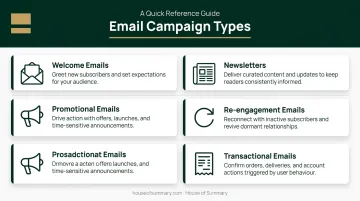
Each serves a different role in the subscriber relationship. Welcome emails, for instance, see open rates as high as 91% according to Campaign Monitor — because the subscriber just signed up and interest is at its peak.
That initial spike doesn't last, though. Newsletters work on a different dynamic: consistent, high-quality editorial content builds loyal readership that compounds over time. House of Summary has grown this way — starting with a single newsletter and expanding to four specialized publications as readers kept coming back for more.
For beginners, pick one campaign type that matches your immediate goal:
- Starting with a new product? Launch a short promotional sequence.
- Building an audience over time? Commit to a consistent newsletter.
- Onboarding new sign-ups? A welcome email series is your highest-ROI starting point.
Running all five types before you have systems in place dilutes your focus and your results.
How to Build and Grow Your Email List
Never Buy a List
This is non-negotiable. Purchased lists violate Mailchimp's Terms of Use, generate high bounce and abuse rates, and often contain spam traps that damage your sender reputation permanently. Beyond the platform penalties, purchased contacts didn't ask to hear from you — so they don't open, don't click, and frequently report you as spam.
Organic list building takes longer, but every subscriber on it chose to be there — and that changes everything about how they engage.
The List-Building Formula
Two components work together:
- A compelling incentive — a lead magnet, discount, exclusive content, or early access that gives someone a clear reason to subscribe
- Prominent opt-in placement — making it easy to subscribe wherever your audience already is
Practical placements to implement immediately:
- A header bar or sticky banner on your website
- A timed pop-up or exit-intent lightbox
- An end-of-content sign-up prompt after blog posts or articles
- A dedicated landing page built specifically for the newsletter or offer
Segment As You Grow
Building a list is step one. Segmenting it is what turns that list into a precision tool. Segmentation means dividing subscribers by demographics, interests, purchase behavior, or engagement level so you can send more relevant messages to each group.
Mailchimp's research found segmented campaigns produced 14.31% higher open rates and 100.95% more clicks than non-segmented campaigns — a difference that compounds as your list grows.
A smaller, engaged list consistently outperforms a large, disengaged one on every metric that matters — opens, clicks, conversions, and deliverability.
How to Write Emails That Actually Get Opened and Clicked
Start With the Subject Line
The subject line is the single biggest factor in whether your email gets opened. A weak one and it doesn't matter how good the content inside is.
What works:
- Short and specific (under 50 characters for mobile visibility)
- Curiosity-driven or value-forward
- Personalized when possible
What to avoid:
- Vague teaser language that promises nothing
- Spam-trigger words like "FREE!!!" or excessive punctuation
- Misleading phrasing that doesn't match the email content
Omeda analyzed over 1.6 billion emails and found subject lines of 20 characters or fewer achieved a 29.9% average open rate, compared to 17.3% for longer lines. That's a significant gap for a small adjustment.
Structure the Body for Scanning
Most people don't read emails — they scan. Structure your content accordingly using the inverted pyramid approach:
- Lead with the most important message or offer — put it at the top
- Add brief supporting context — keep it short, visual where possible
- End with one clear call to action — not three, not five, one
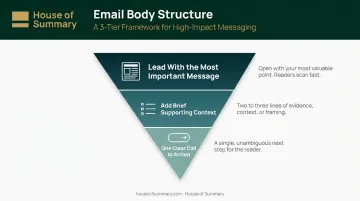
Avoid walls of text. If your email looks like a research paper, it won't get read.
Optimize for Mobile
Campaign Monitor reports that 60% of email campaign opens happen on mobile devices. If your email isn't built for a small screen, you're designing for a minority of your readers.
Mobile email checklist:
- Subject line: 33–43 characters visible before truncation on most phones
- Layout: single-column only
- Buttons: large enough to tap with a thumb
- Copy: short paragraphs, generous white space
Balance Value with Promotion
A practical rule: most of your emails should deliver genuine value — useful information, insights, education — while a smaller portion drives direct promotion.
- Subscribers who feel sold to constantly unsubscribe
- Subscribers who learn something stay engaged long enough to convert
- The right ratio keeps your list healthy and your click rates climbing
A/B Test One Variable at a Time
Once you're sending consistently, run A/B tests to find what actually moves your numbers. Test one variable at a time:
- Subject line A vs. subject line B
- Different send times
- CTA placement (top vs. bottom)
Each test produces data. Run enough of them and the cumulative lift becomes hard to ignore.
Key Email Marketing Metrics You Should Track
Four metrics tell you almost everything about campaign health:
| Metric | What It Tells You |
|---|---|
| Open rate | Are your subject lines working? |
| Click-through rate (CTR) | Is your content compelling enough to act on? |
| Unsubscribe rate | Are you sending too often, or to the wrong people? |
| Bounce rate | Is your list clean and current? |
Industry Benchmarks
Having a baseline helps you know whether your numbers are strong or need attention. From Mailchimp's benchmark data (across industries):
- Average open rate: 35.63%
- Average click-through rate: 2.62%
- Average unsubscribe rate: 0.22%
Rates vary by sector. Nonprofits average 40% open rates and 3.27% CTR. Ecommerce runs lower at 29.81% opens and 1.74% CTR. Compare your performance against your specific industry rather than the overall average.
Campaign Monitor uses under 2% as a healthy bounce rate threshold. Above that, your list needs cleaning.
Most email service providers (ESPs) surface all four metrics automatically in their dashboards. Review them after every send, not just the first — consistent tracking over time reveals patterns that single data points miss.
Email Marketing Compliance: The Rules You Can't Ignore
Three laws govern email marketing for most senders:
| Law | Jurisdiction | Consent Requirement | Unsubscribe Window |
|---|---|---|---|
| CAN-SPAM | United States | Accurate sender ID, no deceptive subject lines, valid postal address | 10 business days |
| GDPR | European Union | Freely given, specific, unambiguous — no pre-ticked boxes | As easy to withdraw as to give |
| CASL | Canada | Explicit consent required; implied consent (purchase/inquiry) is time-limited | 10 business days |
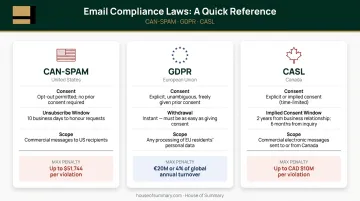
The fines are real. Each CAN-SPAM-violating email can carry a penalty of up to $53,088 — the FTC charged Experian $650,000 for violations involving emails consumers couldn't opt out of. CASL's implied consent window is strict: two years after a transaction, six months after an inquiry.
The case for compliance goes beyond avoiding penalties. A consent-based list keeps your emails out of spam folders, protects your sender reputation, and builds the kind of trust that makes subscribers more likely to open and click. Subscribers who opted in genuinely tend to engage more — and that engagement improves your deliverability over time.
Frequently Asked Questions
How much is a 1,000-subscriber email list worth?
List value depends on engagement quality, niche, and monetization method. A highly engaged 1,000-person list in finance or B2B can generate more revenue than a 20,000-person list of disengaged contacts. What your list is worth is exactly what it drives in attributed revenue — nothing more, nothing less.
What is the 60/40 rule in email advertising?
The 60/40 rule is a content ratio guideline: roughly 60% of your email should deliver genuine value (education, news, useful tips) and 40% can be promotional. It's not a research-backed law, but the principle is sound. Too much promotion erodes trust and drives unsubscribes.
What is the 3-3-3 rule in email marketing?
The first 3 seconds capture attention through your subject line and preview text. After that, your opening 3 lines need to pull the reader into the body copy. From there, the email focuses on delivering 3 key pieces of information or guiding toward 3 actions — the goal is focus, not sprawl.
What is a good open rate for email marketing?
Average open rates range roughly from 29% (ecommerce) to 40%+ (nonprofits and niche newsletters), based on Mailchimp industry benchmarks. Improving subject lines and tightening list segmentation are the fastest levers for raising open rates.
How often should I send marketing emails?
Frequency depends on your audience type. Campaign Monitor's guidance suggests retail and ecommerce at 1–2 emails per week, B2B at 2–4 per month, and nonprofits at 1–2 per month. Test your cadence, watch your unsubscribe rate, and adjust from there.
Do I need a big email list to see results?
No. A few hundred highly engaged, targeted subscribers can drive meaningful revenue or action. Chasing list volume before you have an engaged core audience is a distraction. Quality and consent matter more than size from the very first subscriber.