Newsletter ads sidestep all of this. They reach readers directly in the inbox — a space people have chosen to protect and check daily. No algorithm decides whether your message gets seen. No ad blocker can strip it out. And because subscribers have opted in to receive that newsletter, your ad appears in a context of trust and attention that paid social simply can't replicate.
This guide covers what newsletter ads are, why they consistently outperform other digital channels, the main ad formats available, how to choose the right newsletter for your brand, and how to write and price your first placement.
Key Takeaways
- Newsletter ads are paid placements inside email newsletters, reaching engaged audiences without algorithms or ad blockers
- Email marketing delivers $36 ROI for every $1 spent — far outpacing social media's 2-4% engagement rates
- Formats range from sponsored placements to dedicated sends, so you can match the ad type to your goal and budget
- Engagement and audience fit matter more than list size — a niche 8,000-subscriber newsletter often outperforms a generic list ten times its size
What Are Newsletter Ads and How Do They Work?
Newsletter ads are paid placements inside a third-party email newsletter. Unlike email marketing — where your brand sends messages to your own subscriber list — newsletter advertising lets you borrow access to someone else's established, trusted audience.
The mechanics are straightforward: an advertiser pays a publisher to include their message inside a newsletter issue that goes directly to subscribers' inboxes. That message might be a short text blurb, a visual banner, a product feature, or an entire dedicated email, depending on the format and budget.
Two parties, one arrangement:
- Advertisers pay for access to a specific, pre-built audience that matches their offer
- Publishers monetize their subscriber base by featuring relevant, vetted placements
Success depends on alignment. A finance product placed inside a business newsletter makes sense; that same product in a parenting newsletter does not. When the fit is right, the advertiser gets qualified leads and the publisher maintains reader trust by only featuring relevant offers.
It's also worth remembering that newsletter ads are not spam. Subscribers opted in to receive that newsletter, so your ad appears in a context the reader has actively invited into their inbox. That's why newsletter placements consistently outperform cold outreach and interruptive display ads.
Why Newsletter Ads Work Better Than You Think
Email marketing returns $36 for every $1 spent, according to 2024/2025 data from Litmus. That's a 3,600% ROI. Compare that to social media, where average engagement rates sit between 2.08% on Facebook and 4.04% on Instagram, and the financial case becomes clear: the inbox is where attention — and conversion — actually happen.
The Inbox Advantage
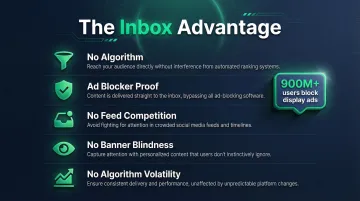
Newsletter ads reach subscribers directly, without intermediaries:
- No algorithm decides who sees your message — every subscriber receives it
- Ad blockers can't strip it out — over 900 million users block display ads, but newsletter content lands in the inbox regardless
- No feed competition — your ad isn't fighting for attention against cat videos and political arguments
- No banner blindness — users have learned to tune out anything resembling a display ad, but newsletter content reads as editorial
- No algorithm volatility — reach doesn't shift based on opaque platform priorities
Even when display ads are technically "viewable," only 30% are actually seen by users. The rest are scrolled past or dismissed before a single word registers. Newsletter ads don't have that problem.
The Warm Audience Principle
Subscribers didn't stumble onto this newsletter by accident. They opted in, they've been reading for weeks or months, and they trust the publisher's voice. When an ad appears in that context, it benefits from borrowed credibility.
Contrast this with cold social media targeting, where you're interrupting strangers mid-scroll with no prior relationship. Newsletter subscribers are in a focused reading mindset — and far more likely to act on something the publisher recommends.
Niche Newsletters Drive Higher Engagement
A newsletter serving 8,000 DevOps engineers will outperform a general tech newsletter with 100,000 passive subscribers — because relevance beats reach. The audience is self-selected around a specific topic, which means your ad speaks directly to people who actually care about what you're offering.
House of Summary's advertiser data illustrates this: click-through rates on their specialized newsletters — Presidential Summary, Geopolitical Summary, Dubai Summary, London Summary — run 4x higher than Google AdWords benchmarks. When audience fit is tight, performance follows directly.
Newsletter ads offer stable, measurable performance for one straightforward reason: the audience is defined, engaged, and opted-in — not assembled by an algorithm that can shift overnight.
The Main Types of Newsletter Ad Formats
Sponsored Placement (Inline/Native Ad)
The most common format: a short ad — text, image, or both — embedded within a regular newsletter issue, labeled "sponsored" or "in partnership with."
Placement positions matter:
- Top/Hero: Highest visibility at open, but readers often skim past. Commands base pricing.
- Mid-content: Catches readers mid-scroll when they're engaged. Can drive up to 22% higher CTR than top placements, despite costing 50-70% of the base rate.
- Footer/Classifieds: Lower engagement overall, but budget-friendly for branding or secondary CTAs at 20-40% of base rate.
Native ads are designed to match the newsletter's editorial tone and visual style. They feel like a natural recommendation rather than a disruptive sales pitch — which is why they avoid the scroll-past reflex that affects banner-heavy formats. Native ads are viewed 53% more frequently than display ads and register an 18% higher lift in purchase intent.
Dedicated Email Blast
An entire newsletter issue given over to a single advertiser's message. The reader opens what looks like their regular newsletter, but the full content is from your brand.
This format commands premium rates because of the undivided attention it delivers. It makes sense for:
- Major product launches
- High-intent offers with larger budgets
- Event promotions requiring detailed messaging
If your goal is awareness and you have the budget, a dedicated blast ensures your message lands without distraction.
Product Spotlight / Feature
A curated editorial-style section within a newsletter issue that features one advertiser in a "recommended tool" or "sponsor of the week" format.
Sitting inside trusted editorial content, it reads as a genuine endorsement rather than an interruption. This format works especially well for SaaS tools, services, and products that benefit from context and explanation.
Text Classifieds vs. Visual Banners
Text classifieds:
- Short, copy-only ads that blend seamlessly with written content
- Low cost, often used by creators or smaller brands
- Convert better for direct-response goals because they don't trigger the instinctive "this is an ad" skip reflex
Visual banners work differently:
- Image-based, best for brand awareness and product launches
- More expensive, but effective for visual products
- Susceptible to banner blindness — users scroll past without engaging
For most beginners, text-based placements are the sharper starting point. Banners earn their cost once you've built enough brand recognition for visuals to do the work.
How to Choose the Right Newsletter to Advertise In
Start with Audience Alignment
The single most important factor: does the newsletter's readership match your target customer?
A mismatched placement — regardless of list size or creative quality — will underperform because the offer isn't relevant to the people reading it. Natural fits matter:
- Finance product → business newsletter
- Travel brand → destination-focused publication
- Developer tool → tech or SaaS newsletter
If the audience doesn't care about what you're selling, no amount of optimization will save the campaign.
Look Beyond List Size to Engagement Metrics
A smaller, highly engaged list consistently outperforms a massive but disengaged one. A newsletter with 8,000 niche professionals will almost always beat a general newsletter with 100,000 passive subscribers because relevance trumps reach.
What to request from publishers:
- Average open rate — but remember that Apple's Mail Privacy Protection inflates this metric, so use it for trends only
- Click-through rate (CTR) — a more reliable indicator of engagement. A "good" CTR ranges from 1.5% to 4%, depending on industry
- Click-to-open rate (CTOR) — shows how engaged readers are once they open the email
- Audience demographics — confirm the subscribers match your ideal customer profile
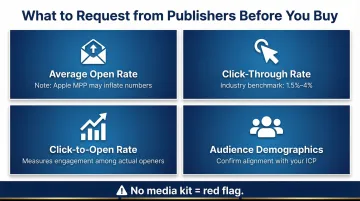
Always request a media kit before committing budget. If the publisher can't provide basic engagement data, that's a red flag.
Evaluate Editorial Credibility and Tone
Engagement metrics tell part of the story — but editorial quality shapes the environment your ad lives in. A newsletter with verified, credible content builds reader trust, which carries over to the brands featured inside it.
For example, House of Summary's specialized publications (Presidential Summary, Geopolitical Summary, Dubai Summary, London Summary) attract executives and business professionals precisely because the content is factual and free of sensationalism — that reader trust is what makes ad placements in those issues perform.
Before buying any placement, assess:
- Voice and tone — does it align with how your brand communicates?
- Sponsor history — are existing advertisers well-matched to the audience?
- Ad transparency — are sponsored placements clearly labeled?
- Content quality — is the editorial accurate, well-sourced, and free of clickbait?
Readers trust newsletters that are honest about advertising. Mismatched or deceptive placements erode that trust fast.
Check Publishing Frequency and Placement Availability
Weekly or biweekly newsletters tend to have longer shelf life than daily publications where ads can get buried quickly.
Key questions to ask:
- How often is the newsletter published?
- How many ad slots are sold per issue?
- Will my ad appear alongside competitors?
- How far in advance do I need to book?
Writing Your First Newsletter Ad: Copy, Pricing, and Practical Basics
Use the AIDA Framework for Ad Copy
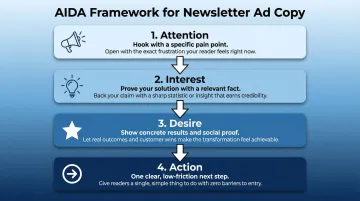
Most newsletter ads fail at the copy level before they ever reach the targeting question. The AIDA framework gives you a reliable structure to build on:
Attention — Hook the reader with a headline that identifies their specific problem or need. Don't be vague. Name the pain point directly.
Interest — Show why your product solves that problem using a specific, relevant fact. Engage their mind with proof, not fluff.
Desire — Share compelling social proof, results, or benefits that show how life will be different after using your product. Make it concrete.
Action — Provide exactly one clear next step. Create urgency without making it feel like a huge, time-consuming obligation.
Lead magnets vs. direct product pitches:
For beginners, offering something free — a report, a trial, a download — consistently outperforms asking for a purchase. It lowers friction and gets the reader into your funnel first. Changing a CTA from "Sign up for free" to "Trial for free" resulted in a 104% month-over-month increase in premium trial starts. Words matter.
CTAs that work:
- "Try It Free" or "Start Free" — emphasize ease and no commitment
- "Download the Guide" — offers value upfront
- "Get Early Access" — creates exclusivity
Avoid hard-sell CTAs like "Buy Now" or "Sign Up" in cold newsletter placements. You're borrowing trust, not closing a sale.
Once your copy is set, the next decision is how you'll pay for placement. Understanding pricing models upfront prevents budget surprises.
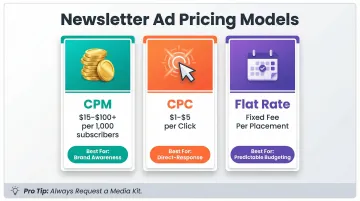
Understand the Three Main Pricing Models
CPM (Cost Per Thousand Subscribers):
- You pay a set rate per 1,000 people the newsletter reaches
- Typical rates: $15 to $30 for consumer newsletters, $50 to $100+ for specialized B2B newsletters
- Best for: Brand awareness campaigns where reach matters
CPC (Cost Per Click):
- Payment is tied to actual clicks, making it performance-based
- Typical rates: $1 to $5 per click
- Best for: Direct-response campaigns focused on driving traffic
Flat-Rate Sponsorship:
- A fixed fee per placement regardless of list size or clicks
- Most common among independent newsletters
- Best for: Predictable budgeting and testing new channels
Always request a media kit to see what pricing model the publisher uses and whether rates are negotiable for first-time advertisers or package deals.
Track the Right Metrics
Don't just count clicks. Measure quality:
- CTR on the ad itself — how many people clicked?
- Conversion action on the landing page — how many completed the desired action (signup, download, purchase)?
- Quality of leads generated — are they the right subscribers or customers?
The goal is attracting the right people, not the most people. Before you scale spend, verify that the audience you're reaching actually matches who buys from you — otherwise volume is just noise.
Frequently Asked Questions
What are newsletter ads?
Newsletter ads are paid placements inside a third-party email newsletter, reaching an opted-in audience without algorithms or ad blockers. Unlike email marketing (where you send to your own list), newsletter advertising lets you borrow access to someone else's trusted subscriber base.
How much does ad placement cost?
Pricing varies by list size, engagement, and placement type. The three main models are CPM ($15–$100+ per 1,000 subscribers), CPC ($1–$5 per click), and flat-rate sponsorship (fixed fee per placement). Request a media kit to see specific rates and available packages.
Are newsletter ads better than social media ads?
Newsletter ads reach opted-in audiences directly in the inbox — no algorithm interference, no ad blockers (which affect 42.7% of internet users), and less ad fatigue than social feeds. For direct-response and B2B campaigns, they tend to outperform social media on trust and engagement.
How do I find the right newsletter to advertise in?
Start with audience alignment: does the newsletter's readership match your target customer? Then evaluate engagement rates (CTR, open rate, CTOR) and request a media kit. A smaller, highly engaged niche newsletter will outperform a larger, disengaged one in most cases.
What should a good newsletter ad include?
Most high-performing newsletter ads share four elements:
- A hook or headline that identifies the reader's problem
- A clear benefit statement showing how your product solves it
- Social proof or a low-friction offer (free trial, download, or report)
- A single, direct call to action that makes the next step obvious