Most people encounter these forces daily without recognizing them as connected. This guide cuts through the jargon and explains geopolitics in plain terms — what it is, where the concepts come from, how it plays out in real conflicts, and why understanding it gives professionals a genuine edge.
Key Takeaways
- Geopolitics studies how geography, resources, and location shape power between nations
- Core concepts include spheres of influence, alliances, resource competition, and geo-economics
- The Russia-Ukraine war and US-China rivalry are the defining geopolitical conflicts of the current era
- Geopolitical shifts directly affect fuel prices, supply chains, investment risk, and inflation
- Curated expert analysis cuts through news noise to surface what actually drives global decisions
What Is Geopolitics? A Clear Definition
Britannica defines geopolitics as "the analysis of the geographic influences on power relationships in international relations." Put plainly: it's the study of how a nation's location shapes its options — and how countries use that reality to pursue power, build alliances, or apply pressure on rivals.
The term was coined by Swedish political scientist Rudolf Kjellén around 1899–1900. Its meaning has since grown considerably, stretching far past physical maps and military borders into economics, energy, and trade.
What Geopolitics Is — and Isn't
Geopolitics is frequently confused with general international relations or military strategy. The distinction matters:
- International relations covers the full range of interactions between states — culture, law, trade, diplomacy
- Military strategy focuses on armed force and conflict planning
- Geopolitics sits at the intersection: it specifically examines how physical and geographic realities — coastlines, mountains, resource deposits, trade routes — constrain or enable a country's choices on the world stage
Classical vs. Modern Usage
Early geopolitical thinkers focused on land and sea control. Today, the concept has widened to include what scholars at Chatham House call geo-economics: using trade policy, sanctions, investment restrictions, and energy supply as geopolitical tools. Strategist Edward Luttwak formalized the concept in 1990, and it has since become the dominant mode of great-power rivalry — where tariffs and pipeline contracts often do the work that tanks once did.
The Origins of Geopolitical Thinking
Three thinkers built the conceptual foundation that still shapes how analysts read global power today.
| Thinker | Key Work | Core Argument |
|---|---|---|
| Alfred Thayer Mahan | The Influence of Sea Power upon History (1890) | Naval power is central to national power; controlling sea routes determines which nations rise |
| Halford Mackinder | "The Geographical Pivot of History" (1904) | Whoever controls the Eurasian "Heartland" holds decisive strategic advantage over the world island |
| Nicholas Spykman | The Geography of the Peace (1944) | The Eurasian "Rimland" — coastal Europe through East Asia — is more strategically valuable than the interior |
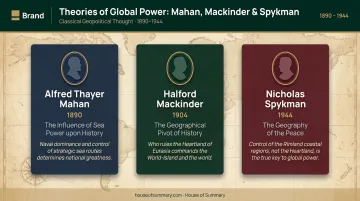
These aren't just historical footnotes. Cold War containment strategy was directly built on Mackinder's Heartland concept, per scholars at the US Army War College. Modern competition over Arctic shipping lanes, Pacific island chains, and Central Asian pipelines still echoes these original frameworks.
Those frameworks didn't emerge from nothing. Aristotle made the earliest recorded observations linking geography to governance — noting in Politics that climate and terrain shaped the character of peoples and their political systems. Mahan, Mackinder, and Spykman formalized what observers had suspected for centuries.
The Basic Concepts That Drive Geopolitics Today
Spheres of Influence
Major powers — the US, China, Russia, the EU — seek to extend political, economic, or military dominance over neighboring or strategically important regions without formal sovereignty over them. Smaller nations constantly navigate pressure from multiple directions, making choices about alignment, neutrality, or hedging between competing powers.
Alliances and Intergovernmental Bodies
Alliances aren't just military arrangements — they're geopolitical tools. NATO amplifies the security of each member. OPEC pools energy leverage. ASEAN gives smaller Southeast Asian states collective weight. The EU coordinates economic and political power across 27 nations. Membership in these bodies raises a country's bargaining position significantly.
Geo-Economics
Economic instruments have become as consequential as military ones:
- Sanctions — cutting off access to financial systems or specific goods
- Export controls — restricting technology transfers to rivals
- Investment screening — blocking foreign acquisitions of strategic assets
- Infrastructure finance — using development funding to build political relationships
These tools are wielded alongside, and sometimes instead of, military force.
Resources and Critical Minerals
Control over critical resources shapes alliances and generates conflict. The IEA's Global Critical Minerals Outlook 2025 frames supply security for copper, lithium, cobalt, and rare earths as a central energy-transition issue. Water is equally contested — 153 countries share transboundary water basins, yet fewer than half have comprehensive operational agreements covering them.
Technology and Cyberspace
The same competition playing out over pipelines and mineral deposits now runs through fiber-optic cables and data centers. Modern geopolitics extends into digital infrastructure, data governance, and cyber operations — territory with no physical borders but with very real strategic consequences.
NATO treats cyber defence as a core collective security task, noting that cyber attacks are growing more frequent, more destructive, and more deliberately coercive. States can disrupt power grids, financial systems, or military communications without deploying a single soldier.
Geopolitics in the Real World: Key Examples
Russia-Ukraine: Energy, Food, and Alliance Realignment
The Russia-Ukraine conflict is the sharpest recent illustration of how a regional conflict produces global geopolitical consequences.
Energy: Russia supplied 45% of EU gas imports in 2021. By 2023, that share had fallen to 15% under the EU's REPowerEU program — a structural shift in European energy policy forced by the war.
Food: The UN's Black Sea Grain Initiative, brokered in July 2022, enabled nearly 33 million metric tons of grain and foodstuffs to reach 45 countries before the agreement collapsed — demonstrating how a territorial conflict can directly threaten global food supplies.
Alliances: Finland joined NATO as its 31st member in April 2023. Sweden followed as the 32nd in March 2024. Two countries that had maintained decades of military non-alignment changed course directly because of the war.
US-China Competition: Semiconductors and Sea Lanes
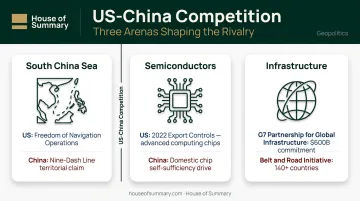
The US-China rivalry plays out across multiple connected arenas:
- South China Sea — A July 2016 arbitral tribunal ruling invalidated Chinese historic-rights claims within the nine-dash line, but China has continued its presence, keeping maritime tensions active
- Semiconductors — US export controls implemented in October 2022 targeted advanced computing chips and semiconductor manufacturing equipment, framing technology as a national security asset
- Infrastructure — China's Belt and Road Initiative has reached more than 140 countries since its 2013 launch. The G7 responded with a commitment to mobilize up to $600 billion by 2027 through the Partnership for Global Infrastructure and Investment
Energy as Leverage: The 1973 Oil Embargo
Energy isn't only a trade commodity — it's a pressure point. The 1973–1974 oil embargo offers the clearest historical precedent: following US support for Israel, OPEC members cut supply and oil prices first doubled, then quadrupled. Fifty years later, pipeline routes, LNG terminals, and energy import dependency remain live geopolitical leverage points.
Cyprus: A Compact Case Study
Cyprus has been divided since 1974, when Turkey invaded following a Greek-backed coup. The island sits at the intersection of Greek, Turkish, and British interests — all three are guarantor powers from the 1960 constitutional settlement.
The stakes sharpened after major offshore gas discoveries beginning in 2011, adding resource competition to an already contested geography. Few cases illustrate as concisely how ethnic composition, strategic location, and energy proximity can pull a small country into much larger power struggles.
Why Geopolitical Analysis Matters for Business and Daily Life
Geopolitics isn't abstract. Its effects reach household budgets and boardroom decisions alike.
The downstream effects most people feel:
- Fuel price spikes after supply disruptions
- Product shortages when trade routes or manufacturing regions are disrupted
- Inflation driven by commodity price surges
- Currency volatility tied to political risk
Those consumer-level disruptions are a direct consequence of risks that boardrooms are now pricing in as primary threats.
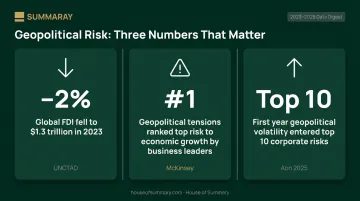
UNCTAD's World Investment Report 2024 found that global foreign direct investment fell 2% to $1.3 trillion in 2023, driven in part by rising geopolitical tensions. McKinsey's research found business leaders now view geopolitical tensions as the biggest single risk to economic growth. Aon's 2025 Global Risk Management Survey marked the first time geopolitical volatility broke into the top 10 corporate risks.
For executives and investors, the practical requirements are clear:
- Assess political risk before entering new markets
- Run sanctions exposure checks as part of due diligence
- Map supply chains against known geopolitical chokepoints
- Build scenario plans around alliance shifts and regulatory changes
The executives and investors who move fastest on these requirements are the ones who saw the signals early — which is exactly what good geopolitical analysis is for.
How to Stay Ahead of Geopolitical Shifts
The challenge isn't access to information — it's filtering it. Geopolitical news is constant and often designed to provoke reaction rather than build understanding.
Signals Worth Tracking
Focus on structural signals rather than reacting to every headline:
- Alliance announcements — who is joining, leaving, or distancing from security arrangements
- Sanctions and export controls — what economic tools are being deployed and against whom
- Resource and infrastructure deals — where capital is flowing and who controls supply chains
- Election outcomes in major economies that shift trade or security posture
- Military movements — deployment patterns that signal escalation or de-escalation
Quality Over Volume
Raw news feeds generate noise. Most professionals need filtered, contextualized analysis that surfaces patterns — not just events.
House of Summary's Geopolitical Summary newsletter is designed for exactly this. Published Monday through Saturday, it's human-written and fact-checked — editors review a wide range of sources, cut the noise, and deliver only what matters, with context. No AI-generated content, no sensationalism, no half-truths.
One reader from Georgia put it directly: "It always keeps me updated even on the go and every day I find news I hadn't heard anywhere else." For executives, policy professionals, and investors who need to understand global power dynamics without spending hours on the news, it's a practical solution — delivered to your inbox, six days a week.
Frequently Asked Questions
What is a simple summary of geopolitics?
Geopolitics is the study of how geography, resources, and location shape foreign policy and power relationships between nations. It examines how countries compete and cooperate through territory, trade, alliances, and military positioning.
What are the basic concepts of geopolitics?
The core concepts are spheres of influence, alliances, resource competition, and geo-economics. More recently, technology and digital infrastructure have become major arenas of geopolitical competition — power contested through semiconductors, data governance, and cyber operations.
What is an example of geopolitics?
The Russia-Ukraine war is the clearest recent example. It reshaped European energy supply, triggered NATO expansion, disrupted global grain markets, and produced alliance changes across the continent — all downstream effects of a single regional conflict.
How does geopolitics affect everyday life?
Geopolitical events drive fuel prices, product availability, inflation, and job markets. When a major supplier country faces sanctions or conflict, the effects ripple through commodity prices and supply chains that consumers feel directly.
What is geo-economics?
Geo-economics is the use of economic tools (sanctions, trade restrictions, export controls, infrastructure investment) to achieve geopolitical goals. It now rivals military strategy as a competitive arena, most visibly in the US-China contest over semiconductors and global infrastructure.
How do I stay informed about geopolitical events without getting overwhelmed?
Track structural signals — alliance shifts, sanctions, resource deals — through curated, expert-verified sources rather than raw news feeds. Publications like Geopolitical Summary are built specifically to filter and contextualize those developments so you're not reacting to every headline.