Introduction
B2B marketers face a harsh reality: ad blockers are stripping display ads from 32.5% of American internet users' screens, algorithm changes are throttling organic reach on social platforms, and sales teams are demanding leads that actually convert — not just names on a spreadsheet. Meanwhile, the B2B buying cycle now involves 13 internal stakeholders and 9 external influencers, with 81% of the customer journey happening before sales ever gets involved.
Email marketing and digital advertising remain the two highest-ROI channels for B2B lead generation. Email delivers $36 to $45 for every dollar spent. Strategic LinkedIn and Google PPC campaigns reach decision-makers at the exact moment they're evaluating solutions. Most companies have access to both channels — the gap is in how they use them.
This guide covers channel selection, segmentation, ad targeting, and lead qualification: what actually works for building a consistent, conversion-ready B2B pipeline.
Key Takeaways
- Email marketing reaches decision-makers directly — no algorithms, no ad blockers, and the highest ROI of any digital channel
- LinkedIn and Google PPC deliver speed and targeting precision for campaigns built around conversion-focused landing pages
- Lead quality always beats volume — define your ICP and MQL criteria before launching campaigns
- Combining both channels across the buyer journey shortens sales cycles and lowers cost per qualified lead
Why Email Marketing and Digital Advertising Lead B2B Lead Gen
B2B buying decisions are fundamentally different from consumer purchases. The average sales cycle runs 10.1 months, involves multiple stakeholders across departments, and often carries deal values that require CFO approval. These dynamics demand precision over volume. You need to reach the right person at the right moment in their buying journey, not just maximize impressions or clicks.
Email holds a structural advantage for B2B: it bypasses the algorithmic gatekeeping that throttles LinkedIn posts and the ad-blocking mechanisms that strip out display banners. A message delivered to an inbox commands attention in a way a banner ad on a cluttered webpage never can. There's no feed algorithm deciding whether your content deserves visibility, and no browser extension erasing your message before it renders.
Digital advertising provides the complementary strength: immediate reach and the ability to retarget warm prospects who've already engaged with your brand. The targeting precision goes well beyond demographics:
- LinkedIn lets you reach a VP of Finance at a mid-sized manufacturing firm by title, company size, and industry
- Google Search Ads capture prospects actively typing queries like "contract management software for healthcare"
- Behavioral retargeting re-engages visitors who browsed your site but didn't convert
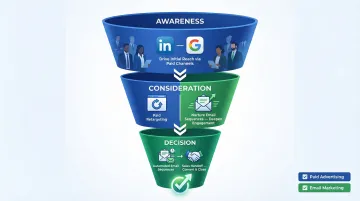
The real leverage comes from running both channels across the buyer journey. Paid advertising builds awareness and captures early-stage interest. Email deepens that relationship over time and moves leads toward a decision — so by the time a prospect enters a sales conversation, your brand isn't a cold introduction.
Email Marketing Strategies That Generate Quality B2B Leads
Prioritize List Quality Over List Size
A smaller list of well-matched contacts outperforms a massive cold database every time. Define your Ideal Customer Profile using firmographic criteria — industry, company size, job title, geography — and behavioral signals before building or sourcing any contact database.
Purchased cold email lists are a trap. They produce low conversion rates, damage your sender reputation, and risk non-compliance with regulations like GDPR and CAN-SPAM. More importantly, opt-in lists deliver conversion rates 15 times higher than non-opt-in lists, while cold emails suffer from 7-8% bounce rates compared to under 2% for permission-based campaigns.
Key principles for building opt-in lists:
- Gate high-value content behind forms (whitepapers, benchmarks, calculators)
- Use progressive profiling to enrich contact data over time
- Segment by firmographic and behavioral attributes from day one
- Verify email addresses at point of capture to reduce bounces
- Remove unengaged contacts regularly to maintain deliverability
Use High-Value Content to Capture Lead Information
The lead magnet approach works because it signals intent. A prospect who exchanges their contact information for an original research report or industry benchmark is actively researching solutions. That's a fundamentally different lead than someone who clicked a banner ad out of curiosity.
Match content format to buyer stage:
- Awareness stage: Trend reports, industry overviews, "State of [Industry]" benchmarks
- Consideration stage: Solution comparison guides, buyer's checklists, implementation roadmaps
- Decision stage: ROI calculators, pricing guides, product demos, case studies
The content quality matters more than the volume. One deeply researched, data-driven asset that answers a critical question will generate more qualified leads than ten generic PDFs.
Build Personalized, Behavior-Triggered Sequences
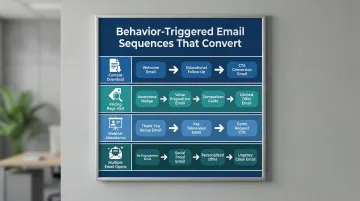
Drip campaigns that respond to specific prospect actions consistently outperform generic broadcasts. Segmented and behavior-triggered emails drive 30% more opens and 50% more click-throughs than unsegmented blasts. A whitepaper download, for instance, should trigger a follow-up sequence that builds on that topic — not a generic product pitch.
Effective behavior-triggered sequences:
- Content download → Related case study → Implementation guide → Demo offer
- Pricing page visit → ROI calculator → Customer testimonial → Sales outreach
- Webinar attendance → Recording + slides → Deep-dive article → Consultation booking
- Email engagement (multiple opens) → High-value content upgrade → Direct sales introduction
Use marketing automation platforms to track engagement signals and adjust messaging dynamically. A prospect who opens three consecutive emails is showing higher intent than someone who hasn't engaged in weeks — adjust your approach accordingly.
Leverage Newsletter Advertising to Reach Engaged Audiences
Rather than building a list from scratch, brands can place sponsored content directly inside established newsletters read by high-intent decision-makers. This combines the inbox advantage of email with the reach and targeting of paid advertising.
Newsletter placements on specialized networks deliver ads to readers who are actively engaged, not passively scrolling. Unlike display ads stripped by browser extensions or social posts throttled by feed algorithms, newsletter sponsorships land in the inbox with no ad-blocking risk and no algorithm interference.
House of Summary operates a network of specialized newsletters — including Presidential Summary (global news), Geopolitical Summary (international politics), Dubai Summary (UAE news and lifestyle), and London Summary — serving global executives and business professionals. The network generates over 250,000 daily email opens across 500,000+ subscribers.
One advertiser reported click-through rates 4x higher than Google AdWords through placements in the network, attributing the performance to editorial tone alignment with high-intent readers.
Track the Metrics That Actually Matter
Open rate and click-through rate measure engagement, but neither tells you whether the channel is producing revenue-ready pipeline. Apple's Mail Privacy Protection has artificially inflated open rates — the current industry average sits at 42.35%, but that figure includes pre-fetched emails that were never actually read.
Metrics that signal lead quality:
| Metric | What It Measures | B2B Benchmark |
|---|---|---|
| Click-Through Rate (CTR) | Email engagement depth | 2.5% average; 2.21% for B2B services |
| Lead-to-Opportunity Rate | Conversion to sales-ready status | Varies by ICP; track against your own baseline |
| Cost Per Qualified Lead | Efficiency of spend | ~$200 average for B2B; email typically lower than paid channels |
| Email-to-Revenue Attribution | Direct pipeline contribution | Track in CRM with multi-touch attribution |
Focus on conversion rate from email click to MQL, and from MQL to sales opportunity. Those metrics tell you whether the channel is delivering value, not just activity.
Digital Advertising Tactics That Reach B2B Decision-Makers
LinkedIn Ads: The B2B Targeting Standard
LinkedIn is uniquely suited to B2B advertising because it's the only major platform where audiences can be segmented by job title, seniority, company size, industry, and skills simultaneously. This precision matters when your ICP is a VP of Finance at a mid-sized manufacturing company — not a general business audience.
LinkedIn commands 41% of total B2B ad budgets, and for good reason. With over 1.2 billion members across 200 countries and 89% of B2B marketers using the platform for lead generation, it delivers unmatched access to decision-makers.
Two most valuable ad formats for lead gen:
- Sponsored Content: Native ads that surface in the feed with high visibility and engagement
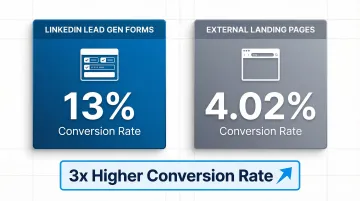
- Lead Gen Forms: Pre-filled forms that capture prospect information without requiring a click to an external landing page, reducing drop-off dramatically
LinkedIn Lead Gen Forms convert at 13%, versus 4.02% for typical external landing pages. A 3x improvement in conversion rate translates directly to lower cost per lead.
Google PPC: Capturing In-Market Demand
Google Search ads deliver an intent-driven advantage: someone typing "contract management software for healthcare" is already in buying mode. That's a different dynamic entirely from interrupting someone scrolling LinkedIn with an ad for a product they weren't thinking about.
Focus budget on bottom-of-funnel, high-intent keywords that indicate active research. The average B2B conversion rate in Google Ads is 7.52%, with an average cost per lead of $70.11. Those benchmarks mask a critical insight, though: branded and exact-match BOFU keywords deliver 1299% ROAS, while broad non-branded terms yield just 68% ROAS.
Google PPC best practices:
- Prioritize exact-match keywords with clear commercial intent
- Build dedicated landing pages for each campaign, not homepage links
- Use single, benefit-focused CTAs with short lead forms
- Track Quality Score and optimize for relevance, not just clicks
- Test ad copy variations systematically to improve CTR
Retargeting: Re-Engaging Warm Prospects
A prospect who visited your pricing page or downloaded a resource but didn't convert is a high-value target. Retargeting ads on LinkedIn, Google Display, or Facebook keep your brand visible and deliver tailored messaging based on what they already engaged with.
Retargeting delivers a 0.7% CTR — 10 times higher than cold display ads — and reduces cost per lead by 40-50%. On LinkedIn specifically, retargeting costs $5-7 per click compared to $8-10 for cold prospecting, representing a 25-35% savings.
The challenge: display ads face significant blocking issues. With 32.5% of US internet users running ad blockers — and 27% using them on desktop specifically — display-heavy strategies lose reach before a single impression is counted. In-feed social ads and inbox-based placements sidestep this entirely. Newsletter advertising, in particular, lands directly in the reader's inbox with no algorithm filtering, no ad blocker interference, and no visual clutter competing for attention — making it a reliable complement to display-heavy retargeting strategies.
Continuous A/B Testing and Optimization
Paid B2B campaigns require ongoing testing. Ad copy, headlines, audience segments, and landing page CTAs should all be tested systematically. Small improvements compound, and over time they reshape the economics of a channel.
Key metrics to monitor:
- Cost-per-lead (CPL)
- Conversion rate (ad click → form submission)
- Quality Score (Google Ads) or Relevance Score (LinkedIn)
- Cost-per-MQL (qualified lead, not just form fill)
Track performance weekly and reallocate budget toward the best-performing segments, keywords, and creative variations. A 10% improvement in conversion rate or a 15% reduction in CPL can meaningfully shift what a channel costs — and what it returns.
How to Qualify and Nurture the Leads You Generate
Generating a lead is only the beginning. Before campaigns go live, sales and marketing teams need to agree on what a Marketing Qualified Lead (MQL) actually looks like.
That definition combines two things: firmographic fit (right industry, company size, job title) and behavioral signals (email opens, content downloads, pricing page visits).
Why this matters: 73% of B2B leads are not sales-ready when first captured. Sending unqualified leads to sales wastes time and damages credibility.
Lead scoring solves this by assigning point values to prospect actions and profile attributes, so sales focuses only on leads most likely to convert. CRM and marketing automation tools (HubSpot, Marketo, Salesforce) support this out of the box.
Basic scoring framework:
- Firmographic fit (ICP match): +20 points
- Email engagement (open, click): +5 points per action
- Content download (whitepaper, case study): +10 points
- Pricing page visit: +15 points
- Demo request or consultation booking: +50 points (immediate MQL)
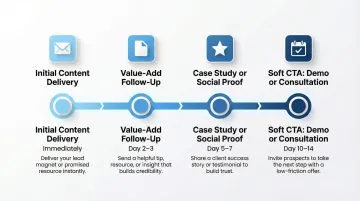
Once scoring is in place, a structured nurture sequence moves qualified leads toward a decision over 10–14 days:
- Initial content delivery (immediately after form submission)
- Value-add follow-up email (2-3 days later, related topic)
- Case study or social proof (5-7 days later)
- Soft CTA — demo request or consultation (10-14 days later)
Companies that excel at lead nurturing generate 50% more sales-ready leads at 33% lower cost — a strong case for patience over the hard pitch.
Building a Channel Mix That Scales
Not every channel serves the same purpose — and treating them as interchangeable wastes budget. Digital advertising (LinkedIn, Google PPC) is most efficient for generating awareness and capturing in-market demand at the top and middle of the funnel. Email marketing and newsletter placements work better for nurturing and converting prospects who have already shown interest.
Budget allocation framework:
Rather than splitting spend equally across channels, start with a higher share on the channel best suited to your ICP's behavior. B2B brands targeting finance or executive audiences may see stronger ROI from newsletter advertising and LinkedIn than from broad social display.
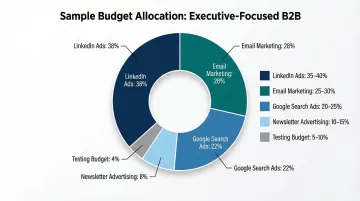
Sample allocation for executive-focused B2B:
- LinkedIn Ads: 35-40% (awareness + retargeting)
- Email Marketing: 25-30% (list building + nurture)
- Google Search Ads: 20-25% (BOFU capture)
- Newsletter Advertising: 10-15% (executive reach)
- Testing Budget: 5-10% (new channels, creative tests)
Budget allocation only tells half the story. Unified tracking reveals what's actually working — and what isn't. Use UTM parameters, CRM integration, and consistent attribution models to understand which channel and which specific asset (whitepaper, ad creative, newsletter placement) is driving pipeline, not just clicks. Without that visibility, budget decisions become guesswork.
Frequently Asked Questions
What is B2B lead generation?
B2B lead generation is the process of identifying and attracting potential business customers through targeted marketing strategies, including email campaigns, paid advertising, and content offers. The goal is to build a pipeline of qualified prospects ready for the sales team.
How do you find B2B leads?
Define an Ideal Customer Profile, use LinkedIn for targeted outreach and advertising, place content in industry newsletters, run PPC campaigns targeting high-intent keywords, and gate valuable content to capture opt-in contact information from prospects actively researching solutions.
What are the best practices for B2B lead generation?
Prioritize audience precision over list size, align MQL definitions between marketing and sales, use personalized and behavior-triggered communication, and consistently test every channel. A smaller list of highly qualified prospects will outperform a large, loosely targeted one every time.
Which tools are commonly used for B2B lead generation?
CRM platforms (Salesforce, HubSpot), marketing automation tools (Marketo, HubSpot), LinkedIn Sales Navigator for prospecting, Google Ads for PPC, and email marketing platforms (Mailchimp, ActiveCampaign). The right stack depends on team size, budget, and ICP.
What makes email marketing effective for B2B lead generation?
Email reaches decision-makers directly in the inbox — bypassing algorithms and ad blockers — and allows precise personalization based on behavior and firmographic data. Sent to opted-in, high-intent audiences, it reliably produces stronger ROI than cold purchased lists.