

Introduction
Marketers invest thousands—sometimes millions—into campaigns, yet many can't answer the most basic question: did the right people actually see it? Without measuring audience reach, media budgets operate on guesswork rather than evidence. You might know how many impressions were served, but impressions don't tell you whether you reached 100,000 different people or the same 1,000 people 100 times each.
This guide covers the fundamentals of audience reach measurement: what it is, how it works, the formula behind it, and how to interpret results. Whether you're planning a brand awareness campaign or auditing cross-channel spend, getting reach right is what separates a well-allocated budget from an expensive one.
Key Takeaways
- Audience reach counts unique individuals exposed to your content at least once—not total views
- Core formula: Reach = Impressions ÷ Frequency
- Reach differs from impressions (total displays) and engagement (actions taken)
- Accurate measurement requires unique user identification, bot filtration, and consistent cross-channel methodology
- Tracking reach prevents overspending on frequency and makes cross-platform performance comparison meaningful
What Is Audience Reach Measurement?
Audience reach measurement is the process of counting the total number of unique individuals or devices exposed to an advertisement or piece of content at least once within a defined period—regardless of how many times they saw it. A campaign with 500,000 impressions might reach 100,000 people (each seeing it five times on average) or 250,000 people (each seeing it twice). That gap directly affects cost-per-person calculations and how efficiently a budget is being spent.
The Interactive Advertising Bureau (IAB) establishes a strict hierarchy of audience measurement:
- Unique Cookies - weakest measure, deleted by 72% of users within 12 months
- Unique Browsers - adjusts for cookie deletion across sessions
- Unique Devices - accounts for multiple browsers on the same device
- Unique Users/Visitors - strongest measure, requiring direct attribution to actual individuals
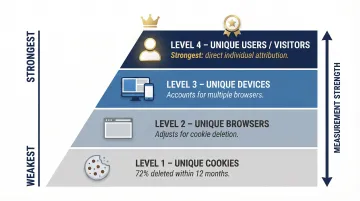
The IAB mandates clear disclosure of whether reach figures are machine-based (cookies, browsers, devices) or people-based (actual users). Misrepresenting machine counts as people-based counts violates industry compliance standards.
Audience reach measurement applies across:
- Paid advertising campaigns (social, display, search)
- Content distribution tracking
- Brand awareness initiatives
- Media planning and budget allocation
- Cross-channel performance comparison
To use reach data effectively, it helps to understand how it differs from two metrics it's often confused with.
Reach vs. Impressions vs. Engagement
These three metrics answer different questions:
- Reach - How many distinct people saw it?
- Impressions - How many total times was it displayed?
- Engagement - How many people took action?
Say a campaign delivers 50,000 impressions at an average frequency of 5, reaching 10,000 unique people — of whom 800 clicked through. Impressions measure volume, reach measures audience breadth, and engagement measures resonance. Each metric answers a distinct question; combining all three gives a complete picture of campaign performance.
Why Audience Reach Measurement Matters
Reach measurement directly informs budget decisions. High reach with low engagement signals a targeting or creative problem—you're reaching people, but the message doesn't resonate. Low reach with high engagement suggests the opposite: your message works, but your audience is too narrow. Each scenario requires a different response.
Core business benefits of measuring reach accurately:
- Proves how widely a campaign penetrated the target audience
- Prevents overspend on repeatedly reaching the same individuals (frequency waste)
- Enables fair comparison of performance across channels and campaigns
- Supports media planning by identifying which channels extend reach to new audiences
- Provides a baseline for calculating cost-per-unique-reach and overall efficiency
Nielsen research demonstrates the law of diminishing returns: increasing a campaign from 200 to 300 GRPs grows reach by 29%, but scaling from 300 to 400 GRPs yields only 16% growth. The next 100 GRPs deliver just 2% additional reach. Beyond a certain threshold, new impressions simply hit the same people—pure waste.
That pattern has real budget consequences. Procter & Gamble's Chief Brand Officer Marc Pritchard stated "excess frequency is the biggest waste," prompting the company to shift focus toward reducing repetitive exposures and reinvesting savings into net-new reach.
Reach alone is incomplete, though. Always read it alongside frequency, engagement, and conversion data. A campaign that reaches 80% of your target audience but converts no one has a distribution problem, not a success story.
How Audience Reach Measurement Works – Step by Step
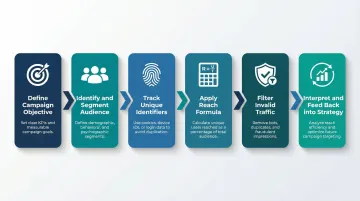
Audience reach measurement follows six practical stages. Each stage builds on the last — and the most common errors happen when teams rush past validation or fail to separate human exposure from machine-generated noise.
Step 1 – Define the Campaign Objective
Start by defining what the measurement must answer: Is the goal maximum unique exposure (brand awareness) or targeted reach within a narrow segment (market penetration)? The objective determines which benchmarks matter and how success gets defined.
Step 2 – Identify and Segment the Target Audience
Define the target audience before launch using demographic, behavioral, or contextual criteria. Without this baseline, there's no reliable way to calculate whether actual reach matched intended reach — or why it didn't.
Step 3 – Track Unique Identifiers Across Channels
Unique reach requires identifying each person or device only once across the measurement period. Methods include cookies, device IDs, authenticated logins, or subscriber data. Not all identifiers are equal:
| Identifier Type | Accuracy | Weakness |
|---|---|---|
| Cookies | Weakest | 72% deleted within 12 months |
| Device IDs | Moderate | Can be reset by users |
| Authenticated Users | Strongest | Requires login/registration |
Hybrid measurement models combine deterministic user-level data (email addresses, logins) with probabilistic modeling (statistical inference from anonymous signals) to balance accuracy and scale.
Metrics impacted: Deduplication accuracy, data reliability
Step 4 – Apply the Reach Formula
The standard formula is:
Reach = Impressions ÷ Frequency
Where:
- Impressions = total times the ad was displayed
- Frequency = average number of times each unique individual was exposed
Example: 100,000 impressions with average frequency of 4 = 25,000 unique reach
Metrics impacted: Audience size estimate, frequency-to-reach ratio
Step 5 – Filter Non-Human and Duplicate Activity
Raw impression counts include bot traffic, internal traffic, and technical duplications—all of which inflate reach figures. The Media Rating Council (MRC) mandates strict filtration of Invalid Traffic (IVT):
- General Invalid Traffic (GIVT) - identified through routine filtration using known bot/spider lists
- Sophisticated Invalid Traffic (SIVT) - requires advanced analytics to detect hijacked devices, manipulated activity, falsified events
The MRC establishes a 5% materiality threshold: invalid traffic exceeding 5% of reported activity is considered material and requires intervention.
Metrics impacted: Data integrity, count accuracy
Step 6 – Interpret Results and Feed Back into Strategy
Read reach data in context:
- Compare actual reach to target audience size to calculate reach percentage
- Review frequency distribution to check for oversaturation
- Segment by channel to identify where incremental new-audience reach originates
These three checks turn raw numbers into decisions — whether to reallocate budget, adjust targeting, or shift channel mix for the next campaign.
Audience Reach Measurement in Action – A Practical Walkthrough
Consider a mid-size brand launching a new product across three channels: social ads, display, and email newsletter placements. The brand sets a target of reaching 500,000 unique adults aged 25–45, allocates budget across all three channels, and defines frequency caps at 3 exposures per person.
Per-channel results:
- Social ads: 200,000 reported reach
- Display: 180,000 reported reach
- Email newsletters: 140,000 reported reach
The deduplication challenge: The same person may appear in social and display counts. Total reach is not simply 520,000 (the sum of each channel). An Innovid/ANA study revealed an average publisher duplication rate of 32% across campaigns—nearly a third of households were reached by more than one publisher with the same campaign.
Two common mistakes at this stage:
- Accepting platform-reported reach figures as deduplicated when they are not
- Ignoring the gap between machine-based unique devices and actual unique people
After cross-channel deduplication using a third-party measurement tool, the actual unique reach is 420,000—not 520,000. This represents 84% of the 500,000 target.
That gap between 520,000 and 420,000 is where the real decision-making starts. If reach came in at only 60% of target, investigate which channel underdelivered and whether budget should shift or frequency caps need adjusting. At 84%, this campaign is performing well — but reviewing frequency distribution by segment will confirm whether that reach is spread evenly or concentrated on a smaller audience seeing the ad repeatedly.
How House of Summary Delivers Measurable Audience Reach
House of Summary operates as an advertising channel where audience reach is inherently cleaner and easier to verify than display or social platforms. Subscribers are opted-in, authenticated individuals—not anonymized cookie pools. There are no ad blockers stripping impressions, no bot traffic inflating numbers, and no algorithm-driven uncertainty about who received the content. Every newsletter send goes directly to a real person's inbox.
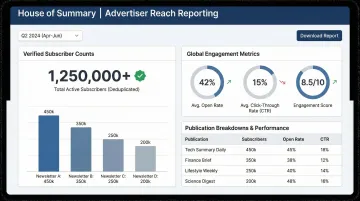
Advertisers placing campaigns in House of Summary's newsletter network receive transparent, first-party reach data: verified subscriber counts per publication, with engagement rates that run roughly 4x higher than standard display benchmarks. Google Ads search campaigns average 6.66% click-through rates — newsletter advertising consistently outperforms that figure with readers who are already primed to engage.
For brands targeting global executives, business professionals, and high-intent news readers across publications like Presidential Summary, Geopolitical Summary, London Summary, and Dubai Summary, House of Summary provides segmented reach to audiences that are genuinely difficult to access through algorithmic advertising.
Reach measurement here is straightforward:
- Subscriber counts are verified and tied to real, opted-in individuals
- Emails land directly in inboxes — no ad blockers, no filtered impressions
- Engagement tracked at the individual level, not sampled or estimated
- Cost-per-unique-reach is simple to calculate and compare against other channels
Conclusion
Audience reach measurement is a core discipline in campaign evaluation — one that tells you how widely your message traveled, how efficiently your budget was spent, and whether you're finding new audiences or repeating yourself to the same group.
Treat reach measurement as an ongoing process, not a one-time calculation. Review it after every campaign, refine it as channels evolve, and always read it alongside frequency, engagement, and conversion data. The signals it surfaces are worth paying attention to:
- High reach, low engagement — your message is spreading but not resonating; revisit creative or targeting
- Low reach, high engagement — your audience is responding well but too narrow; scale distribution
- High reach, high frequency — you may be saturating the same group; expand to new segments
- Steady reach growth — a sign your channel mix and targeting are working
Apply these benchmarks consistently and budget allocation becomes a deliberate decision, not a guess.
Frequently Asked Questions
How is audience reach measured?
Reach is calculated using the formula Reach = Impressions ÷ Frequency, where impressions are total ad displays and frequency is the average number of times each unique individual was exposed. Analytics platforms and ad managers automate this, but proper deduplication and bot filtering are required for accurate results.
What does 3+ reach mean?
"3+ reach" refers to the portion of the audience exposed to an ad at least three times. Marketers use it to gauge how many people received enough repetitions for a message to register, distinct from single-exposure reach.
What are the 4 levels of audience?
The IAB hierarchy establishes four levels, ranked weakest to strongest:
- Unique Cookies — subject to deletion, least reliable
- Unique Browsers — adjusted for cookie deletion
- Unique Devices — accounts for multiple browsers per device
- Unique Users/Visitors — people-based, requires direct individual attribution
What is cross-channel measurement?
Cross-channel measurement tracks and deduplicates audience reach across multiple platforms (social, display, email, CTV) to produce a unified view of how many unique individuals were reached overall, rather than summing each channel's reported reach separately.
What is the difference between reach and impressions?
Reach counts unique individuals who saw the content at least once, while impressions count every time the content was displayed, including multiple views by the same person. A campaign can have 100,000 impressions but only 20,000 reach if the average person saw it five times.
What is a good reach rate for a marketing campaign?
Reach goals depend on campaign type, audience size, and channel. Brand awareness campaigns prioritize maximizing reach against a defined target audience, while conversion campaigns often accept narrower reach in exchange for higher frequency and deeper engagement.