The reason is straightforward: healthcare settings deliver something most advertising environments can't. Captive, health-focused audiences with almost no competing distractions, encountered at the exact moment they're thinking about their wellbeing.
This guide covers everything advertisers need to know about healthcare digital signage — what it is, why it outperforms many traditional formats, where ads appear, which creative approaches work best, and how to build a channel strategy that delivers results.
Key Takeaways
- Healthcare digital signage places brand messages on screens inside medical facilities, reaching patients who can't skip or block ads
- POCMA member revenue surpassed $1 billion in 2024, up 16% year-over-year — the channel is growing fast
- Patients spend an average of 13.3 minutes in waiting rooms and 9.6 minutes alone in exam rooms, giving brands extended, uninterrupted exposure
- 58% of patients exposed to in-office healthcare ads said they'd discuss the treatment with their doctor
- Newsletter advertising complements in-facility screens by reaching the same health-conscious audience outside the clinical visit
What Is Healthcare Digital Signage Advertising?
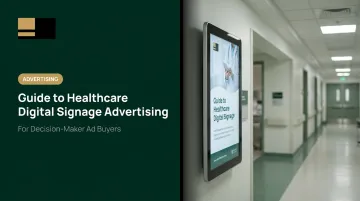
Healthcare digital signage advertising places paid or sponsored content on digital screens inside medical facilities. These screens appear in waiting rooms, exam rooms, pharmacy counters, hospital lobbies, and staff areas, and they're typically managed through vendor networks that handle content scheduling, ad delivery, and audience verification.
The Two-Sided Ecosystem
The channel works because it solves problems on both sides of the transaction:
- Healthcare facilities generate ancillary revenue while gaining a patient education tool — screens run condition awareness content, medication reminders, and care instructions alongside sponsor messages
- Advertisers reach a verified, health-focused audience with minimal distractions and no ability to skip, scroll past, or block the content
Market Scale and Growth
That dual-sided value has driven real commercial scale. POCMA reported that member point-of-care revenue exceeded $1 billion in 2024, a 16% increase from $870 million in 2023. That figure represents voluntary reporting from 25 member organizations and doesn't capture total industry spend — actual market size is larger.
Major networks now operate at significant scale. PatientPoint combined with Outcome Health in 2021 and now serves nearly 150,000 providers — reaching approximately 750 million patient visits annually across its digital screen network.
Why Healthcare Settings Create Powerful Advertising Opportunities
Most advertising environments compete for fragmented, distracted attention. Healthcare facilities work differently — the audience isn't scrolling past. They're sitting still, with time to fill and health already on their mind.
The Captive Audience Advantage
Patients in waiting rooms and exam rooms have limited options for what to do with their time. The numbers reflect this:
- 13.3 minutes — average waiting room time (PatientPoint, 2024 survey of 11,009 respondents)
- 9.6 minutes — average time alone in the exam room before the physician enters
- 38.1 minutes — mean wait time in emergency departments, per CDC 2022 data
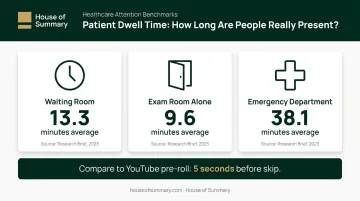
For context: a typical YouTube pre-roll ad gets 5 seconds before a skip button appears. Healthcare digital signage gets 13+ uninterrupted minutes in the waiting room alone.
Contextual Relevance as a Multiplier
A patient sitting in a cardiology clinic is already thinking about heart health. A patient at an orthopedic practice is focused on joint or bone issues. This isn't passive reach — it's messaging delivered at the exact moment a health topic is top of mind.
When an audience has already self-selected into a relevant medical setting, a generic health message lands as a specific, timely one. The environment does the targeting work.
High-Intent Patient Behavior
The behavioral evidence is strong. According to POCMA citing the M3 MI 2024 MARS Consumer Health Study:
- 58% of patients who saw in-office healthcare ads were willing to discuss the advertised treatment with their doctor
- 38% searched online for more information
- 34% obtained new prescriptions
Patients who noticed in-office advertising were also more likely to fill prescriptions (59% vs. 48%). They were more likely to take medication as prescribed, too — 59% vs. 47% among those who didn't see the ads.
No Ad Blocking, No Skip Button
According to eMarketer citing GWI data, 52% of consumers across 48 global markets have installed or used an ad blocker. Healthcare digital signage exists entirely outside that problem. These screens run in physical environments where patients have no mechanism to block, skip, or mute the content — and often, the screen is the only thing in the room worth looking at.
Where Healthcare Digital Signage Ads Appear
Waiting Room Screens
Waiting rooms are the highest-volume touchpoint in healthcare digital signage. Screens are typically large-format, wall-mounted displays running content loops that mix health education, facility announcements, and sponsored brand messages.
Patients in waiting rooms are anticipatory — often slightly anxious — and highly receptive to health-related information that feels helpful rather than interruptive. Well-designed content that leads with education lands particularly well here.
Exam Room Screens
Pharmaceutical and clinical brands treat exam room placements as the highest-value touchpoint in the network. The patient is alone or with a caregiver, focused on a specific condition or treatment decision, and the content is matched to the specialty of the practice.
Some networks allow condition-specific messaging based on practice specialty. A rheumatology practice can run ads relevant to joint disease treatments; a cardiology office can carry cardiovascular health content. CheckedUp, for example, notes that sponsored content on its Consult Digital Exam Room Wallboard plays approximately every five minutes.
Pharmacy and Retail Health Displays
In-pharmacy digital signage bridges healthcare and consumer purchasing. Screens near prescription pickup counters or OTC product aisles reach patients at the exact moment of a buying or adherence decision — the most direct conversion opportunity in the patient journey.
The "medtail" category — urgent care centers and clinics inside retail stores — is expanding this inventory further. As of July 2024, there were 1,733 active retail health clinics operating across 43 U.S. states.
Hospital Lobbies, Corridors, and Specialty Areas
Larger hospital environments offer distinct micro-audiences across multiple placements:
- Lobby directories and wayfinding screens — visitors and new patients
- Elevator banks and corridor displays — staff, families, and ambulatory patients
- Cafeteria screens — mixed staff and visitor audiences
- Specialty department waiting areas — condition-specific patient populations
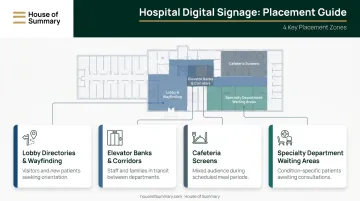
Each of these serves a different advertiser purpose and warrants separate creative and messaging considerations.
Ad Formats and Creative Best Practices for Clinical Settings
Common Ad Formats
Healthcare digital signage networks support several standard formats:
| Format | Description | Best For |
|---|---|---|
| Static image slides | Still graphics in content loops | Brand awareness, product shots |
| Short looping video (15–30 sec) | Motion content without sound dependency | Pharmaceutical brands, condition education |
| Sponsored health education | Branded infographics or condition segments | Building trust, driving doctor conversations |
| QR code-enabled prompts | Interactive elements linking to external content | Measuring engagement, patient support programs |
The Education-First Creative Principle
In clinical environments, advertising that leads with genuinely useful health information outperforms hard-sell formats. Patients and facility administrators respond better to content that feels like patient education. The brand functions as a supporting resource, not a promoter.
POCMA data supports this: 84% of patients value digital education materials from a doctor or hospital, including 74% who value digital screens and tablets. That's a strong signal for any brand deciding how to frame its creative.
Regulatory and Compliance Considerations
Pharmaceutical advertising in healthcare settings faces specific requirements:
- FDA OPDP oversight requires that prescription drug promotion be truthful, balanced, and accurately communicated
- 21 CFR 202.1 defines Rx ads lacking fair balance — meaning adequate information about side effects, contraindications, and effectiveness — as false or misleading
- Facility-level content approval: most managed networks require creative to pass an internal review before it goes live on screens
Brands should expect longer production and approval timelines than standard digital campaigns. Networks with established compliance review processes can shorten that timeline considerably — often cutting revision cycles from weeks to days.
QR Codes and Call-to-Action Design
QR codes extend the ad's impact beyond the screen and provide measurable engagement data. To work effectively in clinical settings:
- Keep them large — patients are viewing from a distance, often while seated
- Pair with a clear value exchange — "Scan to learn more" is weak; "Scan for a savings card" or "Scan for your condition guide" gives patients a reason to act
- Link to mobile-optimized destinations — the QR journey should be completable on a phone in 60 seconds or less
Targeting and Audience Capabilities
Healthcare digital signage offers more precise targeting than most traditional healthcare channels. Key capabilities include:
- Practice specialty targeting — PatientPoint reports 14+ high-value specialties across its network
- Geographic targeting — campaigns can be concentrated in specific markets or regions
- Facility type targeting — different networks specialize in primary care, specialty practices, pharmacies, or hospital systems
- Touchpoint targeting — pre-visit, waiting room, exam room, HCP/staff meeting room, and post-visit placements can be selected independently
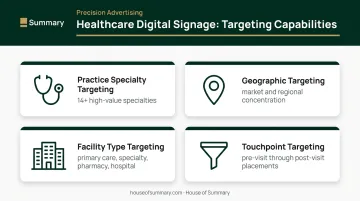
Compare this to healthcare TV or medical journal advertising, which reaches broad, largely undifferentiated audiences and offers minimal targeting beyond demographic estimates. That precision is what makes the channel attractive to a specific set of advertisers.
Key Advertiser Segments
- Pharma and life sciences brands target condition-specific patients through specialty-matched placements
- OTC and consumer health brands reach health-conscious adults across primary care settings
- Health insurers time campaigns around open enrollment windows when coverage decisions are top of mind
- Medical device and wellness brands connect with preventive care seekers at the point of care
Measurement and Attribution
Networks report campaign performance through several metrics: impressions, dwell time, QR engagement rates, and script lift studies. Some benchmarks from the research:
- PatientPoint reports 94% of patients recall what they see on waiting room screens (vendor-sourced, 2023)
- A specialty rheumatology case study cited by POCMA attributed 35% of new patient starts to POC advertising with only 14% of total media spend
These figures are vendor-sourced and should be treated as rough reference points, not guaranteed outcomes.
Building a Healthcare Digital Signage Advertising Strategy
Step-by-Step Entry Framework
- Define the target patient population — identify the condition, demographic, or care-seeking behavior you're trying to reach, then map it to relevant facility types and practice specialties
- Identify and vet network vendors — evaluate networks by their verified reach, POCMA certification status, compliance review processes, and available targeting capabilities
- Assess content approval timelines — build 4–6 weeks of pre-launch buffer for creative review and compliance approval, particularly for pharmaceutical brands
- Plan campaign structure — decide which placements (waiting room, exam room, pharmacy) align with your campaign objectives and budget
Multichannel Integration: Before and After the Clinical Visit
In-facility screens capture the moment of care, but health-conscious consumers also research and engage with health content well beyond the clinic walls.
Newsletter advertising reaches the same high-intent audience before appointments are scheduled and after they're completed. House of Summary's network of specialized newsletters — Presidential Summary, Geopolitical Summary, Dubai Summary, and London Summary — reaches 500,000+ subscribers with 254,866+ emails opened daily, with 66% of readers based in the U.S. (concentrated in New York and Los Angeles).
The audience profile maps closely to healthcare's target segments: decision-makers, executives, and high-income consumers who are health-conscious and have the purchasing power for premium healthcare and wellness products. Newsletter placements also sidestep the ad-blocking problem that affects web and social channels — email ads aren't blocked, and subscribers have actively opted in to receive content, so readers are paying attention, not scrolling past.
For healthcare brands, this creates a natural complement to in-facility signage: newsletter placements build awareness and intent among the same audience before they walk into a clinical setting, and reinforce messaging after they leave.
Seasonal Campaign Planning
Healthcare advertising demand follows predictable cycles. Plan budgets around these windows:
- Flu season (October–February) — vaccines, OTC cold and flu products, immune support
- Open enrollment (November–December) — health insurance and supplemental coverage
- Condition awareness months — Heart Month (February), Mental Health Awareness Month (May), Diabetes Awareness Month (November) each create natural campaign pegs
- New Year/Q1 — wellness, weight management, preventive health categories spike with resolution behavior
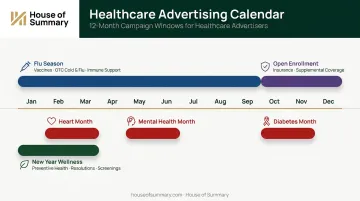
Booking early matters. As point-of-care advertising has grown, premium inventory in high-traffic specialty practices fills faster. PatientPoint held its first upfront event focused on point-of-care in 2024 — a signal that advance planning cycles are becoming standard for this channel.
Frequently Asked Questions
How much does it cost to advertise on healthcare digital signage networks?
Pricing is not publicly disclosed at standardized rate cards. Costs vary by network, facility type, practice specialty, geography, and campaign scope — with touchpoint selection (exam room vs. waiting room), specialty concentration, and measurement methodology all influencing the final number. Contact networks directly for current media kits.
Who are the most common advertisers on healthcare digital signage?
Pharmaceutical and life sciences brands are the largest advertiser category. Consumer health and OTC product companies, health insurance providers, medical device manufacturers, and wellness brands make up the rest of the advertiser mix.
How does healthcare digital signage compare to traditional healthcare advertising?
Unlike TV or print journal advertising — which reaches broader audiences competing with many other stimuli — healthcare digital signage puts your message in front of a captive, condition-specific audience. Content can't be skipped or blocked. The result is measurably higher dwell time and stronger contextual relevance.
Can healthcare digital signage ads be targeted to specific patient populations?
Yes — targeting by practice specialty, geography, and facility type allows brands to reach condition-specific audiences effectively. Individual patient health data cannot be used for targeting under HIPAA privacy rules, so targeting works at the facility and specialty level rather than the individual patient level.
What creative formats perform best in clinical settings?
Short-form educational video, branded infographics, and QR-enabled interactive prompts consistently outperform hard-sell formats. Patients in clinical settings expect health information they can trust. Creative that leads with education and positions the brand as a resource will outperform purely promotional messaging.
Are there regulations governing what can be advertised on healthcare digital signage?
Pharmaceutical advertising must comply with FDA OPDP guidelines and the fair balance requirements of 21 CFR 202.1. Individual facilities also have their own content approval standards. Brands should work with networks that have established compliance review processes to navigate both layers of oversight.