

This article examines the psychology behind how HNWIs form brand memories differently from general consumers, which content formats create the strongest recall, and why the editorial environment surrounding a brand message matters as much as the message itself.
TLDR
- HNWIs filter out promotional content aggressively, making trust and context the primary recall drivers rather than frequency
- Content that triggers elaborative encoding—analytical insights, thought leadership, curated briefings—builds stronger memory traces than passive ad exposure
- Newsletter placements in opted-in editorial environments generate recall advantages because readers are in active attention states
- Standard digital metrics poorly measure recall with affluent audiences; brand lift studies and unaided awareness surveys provide better insight
- The broadcast mindset—high frequency, promotional tone—actively erodes credibility with HNWIs rather than building it
The High Net Worth Audience Is Not Just a Wealthier Consumer
The High Net Worth Audience Is Not Just a Wealthier Consumer
High net worth individuals differ fundamentally from mass-market consumers in how they consume information and form brand memories. These differences go far beyond income level.
Defining characteristics include:
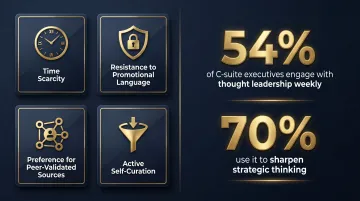
- Severe time constraints paired with high information intake requirements
- Deep resistance to promotional language, built through constant marketing exposure
- Preference for peer-validated or editorially endorsed sources over brand-direct messaging
- Active self-curation of information environments to separate signal from noise
Research shows that 54% of C-suite executives spend at least one hour per week engaging with thought-leadership content. Over 70% consume it specifically to stay current on industry trends and sharpen strategic thinking. This deliberate consumption pattern stands in stark contrast to general audiences' passive media exposure.
The implications for brand recall are profound. Unlike mass-market audiences where frequency drives familiarity, HNWIs actively penalize overexposure without substance. Recall with this segment is earned through quality, not quantity of impressions.
How HNWIs Self-Curate Their Information Environment
This audience subscribes to specialized publications, reads in-depth briefings, and systematically filters out interruptive formats. Upper-income Americans are significantly more likely to get news from email newsletters—38% compared to 27% of lower-income adults. The channels they trust become the channels where brand memories form.
What they avoid is equally instructive. Affluent consumers are 32% more likely than the general population to use ad blockers, and 70% pay for premium, ad-free versions of products and services. Stronger device privacy settings make them harder to track — and even harder to reach through conventional ad formats.
Reaching HNWIs means showing up in environments they choose — not ones they endure. That distinction determines whether a brand registers at all.
How Content Marketing Triggers Memory Formation in This Segment
Brand recall depends on memory encoding—the process by which the brain converts experiences into retrievable memories. Neuroscience research consistently shows that memory encodes more effectively when information is associated with emotion, relevance, and context.
For high net worth audiences, relevance is defined by professional applicability and intellectual depth, not entertainment or novelty. This distinction changes which content formats succeed.
Elaborative Encoding: The Recall Advantage
Editorial content—analysis, insight, curated briefings—activates what psychologists call "elaborative encoding." The reader actively processes information and connects it to existing knowledge, forming stronger memory traces than passive ad exposure creates.
When an HNWI reads a market analysis that helps them understand regulatory changes affecting their portfolio, their brain creates multiple neural pathways connecting that information to existing knowledge structures. A brand associated with that analysis inherits those same neural connections.
Research demonstrates that 74% of consumers are more likely to remember an ad if the message relates to the content surrounding it. This "congruence effect" is even more pronounced with audiences who consume content deliberately rather than passively — which describes most HNWI readers by default.
That advantage compounds across content types. Elaborative encoding is strongest when content delivers:
- Actionable analysis tied to real decisions (portfolio shifts, regulatory changes, market moves)
- Depth that rewards close reading rather than skimming
- A consistent editorial voice the reader learns to trust over time
The Trust Halo Effect
Trust plays a unique role in recall formation for HNWIs. When content is delivered through a source the reader already trusts, the brand associated with that content inherits credibility through association.
This differs sharply from banner advertising, where placement in untrusted or low-attention environments actively degrades brand perception. Consumers looked at native ads 53% more frequently than display ads, and those native ads registered 18% higher lift in purchase intent.
The distinction between aided recall (recognizing a brand when prompted) and unaided recall (naming a brand spontaneously) matters especially here. Content marketing builds unaided recall—the more commercially valuable form—because it creates associations between the brand and specific domains of expertise or authority.
When a wealth manager remembers a brand three months later while discussing portfolio diversification with a client, that's unaided recall. It's the direct result of appearing in a trusted context at the moment a reader was actively forming opinions — not the product of repeated logo exposure.
Content Formats That Create the Strongest Recall with HNWIs
Not all content generates equal recall. Certain formats consistently outperform others with high net worth audiences because they align with how this segment processes and retains information.
Analytical and Insight-Driven Content
HNWIs respond most strongly to content demonstrating expertise through rigorous thinking—market analysis, geopolitical context, sector briefings, data-driven commentary. This format signals that a brand understands their world.
Research shows that 95% of business decision-makers say strong thought leadership makes them more receptive to sales and marketing outreach. More telling, 79% are more likely to champion a proposal in the RFP process if the organization consistently produces high-quality thought leadership.

The content itself becomes a proxy for capability. When a fintech company publishes rigorous analysis of regulatory changes, executives remember that brand when compliance issues arise—even if they never clicked the article.
Serialized Editorial Content
Recurring content formats—weekly briefings, themed series, regular columns—build recall through structured repetition. For HNWIs who consume content habitually, recognizable formats create cognitive anchors linking the brand to specific domains of authority.
A geopolitical newsletter that arrives every Wednesday morning, analyzing international developments affecting markets, becomes associated with pre-meeting preparation. The brand sponsoring that newsletter inherits that mental slot.
Curated Newsletter Content
HNWIs are disproportionate consumers of high-quality newsletters precisely because the format respects their time—delivering distilled, verified information with no algorithmic clutter.
Among newsletter readers, 70% read briefings or summaries at least sometimes, and 60% read deep dives into specific issues. Brands appearing within this format benefit from the reader's active, deliberate attention state, which is conducive to memory formation.
Networks like House of Summary, which deliver specialized editorial content directly to inboxes across finance, geopolitics, and executive affairs, offer advertisers placement within the exact reading environment their target audience has self-selected. That self-selection matters: readers arrive already primed to absorb and retain information, making brand placement more effective than formats that interrupt rather than integrate.
Thought Leadership and Expert Commentary
Content attributed to recognized expertise—whether published by the brand or placed alongside credible expert voices—creates associations between the brand and intellectual authority. For HNWIs making high-stakes decisions, aligning with credible thinking builds recall at the point of need.
The data bears this out:
- 71% of business buyers say thought leadership is more effective than conventional marketing at demonstrating a vendor's potential value
- 53% agree that if thought leadership is high quality, brand recognition matters less—meaning strong content can compensate for limited brand awareness
Why the Editorial Environment Shapes Recall as Much as the Content Itself
Context congruence—the alignment between an advertisement and its surrounding content—consistently drives stronger brand recall than creative execution alone. The reader's cognitive state while consuming surrounding content carries over to the advertising message.
When ad messaging aligns with surrounding content sentiment, brand favorability increases by 107%. This effect extends beyond sentiment to topic, format, and editorial tone.
Inbox vs. Social: Attentional Context Matters
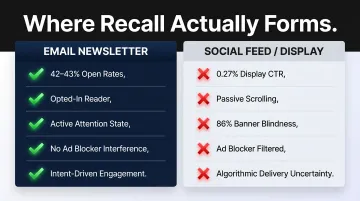
The editorial inbox environment differs fundamentally from social media and programmatic display. Social feeds are associated with distraction and low trust—users scroll passively, filtering aggressively. The inbox, particularly for newsletters a reader has opted into, is associated with intent, focus, and credibility.
The data supports this distinction clearly. Average email newsletter open rates run 42-43% across industries, with click-to-open rates around 6.81%. Compare this to average display ad click-through rates of 0.27% and the reality that 86% of consumers experience banner blindness.
88% of email users check their inboxes multiple times daily (39% check 3-5 times per day). Each check is an active decision to engage — creating an attentional state fundamentally different from passive scrolling.
Brands appearing in this environment inherit its structural advantages:
- No ad blockers filtering the message before it lands
- No competing visual clutter fragmenting attention
- No algorithms deciding whether delivery occurs
- A reader who opened the newsletter deliberately, already primed for information encoding
House of Summary operates entirely within this environment — delivering brand messages inside newsletters that subscribers requested, with no intermediary platform between the advertiser and the reader's focused attention.
Measuring Content-Driven Brand Recall Among Affluent Audiences
Standard digital marketing metrics—click-through rates, impressions, reach—are poor proxies for recall, especially with HNWI audiences who don't make impulsive decisions. An executive who reads analysis that shifts their thinking may never click an ad, yet remember the brand six months later during a purchasing decision.
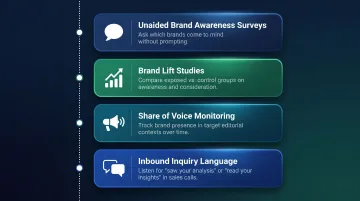
Better measurement approaches include:
- Run unaided brand awareness surveys asking target audience members which brands come to mind in specific categories, without prompting — track changes across campaign periods
- Commission post-campaign brand lift studies comparing exposed and control groups on awareness, favorability, and consideration
- Monitor share of voice to see whether your brand appears more frequently in target publications and editorial contexts over time
- Track inbound inquiry language — if prospects mention "seen your analysis" or "read your insights" during sales calls, recall has translated into action
The measurement mindset must shift from immediate response to cumulative awareness. Research on advertisement recall confirms that successful memory encoding creates durable recall. When a participant correctly recalled an ad once, the probability of correct recall on retest was 75.4% — recall doesn't fade quickly when the initial encoding is strong.
Content marketing compounds rather than spikes. A display campaign generates impressions that decay rapidly once spending stops. Editorial placements create associations that strengthen through repeated exposure in trusted contexts, building recall that persists long after the campaign concludes.
Common Mistakes Brands Make When Marketing to High Net Worth Audiences
The Broadcast Mindset Error
Brands that treat HNWIs like scaled-up mass market audiences—using high frequency, promotional tone, and visual-heavy creative—typically generate low recall and active brand skepticism.
Research shows that more than 60% of consumers report seeing the same ad multiple times within a single session, and that repeated exposure beyond 2-7 impressions triggers "negative reach"—the point where repetition actively damages brand perception. For HNWIs who encounter even higher advertising volumes, this threshold is lower.
This audience pays for ad-free experiences. Those sophisticated enough to install blockers already have. Attempting to reach them through volume creates impressions without encoding—presence without recall.
Channel Mismatch Problem
Many brands invest heavily in social media reach or programmatic display targeting HNWIs, not recognizing that this segment actively avoids those environments or has developed strong attention filters against them.
The result is spend that generates metrics without memory. Thousands of impressions reach the right demographic profile — not one reaching an attention state where recall actually forms.
Frequency-chasing in the wrong channel is a compounding error. The solution is not more impressions; it is better placement. Effective HNWI marketing requires presence in self-selected environments:
- Publications they subscribe to and read by choice
- Newsletters they open out of habit and trust
- Editorial contexts that signal relevance and credibility
- Inbox placements that bypass algorithms and ad blockers entirely
These environments cost more per impression. They also generate far higher recall per exposure — which is the only metric that ultimately matters for this audience.
Frequently Asked Questions
What types of content are most effective for building brand recall with high net worth individuals?
Analytical, insight-driven content and curated editorial formats consistently outperform promotional content with HNWIs. This audience builds brand associations through intellectual engagement rather than repetitive exposure, making thought leadership and expert commentary the most effective formats.
How is brand recall among wealthy audiences different from recall among general consumers?
For general consumers, recall is often built through frequency and sensory impact. For HNWIs, trust, contextual relevance, and editorial quality are the primary recall drivers—meaning the source and format of content matter as much as the content itself.
Why is newsletter advertising particularly effective for reaching high net worth audiences?
HNWIs self-select newsletter subscriptions as a preferred information format, making the inbox one of the few channels where this audience is in an active, attentive reading state. Research consistently ties that active reading state to stronger recall compared to passive media consumption environments.
How many content touchpoints does it take for a brand to achieve recall among HNWIs?
There is no universal frequency threshold for this audience. Because HNWIs consume content deliberately, even a small number of high-quality exposures in trusted publications can achieve recall that hundreds of display impressions cannot—quality matters far more than volume.
What mistakes do brands most commonly make when targeting high net worth audiences with content?
Two errors stand out: using promotional language that signals mass-market intent, and investing in channels like social feeds or programmatic display that HNWIs actively filter out. Both result in spend that generates impressions without memory formation.
How can brands measure whether their content marketing is building recall among affluent audiences?
Look beyond click-through rates to unaided brand awareness surveys, post-campaign brand lift studies, and inbound inquiry language. Content-driven recall compounds over time rather than appearing immediately in campaign dashboards, so measurement must capture cumulative awareness—not just immediate response.