
This is exactly how sponsored content is designed to work. The line between editorial and advertising has never been harder to spot, and publishers have dozens of ways to blur it. This guide breaks down what sponsored content actually is, the clearest signals to look for across formats, and what to do once you find it.
Key Takeaways
- Sponsored content is advertising designed to look like editorial coverage, with or without a disclosure label
- Look for brand-name bylines, one-sided praise with no counterpoints, and links back to the sponsor's own site
- Labels like "Promoted," "Paid Post," "Presented by," or "Sponsored" are the most direct signals — but many publications skip them entirely
- The format matters: articles, social posts, newsletters, videos, and podcasts each hide sponsorship differently
- Cross-reference any claims with independent sources before sharing or acting on them
What Sponsored Content Is and Why Readers Fall for It
Sponsored content goes by many names: native advertising, paid content, branded content, advertorial. The core definition is consistent: a company pays a publisher to produce and distribute content that mirrors the publication's own editorial style. It looks like an article and often appears in the same layout as one.
The IAB defines native advertising as paid ads that are "cohesive with page content and design so they feel like they belong." That cohesion is intentional — and it's what makes the format so difficult to detect.
What makes it effective at deceiving readers is that it borrows the visual authority of the publication hosting it. When you trust a news outlet, that trust extends — automatically and unconsciously — to everything that resembles their editorial work. Sponsored content exploits that transfer of credibility.
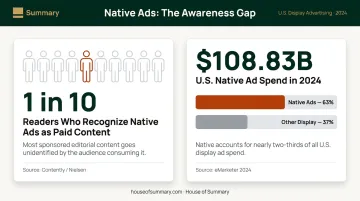
The scale of this format is substantial. U.S. native display ad spend was forecast at $108.83 billion in 2024, representing over 63% of total U.S. display ad spend. This isn't a niche tactic — it's the dominant format in digital advertising.
The recognition problem is severe. A peer-reviewed study of 800 U.S. adults found fewer than 1 in 10 participants recognized native advertising as paid commercial content. Labels alone aren't solving this. Neither is reader awareness.
The FTC requires clear, prominent disclosures for exactly this reason — and enforcement actions against Lord & Taylor and Warner Bros. show how often those requirements go unmet. Knowing what to look for is the reader's most reliable defense.
Warning Signs That Reveal Sponsored Content
Sponsored content doesn't always announce itself. Run any suspiciously promotional piece through these signals before trusting or sharing it.
Disclosure Labels (or Their Absence)
The most direct indicator is a label. Look above or below the headline, in the URL, or near the byline for:
- "Ad" or "Advertisement"
- "Paid Post" or "Paid Advertisement"
- "Sponsored" or "Sponsored Advertising Content"
- "Promoted" or "Featured Partner"
- "Presented by" or "Brought to you by"
The FTC requires disclosures to be "clear and conspicuous" — meaning buried fine print or ambiguous hashtags like "#partner" don't meet the standard. Plain terms like "Ad" or "Sponsored" are what regulators actually recommend.
Real-world examples show how publishers handle this differently. Wired uses a /sponsored/story/ URL path with "Branded Content By" labeling. The New York Times uses a /paidpost/ URL and labels content as "PAID POST by [Brand]." Forbes uses "BRANDVOICE" and "Paid Program" labels.
Absence of a label does not mean absence of a financial relationship. A secondary analysis of over 130 native ad placements found roughly a third failed to comply with FTC disclosure guidance at all.
Author and Byline Red Flags
In legitimate editorial content, a named journalist appears on the byline. In sponsored content, the "author" is frequently:
- A brand name or company's marketing department
- An unnamed "Staff" contributor
- A Forbes BrandVoice or council member (professionals who pay to publish pieces on Forbes.com)
If the byline doesn't belong to someone with an identifiable journalism background at that publication, investigate further.
Content Quality and Tone Signals
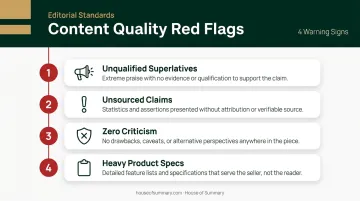
Four specific patterns reveal promotional intent:
- Unqualified superlatives in the headline — "The Best Solution for X" rather than neutral news framing
- Absolute claims with no sourced evidence — assertions that rely entirely on the brand's own materials
- Zero criticism or counterpoint — real journalism acknowledges complexity; sponsored content never will
- Heavy product specifications — technical details that could only originate from the brand's own documentation
Strategic Links and Calls to Action
Legitimate articles cite third-party sources. Sponsored content links strategically to the paying company's website, product pages, or promotions — often closing with a "learn more," "shop now," or "visit [brand]" prompt.
When every outbound link in an article points to one company, that's a paid campaign — not editorial judgment.
How Sponsored Content Hides Across Different Formats
The signals above apply broadly, but the disguise differs by format. Here's where to look in each.
In Online Articles and News Sites
News sites host native advertising within their standard article layout. URL structure sometimes reveals it — Wired's /sponsored/story/ path, the NYT's /paidpost/ — but often the article is visually identical to editorial content.
A more subtle variant: press releases republished without modification. These enter the news cycle looking like independently reported stories, even though the content originated entirely from the brand.
On Social Media Platforms
On social media, sponsored content appears as influencer posts, brand partnership announcements, and promoted posts. The FTC requires disclosures like "#ad" or "Paid partnership with [Brand]" at the beginning of posts — not buried in a stack of hashtags at the end.
The compliance picture is grim. A 2024 European Commission sweep of 576 influencers found 97% posted commercial content, but only 20% systematically disclosed it as advertising. Platform-native disclosure tools exist on Instagram, TikTok, and YouTube — but the FTC is explicit that these tools don't replace the creator's legal obligation to make a clear, hard-to-miss disclosure.
In Email Newsletters
Newsletters present a unique challenge. Reputable publishers separate editorial content from paid placements with clear labels — "Sponsored" or "Advertisement" above the relevant section. But some integrate brand messaging so seamlessly into their editorial voice that readers can't distinguish paid from organic.
In newsletters specifically, check:
- Whether the recommended product is consistently from the same brand across multiple issues
- Whether there's a disclosure at the top or bottom of the sponsored section
- Whether the writing style shifts when the brand is mentioned
Publishers like House of Summary label sponsored placements clearly, keeping paid content visually and editorially distinct from their newsletter content.
In Video and Podcast Content
FTC guidelines require video disclosures to appear in the video itself, not only in the description. A text overlay buried in a corner, or a disclosure that flashes for two seconds, doesn't meet the standard. Live streams should repeat disclosures periodically.
In podcasts, a "brought to you by" segment at the start is standard practice. Harder to catch: mid-roll integrations delivered in the host's own voice, using the same tone and cadence as their genuine opinions. The ASA confirms podcasters must disclose paid partnerships — so if a host recommends a product mid-episode with no mention of sponsorship, that silence is itself a red flag worth noting.
Common Mistakes Readers Make
Three errors account for most cases where readers are successfully misled:
Lending credibility by association. Sponsored content carries an explicit disclaimer that the editorial team had no involvement. The outlet's reputation doesn't cover paid pieces, yet most readers never notice those disclaimers.
Accepting selectively accurate statistics. Sponsored content often cites real data — the issue is curation. Figures are chosen to support the brand's message. Cross-referencing with independent sources is the only reliable check.
Misreading vague disclosure language. Phrases like "Presented by," "In partnership with," and "Brought to you by" read as editorial collaboration to most people. Each is a financial disclosure. Treat them that way.
Research by Wojdynski and Evans found that labels using "advertising" or "sponsored" significantly outperformed vague alternatives in reader recognition. Publishers who choose softer language know exactly what they're doing.
What to Do When You Spot Sponsored Content
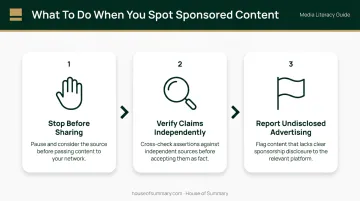
When you encounter sponsored content, three steps keep you from becoming an unwilling part of someone else's marketing funnel:
Stop before sharing. Sponsored content is engineered to spread. Sharing it amplifies a brand's marketing reach at no cost to the advertiser — you become an unpaid distribution channel.
Verify specific claims. Use independent, editorially governed sources to check whether the data holds up outside the branded context.
Report undisclosed advertising. If content appears deceptive and lacks required disclosure, report it to:
International readers can check their local advertising standards authority for equivalent reporting channels.
To reduce long-term exposure to disguised advertising, prioritize publications that publish clear editorial guidelines and label all paid content upfront — not buried in footnotes. A visible, findable disclosure policy is one of the simplest signals of a trustworthy source.
Frequently Asked Questions
How do you spot sponsored content?
Check for disclosure labels near the headline or byline, look at whether the author is a brand rather than a named journalist, and watch for content that is exclusively positive with all links pointing back to a single company's website. The combination of missing labels plus no critical perspective is usually enough to confirm it.
What's the difference between sponsored content and native advertising?
Native advertising refers broadly to paid content designed to match a platform's look and feel; sponsored content specifically describes articles or posts a brand pays a publisher to produce. Both require FTC disclosure — the format doesn't change the obligation.
Is all sponsored content legally required to be labeled?
In the US, the FTC requires any material connection between a brand and an endorser to be clearly disclosed. Enforcement is uneven, though — a significant portion of sponsored content goes unlabeled or uses language that falls short of the "clear and conspicuous" standard.
Can sponsored content still be accurate or informative?
Some sponsored content contains accurate information. But because it's produced to serve the brand's interests rather than the reader's, even accurate content may omit context, downplay limitations, or selectively present data. Always verify claims against independent sources.
How do I identify sponsored content in email newsletters?
Look for labels like "Sponsored," "Advertisement," or "Paid Placement" above a section. Reputable publishers visually or textually separate paid content from editorial — if that separation is absent or the same brand recurs without critical context, treat the content with skepticism.
What should I do if I find undisclosed sponsored content?
Don't share it. Report it to the FTC at ReportFraud.ftc.gov or to the relevant advertising watchdog in your country. If a publication has a pattern of undisclosed advertising, that's worth factoring into whether you continue reading it.