The FTC's disclosure rules apply to all of it.
What trips most people up isn't defiance — it's misunderstanding. Teams assume their platform's built-in disclosure tool is enough. Creators think "gifted" makes the relationship obvious. Publishers bury a disclosure in a footer and consider the job done. None of those pass the FTC's standard.
This article covers what counts as sponsored content under FTC rules, how to disclose correctly across different formats, the variables that affect your obligations, and the mistakes most likely to create liability.
Key Takeaways
- Disclosure is required any time there's a material connection between an endorser and a brand — including free products, affiliate commissions, or discounts
- Both brands and publishers (and creators) share responsibility for inadequate disclosure
- Disclosures must be clear, conspicuous, and visible — not buried in hashtags, captions, or video descriptions
- Platform, format, and audience context all shape what compliant disclosure looks like
- The FTC revised its Endorsement Guides in 2023 — programs not updated since are likely out of compliance
What Counts as Sponsored Content Under FTC Rules
The Core Definition
Under 16 CFR Part 255, an endorsement is any advertising, marketing, or promotional message that consumers are likely to believe reflects someone's independent opinions — when it was actually produced on behalf of a sponsoring advertiser. The 2023 revised Endorsement Guides cover newsletter features, native advertising, blog articles, video reviews, podcast mentions, social media posts, and even depictions of a person's name, likeness, or identifying characteristics.
What Triggers the Disclosure Requirement
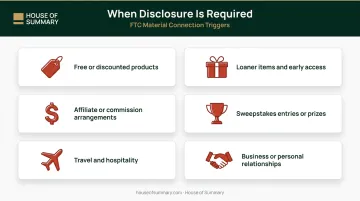
Knowing what counts as an endorsement is only part of the equation. A material connection must be disclosed when it "might materially affect the weight or credibility" of the endorsement and isn't something the audience would reasonably expect. The FTC does not limit this to cash payments. Disclosure is required for:
- Free or discounted products
- Loaner items and early product access
- Affiliate or commission arrangements
- Sweepstakes entries or prize eligibility
- Travel, hospitality, and accommodations
- Business, family, or personal relationships with the brand
The Significant Minority Standard
The standard asks whether a significant minority of the audience would evaluate the endorsement differently if they knew about the connection — not whether that connection actually influenced the content. Even genuinely positive, unbiased coverage still requires disclosure when a material connection exists.
How to Disclose Sponsored Content: A Step-by-Step Approach
Step 1: Identify Whether Disclosure Is Required
Ask one question: is there any material connection between the endorser and the brand?
- If yes — payment, free goods, affiliate relationship, employer tie, or personal relationship — disclosure is required regardless of whether the content is biased
- If no — the person bought the product themselves with no brand relationship — disclosure is generally not required
- If unclear — the FTC recommends erring on the side of disclosure
Step 2: Choose the Right Disclosure Language
Use simple, unambiguous language that an ordinary consumer will understand.
Acceptable terms:
- "Ad," "Advertisement," "Paid advertisement"
- "Sponsored," "Promotion"
- "#ad" (when used at the start of a post, not buried in hashtags)
- "I earn a commission on purchases made through links in this post"
Terms that don't meet the standard:
- "#sp," "#spon," "#collab," "#partner," "#gifted"
- "Thanks to [Brand]" without explicit disclosure of a commercial relationship
- "Ambassador" used alone without context
The FTC doesn't require one exact phrase. The disclosure just needs to clearly communicate the commercial relationship.
Step 3: Place the Disclosure Where It Will Be Seen
Disclosure language is useless if no one reads it. The FTC's standard — defined in 16 CFR 255.0(f) — is that a disclosure must be "difficult to miss and easily understandable by ordinary consumers."
Placements that fail this standard:
- Hidden below a "more" link in an Instagram or Facebook caption
- Buried at the end of a list of hashtags
- Placed only in a profile bio or "About Me" page
- Tucked into a video description when the endorsement is in the video itself
- Appearing only in comments on a post
For newsletter sponsorships, the disclosure must appear within the content itself — clearly labeled at or before the sponsored section. A general footer disclaimer doesn't satisfy the standard.
For live content and long-form podcasts, the disclosure must repeat periodically. Audiences who tune in late cannot be assumed to have heard an earlier disclosure.
Step 4: Match the Disclosure Format to the Content Format
| Content Format | What's Required |
|---|---|
| Written posts and articles | Disclosure before the reader reaches the endorsement — not at the bottom |
| Video content | Both visual and audible disclosure; a text overlay alone is insufficient if the endorsement is also spoken |
| Podcasts and audio | Audible disclosure; repeat in long-form content |
| Instagram captions | Disclosure must appear before the "more" truncation |
| Twitter/X posts | "#ad" or "Ad:" at the start works; character limits don't exempt posts from disclosure |
| TikTok and YouTube | In-video disclosure required — description text alone is insufficient |
| Email and newsletter content | Disclosure within the content block, at or before the sponsored section |
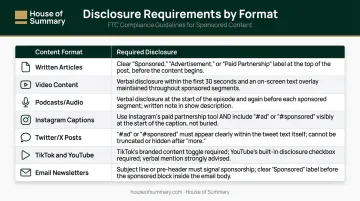
The same-medium rule applies: if the claim is visual, the disclosure must be visual. If audible, the disclosure must be audible. If both, both are required.
Step 5: Confirm Brand-Side Monitoring and Documentation
Brands cannot outsource compliance and walk away. Under 16 CFR 255.1, advertisers are directly liable for misleading endorsements and for failing to ensure material connections are disclosed. An adequate monitoring program includes:
- Provide written guidance to all influencers, publishers, and agency partners before campaigns launch
- Actively search for and review content your partners are publishing on an ongoing basis
- If a partner posts without adequate disclosure, require immediate correction and document your response
- Monitor for the full duration of any brand partnership, not just the launch phase
The FTC's enforcement actions against Teami (2020) and Lord & Taylor (2016) both involved brands that failed to adequately monitor their influencer and publisher partners. In the Teami case, influencer posts included disclosures that appeared only after users clicked "more" — a placement the FTC found insufficient.
Key Variables That Affect How You Must Disclose
The same disclosure that works on Twitter can fail on YouTube. Context, platform, and relationship type all shift what compliance actually requires.
Platform and Format
Each platform has different consumption patterns, and disclosure must account for how the audience actually experiences the content:
- Instagram captions must disclose before truncation — not after the "more" click
- TikTok and YouTube require in-video disclosures, not just description text
- Twitter/X allows shorter labels like "#ad" at the start, given character constraints
- Podcasts and audio require audible disclosure that repeats in long-form content
- Email newsletters require disclosure within the content block, not in metadata or footers
If the disclosure format doesn't match how the audience consumes the content, it will likely fail the "clear and conspicuous" standard even if the language is technically correct.
Ongoing Relationships
A creator who disclosed at the start of a year-long brand deal must still disclose in every individual piece of content. New viewers seeing a single post have no way of knowing about earlier disclosures.
Disclosure obligations are tied to each individual endorsement — not to when a campaign began. The FTC creates no time-based exemptions for active partnerships.
Audience Awareness
Brands and creators who assume their audience "already knows" about commercial relationships get no legal protection from that assumption. The FTC's standard is whether a significant minority of the audience — not a majority, not even half — would be unaware of the material connection.
Common Mistakes That Lead to FTC Violations
The FTC has flagged these patterns repeatedly in guidance documents and enforcement actions:
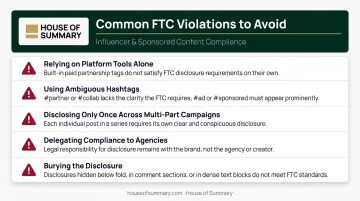
- Relying on platform disclosure tools alone — Instagram's "Paid Partnership" tag and YouTube's "Includes Paid Promotion" banner are helpful but not sufficient on their own; explicit disclosure within the content is still required
- Using ambiguous hashtags — "#spon," "#collab," "#partner," "#gifted," and standalone "ambassador" language don't clearly communicate a commercial relationship to ordinary consumers
- Disclosing only once across a multi-part campaign — every individual post, story, video, or episode in a series needs its own disclosure, regardless of what appeared before it
- Delegating compliance entirely to agencies or influencers — brands remain liable for what their partners publish; outsourcing creates shared accountability, not transferred liability
- Burying the disclosure — after the endorsement, at the bottom of a long page, after the "more" click, or mixed into a hashtag list all fail the clear and conspicuous standard
Gray Areas and Edge Cases in FTC Compliance
Small or Non-Monetary Benefits
The FTC sets no minimum dollar threshold for what requires disclosure. A free restaurant meal, a sweepstakes entry, early access to a product, or even the possibility of future payment can all trigger the disclosure requirement if the benefit could affect how the audience evaluates the endorsement.
The practical rule: if you received anything of value because of a brand relationship, disclose it. That includes perks most creators wouldn't think to report.
Jurisdiction adds another layer of ambiguity — especially for creators operating across borders.
Posting Abroad About U.S. Products
U.S. FTC rules apply when it is reasonably foreseeable that content will reach and influence U.S. consumers. A UK-based creator reviewing a U.S.-sold product for a mixed international YouTube audience may need to comply with both FTC rules and UK ASA guidelines simultaneously.
Major markets have parallel obligations:
- UK — ASA/CAP requires social media marketing to be "obviously identifiable" as advertising
- EU — The European Commission's Influencer Legal Hub requires clear disclosure not hidden behind "read more" links
- Australia — ACCC requires that paid posts and commercial relationships be clearly labeled
Each market you reach adds its own compliance layer. The more international your audience, the more frameworks you're accountable to.
Frequently Asked Questions
How do you disclose sponsored content?
Use plain language like "Ad," "Sponsored," or "Paid partnership with [Brand]" and place it where audiences will see it before or alongside the endorsement. The disclosure must be clear, conspicuous, and close to the sponsored content — not buried at the bottom of a post or hidden in a hashtag list.
What are the legal requirements for sponsored content?
The FTC Endorsement Guides (last updated 2023) require any material connection between an endorser and a brand to be clearly disclosed. Non-compliance can lead to enforcement actions, consent orders, and civil penalties depending on the nature of the violation.
What are the FTC Endorsement Guides?
The FTC's Endorsement Guides are principles governing how endorsements and sponsored content must be handled. They require honest opinions from endorsers, clear disclosure of material connections, and advertiser accountability for their partners' compliance.
Does FTC disclosure apply to newsletter sponsorships?
Yes. Sponsored content in email newsletters must be clearly labeled within the content itself — a general footer disclaimer or metadata tag is not sufficient. The disclosure should appear at or before the sponsored section, visible without any additional action from the reader.
Who is responsible for FTC disclosure — the brand or the publisher?
Both can be held responsible. The FTC expects brands to train and monitor their partners, and expects publishers and creators to make adequate disclosures independently. Delegating the responsibility to one party does not eliminate the other's liability.
What happens if you don't disclose sponsored content?
Non-compliance can result in FTC enforcement action including warning letters, consent orders, and civil penalties. Brands that received a Notice of Penalty Offenses face up to $53,767 per violation for subsequent non-compliance. Reports can be filed anonymously at ReportFraud.ftc.gov.