
Introduction
Most newsletter creators fixate on subscriber counts—celebrating every milestone, watching daily growth numbers, and measuring success by list size alone. Yet they overlook a more consequential question: who exactly are they writing for?
Publishing without a defined target audience is like broadcasting on a frequency nobody has tuned to. You may transmit consistently, but if the signal doesn't reach the right receivers, the effort is wasted.
The consequences of audience misalignment show up fast: open rates drop, unsubscribes climb, sponsorship value weakens, and the content starts feeling like it's written for no one in particular.
This guide covers what a newsletter target audience actually is, how to define yours with precision, and what determines whether your audience fit will hold over time.
Key Takeaways
- A newsletter audience is the specific group your publication is built to serve — shaped by demographics, professional role, and content needs
- Clear audience definition improves open rates, reduces churn, and strengthens content-market fit
- Niche audiences command higher advertiser value—premium newsletters average $23.01 CPMs versus $6.53 for general interest lists
- Validate your audience definition with real subscriber data — not intuition alone
What Is a Newsletter Target Audience?
A newsletter target audience is the specific, intentionally chosen group of people a publication is designed to serve on a recurring basis. It's defined not just by who subscribed, but by who the content is strategically built for.
An email list is simply a collection of addresses. A target audience is an editorial commitment — and that difference shapes every decision, from subject lines and content depth to send frequency and monetization approach.
Without a defined audience, you optimize for vanity metrics. With one, you optimize for engagement, retention, and commercial value. Newsletters that command premium advertising rates are built around readers they know precisely and serve consistently.
Types of Newsletter Target Audiences
Newsletter audiences generally fall into four categories:
- Demographic — Age, location, income level, or life stage shape what content feels relevant
- Professional/industry-based — Job function, sector, or seniority (executives, marketers, developers) drives topic selection and tone
- Interest or psychographic — Shared passions, worldview, or values unite readers around a common lens (sustainability advocates, indie game enthusiasts)
- Behavioral — How and why readers consume content determines format and cadence (daily news scanners vs. weekend deep readers)
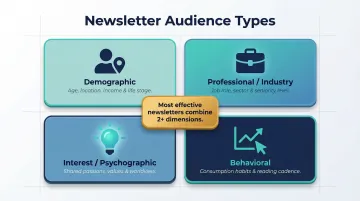
Most effective newsletters combine two or more of these dimensions. A newsletter for "tech enthusiasts" is broad and unfocused. A newsletter for "B2B SaaS product managers seeking product-led growth tactics" is precise and useful.
How to Define Your Newsletter Target Audience
Defining your audience is a structured process, not a guessing game. Follow these steps to move from assumption to evidence.
Step 1 — Anchor to Your Newsletter's Core Purpose
Before describing your audience, define what unique value your newsletter delivers and what problem it solves. The more specific your content promise, the more precisely you can identify who needs it — and who doesn't.
Ask yourself:
- What do readers know after reading my newsletter that they didn't know before?
- What problem does my content solve?
- What does my newsletter help readers decide, understand, or do next?
If you can't answer these questions concisely, your audience definition will remain vague.
Step 2 — Map Your Ideal Reader Profile
A reader profile for newsletters should cover three dimensions:
Demographics:
- Age range
- Geographic location
- Language preferences
Professional context:
- Industry or sector
- Job role and seniority level
- Decision-making authority
Psychographic context:
- What they care about professionally or personally
- What they want to accomplish by reading
- What success looks like for them
Once you've mapped all three dimensions, combine them into a single concrete sentence. For example, a geopolitical newsletter might define its reader as: "Globally minded professionals aged 30-55, primarily based in the US and UK, working in finance, consulting, or government affairs, who need to understand how international power shifts affect markets and policy." That level of specificity is what makes the profile useful.
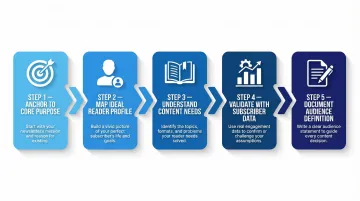
Step 3 — Understand Content Needs and Consumption Habits
Once you know who your reader is, the next question is how they actually read. Consider:
- Reading style: Do they skim for headlines or read deeply?
- Cadence preference: Daily updates, weekly digests, or monthly deep dives?
- Consumption context: Inbox-first or web archive? Mobile or desktop?
These habits influence format decisions (bullet summaries vs. long-form essays), send frequency, and content structure. A daily commuter scanning on mobile needs different formatting than a weekend reader engaging on desktop.
Step 4 — Validate with Real Subscriber Data
Your initial audience definition is a hypothesis. These four methods turn it into something you can rely on:
Analyze engagement by segment:
- Compare open rates and click-through rates across different subscriber cohorts
- Identify which acquisition channels produce the most engaged readers
Send subscriber surveys: Platforms like beehiiv enable embedded surveys directly in newsletters, capturing zero-party data that reveals reader intent and demographics. Bloomreach reports that zero-party data strategies can drive open rates as high as 55%.
Qualify readers at signup: Add optional fields asking for job title, industry, or content preferences. This data enables advanced segmentation and informs both editorial and advertising decisions.
Review qualitative replies: Pay attention to what readers say when they reply to your emails. Their language reveals priorities, pain points, and expectations — often surfacing things no survey would catch.
Step 5 — Document Your Audience Definition
Write a one-to-two sentence audience statement and create a simple reader persona. This transforms research into an editorial compass.
Example audience statement: "Presidential Summary serves globally minded executives and business professionals who need clear, unbiased summaries of U.S. politics and international developments without information overload."
Every content decision—topic selection, tone, depth of analysis—should be testable against this documented definition. If a story or angle doesn't serve this reader, cut it.
Key Factors to Consider When Targeting Your Newsletter Audience
Audience targeting is not one-size-fits-all. The right audience depends on the intersection of content type, business model, and distribution context. The following factors help connect audience definition to measurable outcomes.
Niche Specificity vs. Broad Reach
A narrowly defined audience typically outperforms a large, undifferentiated list on every meaningful metric: open rate, click rate, unsubscribe rate, and sponsor appeal.
Industry data confirms this. Highly targeted, premium niche newsletters command average CPMs of $23.01, compared to just $6.53 for general interest lists—a 3.5x premium for audience precision. Advertisers pay more to reach specific, high-intent readers because conversion rates are higher and waste is lower.
Broad reach may inflate vanity metrics, but niche specificity drives revenue.
Reader Intent
Reader intent defines why subscribers open your emails. Are they consuming content to:
- Stay informed on breaking developments?
- Make professional decisions?
- Learn something actionable?
- Satisfy intellectual curiosity?
Intent shapes content format. Readers seeking professional insights need tactical depth and sourced analysis. Readers satisfying curiosity prefer narrative storytelling and accessible explanations. Misaligning content format with reader intent creates friction and churn.
Intent also determines advertiser fit. Decision-makers with purchasing authority justify premium sponsorships. Casual readers browsing for entertainment do not.
Geographic and Cultural Context
Geographic targeting matters for both content relevance and operational decisions.
Content relevance:
- Local news and regulatory context
- Time-sensitive events and market hours
- Cultural norms and reference points
Operational decisions:
- Send timing across time zones
- Language localization
- Currency and measurement units
International newsletters serving multiple regions may need sub-audience definitions rather than a single universal profile. A newsletter covering Dubai's business landscape serves different content needs than one focused on London's financial markets, even if both attract globally mobile professionals.
Professional vs. Consumer Audience Profile
B2B-oriented audiences—executives, decision-makers, industry professionals—and consumer audiences have fundamentally different engagement patterns, content expectations, and commercial value. Professional audiences justify higher advertising CPMs and sponsorship rates, but require greater editorial depth, sourcing rigor, and credibility. They read to make decisions, which means they scrutinize claims and expect accuracy.
Consumer audiences may engage more emotionally and share more widely, but they typically command lower advertising rates unless the interest niche is particularly precise—luxury watch collectors or ultramarathon runners, for instance.
Audience Accessibility and Acquisition Channel Fit
A well-defined target audience profile reveals where to find and acquire new subscribers.
Audience type determines channel fit:
- Professional audiences — Concentrate on LinkedIn, industry forums, and conference sponsorships
- Interest-based audiences — Cluster on Reddit, Substack Recommendations, or topic-specific social platforms
- Geographic audiences — Respond to local event partnerships, city-specific influencers, and regional media
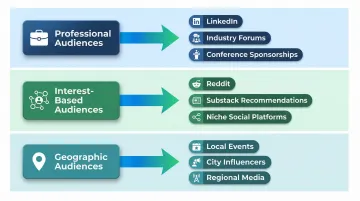
Audience definition drives acquisition strategy, not just content strategy. A precise audience profile tells you which channels to prioritize, which partnerships to pursue, and where your next hundred subscribers are most likely to come from.
How Audience Definition Shapes Content and Growth
Content Alignment
A documented audience definition acts as an editorial filter. It clarifies tone, vocabulary, depth of analysis, format choices, and which stories to cover versus ignore.
Signs of audience-content misalignment:
- Declining open rates over time
- Confused or contradictory subscriber feedback
- High early unsubscribes (within first 3-5 emails)
- Low click-through rates despite strong open rates
These signals indicate your content isn't serving the audience you've attracted. To diagnose the problem, segment engagement metrics by acquisition source and content type — the gap usually reveals itself quickly.
Growth Strategy Alignment
Your audience definition determines which subscriber acquisition channels are worth investing in and which content formats work best as lead magnets.
A professional audience grows through LinkedIn content, guest articles in industry publications, and strategic partnerships. A consumer interest audience grows through social sharing, referral loops, and community engagement.
Audience clarity keeps you from pouring budget into channels that attract the wrong readers.
The Engagement Feedback Loop
A well-defined audience creates compounding feedback:
- High open rates signal that your content is landing
- Low unsubscribe rates indicate readers are staying for the right reasons
- Sponsor alignment shows your commercial positioning is credible
Review these signals quarterly to pressure-test your original audience definition. As a newsletter scales, reader composition shifts — sometimes by design, sometimes not. Catching that drift early keeps your content strategy grounded in who's actually reading, not who you originally built it for.
Why House of Summary Gets Newsletter Audience Targeting Right
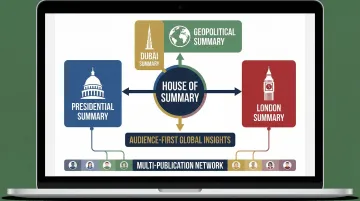
House of Summary operates a network of specialized newsletters—Presidential Summary, Geopolitical Summary, Dubai Summary, and London Summary—each built around a precisely defined, high-intent audience from day one.
This audience-first model separates it from general-interest email publications. The content exists to serve a specific reader, not to maximize raw subscriber volume.
Reader Value
Each publication targets serious, informed readers—global executives, business professionals, and news-engaged individuals. Because the audience is clearly defined, the content can be useful rather than generic.
Each newsletter addresses a distinct need:
- Presidential Summary — unbiased coverage of U.S. politics and global developments
- Geopolitical Summary — analysis of international power shifts for those who need to act on them
- Dubai Summary — city-specific business and policy intelligence for the UAE market
- London Summary — the same focused lens applied to London's business and policy landscape
This specificity drives retention and consistent engagement. Readers keep coming back because the newsletter is written specifically for people like them.
Advertiser Value
House of Summary's audience specificity translates directly into commercial value for brands and media buyers. Advertisers reach a verified, engaged audience through the inbox—no algorithmic interference, no ad blockers.
The result: click-through rates 4x higher than Google AdWords and a direct path to high-intent readers. That combination of audience quality and inbox exclusivity delivers measurably better campaign performance than display or social ads.
Conclusion
Your newsletter target audience is the foundation every content, growth, and monetization decision rests on. The goal was never to write for the most people — it was always to write for the right ones.
That definition isn't fixed. As your newsletter grows and readership signals accumulate, revisit your audience statement and test your assumptions against engagement data. The clearer your picture of who you're writing for, the more deliberately you can serve them — and the harder your newsletter becomes to ignore.
Frequently Asked Questions
What is a newsletter target audience?
A newsletter target audience is the specific group of people a newsletter is intentionally built to serve. Unlike a general email list, it reflects a deliberate editorial choice about who the content is designed for and why.
What are the types of newsletter target audiences?
Four primary types exist:
- Demographic — defined by age, location, or life stage
- Professional or industry-based — defined by role, sector, or seniority
- Interest or psychographic — defined by shared passions or worldview
- Behavioral — defined by how and why readers engage with content
What are the key elements of an effective newsletter?
Effective newsletters consistently share five traits:
- Clearly defined target audience
- Content format aligned to reader intent
- Compelling subject line
- Reliable send cadence
- A value proposition readers can articulate to others
How do you identify your newsletter's target audience?
Start with your content niche and the unique value your newsletter delivers, then map your ideal reader profile across demographics and professional context. Validate your assumptions through subscriber surveys or signup qualification questions, and document the result in a short reader persona.
How does audience segmentation improve newsletter performance?
Segmentation allows publishers to deliver more relevant content to distinct reader groups, which directly improves open rates, click-through rates, and subscriber retention. For advertisers, segmented audiences enable more precise targeting and higher campaign ROI.
Why does newsletter audience quality matter more than size?
A smaller, highly engaged audience consistently outperforms a large undifferentiated list on every key metric: open rates, advertiser CPMs, word-of-mouth growth, and long-term retention. Quality signals intent — and intent is what advertisers and readers both pay for.