Introduction
The most recognizable fashion brands in the world don't just sell products. Nike sells the internal struggle before effort. Patagonia sells moral clarity. Jacquemus sells a certain French lightness of being.
Fashion is the most visually saturated consumer category on earth. McKinsey valued the global fashion industry at $1.7 trillion in 2023, and with global advertising spend topping $1 trillion in 2024, the competition for attention has never been more expensive. A campaign that merely shows a product has already lost.
The question every fashion marketer should be asking isn't "how do we show the product?" It's "what does this campaign say about who we are?"
This piece breaks down how fashion advertising builds lasting brand identity, how different market segments approach this differently, what iconic campaigns got right — and why the channels you choose are as much a brand statement as the creative itself.
Key Takeaways
- Effective fashion campaigns sell values, lifestyle, and cultural belonging — the product is almost incidental
- Emotional advertising is 4x more likely to drive brand equity than rational, product-led creative (Kantar, 2023)
- Luxury, sustainable, streetwear, and fast fashion brands each operate from distinct campaign philosophies
- Nike, Patagonia, and Jacquemus built durable brand identities by leading with narrative, not product specs
- Where you advertise signals as much about your brand as what you advertise
What Sets Fashion Advertising Apart
Fashion marketing operates under pressures most consumer categories never face: seasonal trend cycles, audiences trained to detect inauthenticity, and a purchase that is always an expression of self before it is a transaction.
Unlike financial services or household goods, fashion advertising sells an identity before it sells a garment. Consumers don't buy a Gucci bag — they buy access to a particular self-image. Research confirms this: fashion is used for self-expression and identity construction, functioning more like a cultural medium than a product category.
The Brand World Imperative
The most effective fashion campaigns build what practitioners call a "brand world" — a coherent universe that extends well beyond any single product. Loewe's surrealist visual language and Bottega Veneta's deliberate rejection of visible logos illustrate this clearly. Each brand is selling access to a set of values and a defined aesthetic — the product itself is almost incidental.
That consistency of identity is what makes format evolution possible. Campaigns now span short-form video, fake out-of-home (FOOH), and shoppable content — and the brands that navigate this successfully treat advertising as a long-term identity investment, not a series of disconnected product launches. Few manage it well. The ones that do tend to hold their brand voice tighter the more their distribution channels expand.
The Four Pillars of Brand Identity Built Through Fashion Campaigns
Storytelling: Selling a Vision, Not a Product
The most durable fashion campaigns are built around emotional stakes, not features or price points. Kantar's 2023 research found that digital ads evoking strong emotions are 4x more likely to drive brand equity and 2.6x more likely to go viral — and that click-through rates show little correlation with brand impact.
Good fashion storytelling follows a clear structure:
- The consumer is the protagonist
- The brand is the enabler of a particular kind of life
- The product is the object that makes that life accessible
Nike makes the athlete the hero. Patagonia makes the wilderness defender the hero. Jacquemus makes the aesthetically liberated individual the hero. In every case, the product is supporting cast — not the lead.
Consistency: One Voice Across Every Surface
Brand identity is built through the accumulation of consistent signals across every touchpoint — not by a single standout campaign.
A brand that uses one visual language on Instagram and another in print — or one tone in video and another in email copy — is undermining its own identity-building with every inconsistency. This is particularly acute in fashion, where seasonal pressure creates constant temptation to refresh the look.
The most successful brands manage this by keeping their aesthetic DNA fixed while rotating the specific creative expression of it. Hermès has run a variation of the same visual world for decades. Loewe has changed creative directors multiple times — and the work still reads unmistakably as Loewe.
The discipline required to hold that line is significant. And it's largely invisible when it's working.
Emotional Architecture: Designing What Consumers Feel
"Emotional architecture" is the deliberate engineering of a specific emotional state through advertising choices: casting, setting, music, pacing, color palette, copy. Brands that define their identity most clearly make this engineering explicit rather than leaving it to chance.
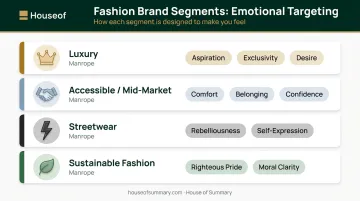
Different emotions map to different brand positions:
| Brand Type | Primary Emotional Target |
|---|---|
| Luxury | Aspiration, exclusivity, desire |
| Accessible/mid-market | Comfort, belonging, confidence |
| Streetwear | Rebelliousness, self-expression |
| Sustainable fashion | Righteous pride, moral clarity |
Getting this right pays off directly. Gallup research shows that fully engaged customers represent a 23% premium in share of wallet, profitability, and revenue growth over average customers.
Values Visibility: Making Beliefs Explicit
Edelman's 2024 research found that 84% of people globally need to share values with a brand to use it — and that 58% of Gen Z assume a brand is hiding something if it doesn't clearly communicate its actions on societal issues.
In fashion, this means values are no longer optional brand decoration. But there's a sharp distinction between brands that use values as a genuine campaign foundation versus those that use them as marketing veneer:
- Genuine foundation: Patagonia's anti-consumerism advertising, Levi's Pride campaigns — consistent with everything else the brand does
- Marketing veneer: Values claims that don't connect to sourcing, supply chains, or actual business behavior — detected and punished by consumers
Brands in the second camp face growing greenwashing scrutiny. The safe position is simple: only advertise what you can operationally substantiate.
Each of these four pillars — storytelling, consistency, emotional architecture, and values visibility — reinforces the others. Campaigns that pull all four levers build brand identities that hold across seasons, channels, and cultural shifts.
How Different Fashion Segments Build Identity Through Advertising
Luxury: Exclusivity as a Brand Architecture
Luxury fashion advertising runs on scarcity signals, not reach. The goal isn't mass visibility — it's making ownership feel like membership in a rarefied group.
Campaigns use opulent settings, minimal copy, editorial-quality imagery, and limited-edition framing. Academic research confirms that scarcity is a desirable attribute for luxury brand marketing, particularly with millennial consumers who equate controlled availability with genuine value.
Jacquemus extended this into a viral digital context with FOOH campaigns — miniature Bambino bags "driving" themselves through Paris streets — demonstrating that luxury brands can generate cultural circulation without mass-market discounting. The bags generated millions of social engagements while keeping the brand's aspirational aura completely intact.
Sustainable Fashion: Mission as Identity
Sustainable fashion brands use their environmental and ethical commitments as the primary identity engine — not just one campaign theme. Advertising leads with the "why" before the "what."
McKinsey data supports the commercial logic here: 67% of fashion consumers consider sustainable materials important, and 63% consider a brand's sustainability promotion important. The demand exists. What separates brands that capture it from those that don't is operational credibility.
Patagonia is the clearest case. Its most famous campaigns actively discourage overconsumption, which paradoxically deepens consumer trust and loyalty. The message is backed by the company's repair programs, environmental grants, and supply-chain transparency — not just stated, but demonstrated.

Streetwear and Niche Brands: Subcultural Credibility
Authenticity is the only currency that matters in streetwear advertising. Campaigns must feel like they originate from inside the community, not aimed at it from the outside.
That means working with artists, photographers, and musicians genuinely embedded in the subculture. It also means visual aesthetics that signal insider credibility and a deliberate rejection of mainstream advertising conventions. As Highsnobiety has argued, brands that try to insert themselves into youth culture through strategy alone read as inauthentic — and the community notices quickly.
H&M's 2018 advertising controversy, which generated immediate boycotts, illustrates what happens when fashion brands miscalculate cultural context. Subcultural credibility cannot be purchased. It has to be earned.
Fast Fashion: Speed and Trend Capture
Fast fashion advertising is engineered for velocity. McKinsey reports Shein produced up to 10,000 new designs per day as of 2023, while Zara's parent Inditex generated €38.6 billion in net sales in fiscal 2024 on the strength of short production series and rapid trend turnover.
The resulting brand identity has a distinct profile:
- Accessible: price points and styling pitched at broad audiences
- Of-the-moment: campaigns built around trend cycles, not brand heritage
- Democratic: volume and variety over exclusivity
That profile also has a ceiling. Speed-based identity is inherently disposable — when the next trend arrives, the previous campaign loses relevance. This is why fast fashion brands rarely build the kind of accumulated cultural equity that gives luxury and streetwear brands pricing power and resilience across cycles.
Campaigns That Became Cultural Moments
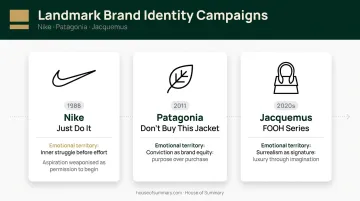
Three campaigns illustrate what brand identity advertising looks like at its highest expression:
Nike "Just Do It" (1988)
Launched by Dan Wieden of Wieden+Kennedy, the campaign succeeded because it identified an emotion — the internal struggle before effort — that had nothing to do with shoes and everything to do with universal human experience. Nike doesn't own athletic footwear. It owns that emotional space, and that ownership is worth more than any product feature.
Jacquemus FOOH Campaigns
Miniature Bambino bags navigating Paris streets. Inflatable bags at beaches. Giant bags outside Opéra Garnier. Each visual communicated the brand's personality — playful, French, high-fashion but not humorless — without a word of product explanation.
The campaigns generated millions of social engagements and extensive press coverage, proving that personality — not product specs — drives reach.
Patagonia "Don't Buy This Jacket" (2011)
A full-page New York Times ad on Black Friday. Patagonia's best-selling jacket. The headline: "Don't Buy This Jacket." What made it work wasn't the provocation — it was complete alignment between the message and everything else the brand had already built: repair programs, environmental activism, supply-chain transparency. The ad landed as conviction because the brand had spent years earning the right to say it.
The Channel Effect: Where You Advertise Is Part of the Message
Media channel selection is a brand signal, not just a reach decision. A luxury fashion house appearing in low-quality programmatic display environments sends a different message about itself than one appearing in curated, premium editorial contexts. The channel is part of the brand — it signals who you think your audience is and what you think of your own prestige.
The Case for Newsletter Advertising
Direct-to-inbox advertising gives fashion brands targeting business professionals, executives, and affluent consumers a channel that works differently from everything else. Unlike social feeds and algorithmic platforms, newsletter advertising delivers brand messages into a distraction-free environment where readers have already self-selected based on their interests.
The numbers support the channel's effectiveness. DMA's 2025 benchmarking report documents 35.9% open rates and 2.3% unique click rates for email in 2024, and IAS research found that contextually aligned ads increase memorability by up to 40%. For fashion brands, that context effect is the entire argument: appearing alongside editorial content that affluent readers have chosen to consume transfers meaning to the brand itself.
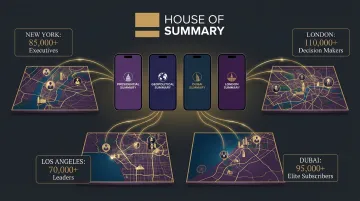
House of Summary's newsletter network reaches 500,000+ subscribers across Presidential Summary, Geopolitical Summary, Dubai Summary, and London Summary. The audience skews toward decision-makers, executives, and high-net-worth individuals concentrated in New York, Los Angeles, London, and Dubai — with 66% of readers based in the USA.
Ad formats available to fashion advertisers include:
- Native editorial placements that match the publication's voice
- Sponsored content with full creative control
- Full-issue takeovers for maximum share of attention
Every edition runs one advertiser only — no algorithmic interference, no ad-blocker exposure, no competing placements.
For luxury and premium fashion brands, that exclusivity is the point: the channel choice signals that this brand knows exactly where its audience reads — and treats their attention accordingly.
The Broader Audit
Every channel where a fashion brand appears either reinforces or dilutes the identity its campaigns have built. A brand cannot claim luxury positioning through its creative while buying inventory on platforms that commoditize brand presence. The full media mix deserves the same strategic scrutiny as the creative itself.
Frequently Asked Questions
What makes a fashion advertising campaign successful in building brand identity?
Successful campaigns consistently communicate a brand's values, emotional territory, and lifestyle vision — not just product features — and do so repeatedly and coherently across every channel over time. A single brilliant campaign rarely defines a brand; accumulated consistency does.
How do luxury fashion brands advertise differently from fast fashion brands?
Luxury brands use exclusivity, editorial-quality imagery, and scarcity signals to build aspiration and identity depth. Fast fashion brands prioritize trend-speed and accessibility to build identity velocity. The fundamental difference is durability: luxury advertising compounds over time while fast fashion advertising resets with every cycle.
Why is consistency so important in fashion advertising?
Brand identity is built through the accumulation of consistent signals over time. Inconsistency fragments the brand image and forces consumers to work harder to understand what the brand stands for — which most won't do.
What role does influencer marketing play in fashion brand identity?
Influencer partnerships work best when the influencer's existing identity genuinely reflects the brand's values — producing credibility neither party could manufacture alone. Misaligned partnerships can erode the identity a brand has spent years building, especially in streetwear and luxury where authenticity is non-negotiable.
How has technology changed fashion advertising campaigns?
FOOH campaigns, AR virtual try-ons, shoppable social content, and AI-personalized targeting have expanded where brand identity can be expressed. What hasn't changed: consistency, emotional resonance, and clear storytelling remain the foundations. Technology expands the canvas — it doesn't replace the craft.
Can emerging fashion brands build strong identity through advertising without large budgets?
Strong brand identity is a function of clarity, not budget. Brands that know precisely what they stand for and who they're for can build compelling identities through focused channel choices and authentic storytelling. The key is committing fully to a few channels rather than spreading thin across all of them.