

Introduction
In 2023, the UK's Advertising Standards Authority banned over 20 major campaigns for misleading environmental claims — and that enforcement trend is accelerating. Brands now face a real bind: stakeholders expect public proof of ESG commitments, yet the rules governing how those commitments can be communicated are tightening across every major market simultaneously.
Get it wrong and the consequences are concrete: ad bans, civil penalties, reputational damage, and greenwashing accusations that take years to recover from. Get it right and the payoff is measurable — stronger brand equity, premium pricing power, and durable audience trust.
This guide covers what marketers need to know:
- The regulatory landscape shaping ESG advertising enforcement
- The most common mistakes brands make with environmental and social claims
- The business case for getting this right
- How to build an ESG advertising strategy that holds up to scrutiny
Key Takeaways
- ESG advertising requires corporate values, regulatory compliance, and brand strategy to align before any claim goes live.
- The FTC Green Guides, EU CSRD, and SEC climate disclosure rules directly govern what brands can claim publicly.
- Greenwashing — whether environmental, social, or governance-related — now carries real legal and financial consequences, not just reputational ones.
- Credible ESG communication delivers real returns: a 9.7% consumer willingness-to-pay premium and stronger investor confidence.
- Channel selection signals values as clearly as the message itself.
What Is ESG Advertising?
ESG advertising is the practice of communicating a brand's environmental, social, and governance commitments through paid, owned, and earned media. It's distinct from ESG reporting (a structured disclosure to investors and regulators) and from general purpose marketing, which tends to be aspirational without tying claims to verified performance data.
The three pillars operate differently in an advertising context:
- Environmental claims (carbon neutrality, sustainable sourcing, green product certifications) attract the most regulatory scrutiny and require the strongest substantiation
- Social claims (DEI commitments, fair labor practices, community impact) face growing scrutiny from regulators moving beyond environmental advertising into "social washing"
- Governance claims (data privacy, ethical supply chains, board accountability) are increasingly relevant as data collection practices become a visible consumer issue
The shift from voluntary to regulated territory is already reshaping how brands communicate. According to the World Federation of Advertisers, 41% of brands had a sustainability story they were proud to communicate in 2023, up from 25% in 2021. But the European Commission has at the same time found that 53% of green claims provide vague, misleading, or unfounded information — driving regulators on both sides of the Atlantic to accelerate enforcement. For advertisers, understanding where the rules sit — and where opportunities remain — is no longer optional.
The Regulatory Landscape Governing ESG Advertising Claims
FTC Green Guides (US)
The FTC Green Guides remain the primary US framework for environmental advertising claims. Last updated in 2012, with a public comment review opened in 2022, they prohibit:
- Unqualified general claims like "eco-friendly" or "green" without substantiation
- Carbon offset claims that cannot be independently verified
- Misleading lifecycle claims that apply to only part of a product
Every environmental claim in US advertising must have a "reasonable basis" — meaning competent evidence before the claim is made, not after. The FTC's 2022 action against Kohl's and Walmart for marketing rayon products as bamboo resulted in $5.5 million in total civil penalties. Sustainability copy should be treated with the same legal review applied to financial or health claims.
EU CSRD and Green Claims Directive
For brands operating in or targeting European markets, the EU Corporate Sustainability Reporting Directive entered force on January 5, 2023. Large companies must now disclose specific, audited ESG data under European Sustainability Reporting Standards — and advertising claims must not outrun that disclosed data.
The EU Green Claims Directive (proposal adopted March 2023, Council position adopted June 2024) targets voluntary environmental claims made to consumers and requires scientific substantiation and lifecycle relevance before claims are used. Any inconsistency between what a company discloses under CSRD and what it says in advertising creates direct legal exposure.
SEC Climate Disclosure Rules (US, Publicly Traded Companies)
The SEC adopted final climate disclosure rules in March 2024, then stayed them in April 2024 pending judicial review. In March 2025, the SEC voted to end its own defense of those rules. The regulatory outcome remains uncertain, but the practical advertising implication is unchanged: if a publicly traded company's advertising makes climate claims that exceed or contradict its filed disclosures, it creates securities law, consumer protection, and litigation risk regardless of whether the specific SEC rule survives.
Data Privacy as a Governance Claim
GDPR and CCPA aren't typically thought of as ESG regulations, but they govern the "G" in ESG advertising directly. When brands claim to respect consumer rights or champion data privacy, their actual advertising data practices must match. The ICO's guidance makes clear that tracking and profiling for online advertising generally requires consent — and California's CCPA gives consumers opt-out rights for cross-context behavioral advertising.
For ESG-focused advertisers, the channel itself matters. Placing campaigns in media environments that comply with GDPR and CCPA — where reader data isn't sold and behavioral targeting is handled with consent — means the data practices behind a campaign reinforce rather than contradict its governance messaging. House of Summary operates on that basis, complying with both GDPR and CCPA/CPRA standards and not selling reader personal information.
Across every framework above, the pattern is the same: ESG advertising claims must be specific, substantiated, and consistent with disclosed performance data. Vague, aspirational language is the primary trigger for regulatory action.
The Greenwashing Trap
What It Actually Means
Greenwashing in advertising means making claims about environmental or social responsibility that are exaggerated, misleading, or unsupported. Regulators have made clear they're not just looking at outright false statements — omissions and overall misleading impressions count.
The ASA's enforcement record illustrates this:
| Brand | Claim | Outcome |
|---|---|---|
| HSBC UK | Ads cited $1T in net-zero financing and 2M trees planted, omitting the bank's financed emissions | Upheld — ads banned, future claims must be qualified |
| Shell UK | Ads highlighted cleaner energy and renewables, creating an overall lower-carbon impression | Upheld — ads must not overstate lower-carbon activities relative to total business |
| Lufthansa | Display ad claimed "Fly more sustainably" | Upheld — insufficient substantiation |
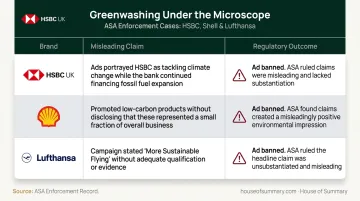
None of these cases turned on fabricated data. Each ruling came down to missing context — what was left out shaped how consumers understood the claim.
The Most Common Self-Inflicted Wounds
Brands get into trouble through predictable patterns:
- Unsupported absolutes — "carbon neutral," "zero waste," "fully sustainable" without qualification or evidence
- Channel inconsistency — what the annual sustainability report says doesn't match what the ad claims
- Scope confusion — a claim applies to one product component but reads as applying to the whole company
- Outdated data — claims based on targets or projections presented as current achievements
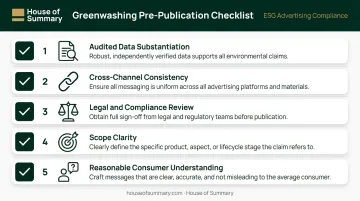
Greenwashing Pre-Publication Checklist
Before any ESG advertising claim goes live, ask:
- Can we substantiate this with audited data — verified performance figures, not projections or targets?
- Does the claim appear consistently across our ESG report, website, and advertising? Inconsistency between channels is a leading greenwashing trigger.
- Have legal and compliance reviewed the specific language — not the concept, but the exact wording in the ad?
- Are we clear about scope? Does the claim apply to the product, the product line, a facility, or the whole company?
- Would a reasonable consumer understand what we're actually claiming? If accuracy requires a footnote, the headline needs to change.
The Business Case for ESG Advertising
The Financial Case
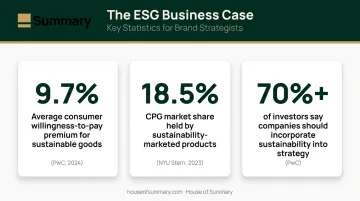
The numbers supporting credible ESG advertising aren't marginal. A 2024 PwC survey of more than 20,000 consumers across 31 countries found an average 9.7% willingness-to-pay premium for sustainably produced goods. NYU Stern found that sustainability-marketed CPG products held 18.5% of market share in 2023, up from 17.3% — a measurable demand advantage.
More than 70% of investors now say companies they invest in should incorporate sustainability directly into strategy and communications, according to PwC's Global Sustainability Reporting Survey.
The Audience Shift
The generational dimension is significant. Deloitte's 2024 Gen Z and Millennial Survey found 64% of Gen Zs and 63% of Millennials would pay more for environmentally sustainable products or services. These are not fringe preferences — they're reshaping purchasing behavior across consumer and investment categories.
The Underrated B2B Opportunity
Many companies with strong ESG performance — across industrial, logistics, and financial services sectors — under-communicate their achievements because they assume ESG messaging is a consumer-brand play. That assumption is costing them.
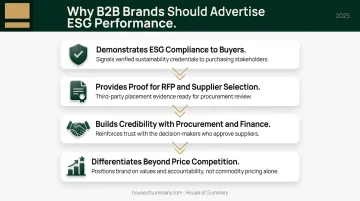
Procurement teams now routinely evaluate suppliers on ESG criteria. For B2B brands, ESG advertising serves a specific commercial function:
- Demonstrates compliance with buyer ESG requirements
- Provides proof material for supplier selection and RFP processes
- Builds credibility with procurement and finance decision-makers
- Differentiates on dimensions that price alone cannot
Compounding Brand Equity
Consistent, credible ESG communication builds a reputational asset that competitors cannot quickly replicate. Brands that communicate commitments transparently — over years, not just when it's convenient — accumulate trust that holds up when things go wrong. That reputational buffer takes time to build and can't be manufactured under pressure.
Building a Credible ESG Advertising Strategy
Start With Materiality
Before writing a single line of advertising copy, identify which ESG issues are genuinely material to your business — meaning they affect financial performance and are backed by measurable data. SASB Standards, organized by industry sector, provide a practical starting point for identifying which issues actually matter for your category.
Not every ESG issue is relevant to every brand. A logistics company's material issues are different from a financial services firm's. Advertising claims that don't map to material, disclosed issues are the ones that attract regulatory scrutiny.
Build a Substantiation File
For every ESG claim used in advertising, maintain an internal record that includes:
- The specific disclosed metric the claim traces back to
- The date range and geographic scope of that metric
- The audited data source or evidence owner
- The legal and compliance approval record
- Any required qualifications or caveats to the claim
That documentation is what protects you when a regulator or journalist asks how a claim was supported.
Maintain Cross-Channel Consistency
The same ESG narrative must be consistent across paid media, owned content, earned media, and investor communications. Inconsistency between channels is one of the primary triggers for greenwashing allegations. Regulators evaluate total campaign impression, not individual ad placements in isolation.
Common points of inconsistency to audit:
- Claims in paid ads that exceed what appears in sustainability reports
- Social posts making absolute statements ("carbon neutral") that investor disclosures qualify
- Regional campaign variations that contradict global ESG commitments
Choosing the Right Channels for ESG Messaging
Why Channel Choice Is an ESG Signal
Where a brand advertises communicates values as directly as what it says. A brand that claims to respect consumer data privacy but runs its ESG advertising through invasive behavioral targeting creates an obvious contradiction. Channel selection carries governance implications — it signals whether a brand's stated values extend to how it actually operates in media markets.
Channels that rely on algorithmically amplified content, brand-unsafe adjacency, or opaque data practices work against ESG advertising goals — regardless of how well-crafted the creative is.
The Case for Premium Editorial Environments
Newsletter advertising offers a structurally different proposition for ESG messaging. Ads appear within human-written editorial content, with no algorithmic curation creating adjacency risk. Delivery through the inbox means ad blockers don't apply — and engagement rates reflect that structural advantage.
Campaign Monitor cites email click-through rates of 2–5% across industries, compared to IAB UK's figure of approximately 0.10% for average display ads.
House of Summary's network — Presidential Summary, Geopolitical Summary, Dubai Summary, and London Summary — reaches 500,000+ subscribers, with 254,866+ emails opened daily. The audience skews toward decision-makers, executives, and high-income professionals across the US, UK, and UAE: precisely the stakeholders who are most actively evaluating brands on ESG credentials. For B2B brands targeting procurement leaders or institutional investors, that audience alignment matters as much as the channel mechanics.
Mapping Messages to Audiences
ESG advertising isn't one message. Different stakeholders need different framings:
- Investor-facing: Connect ESG performance to risk management, long-term value creation, and regulatory compliance
- Procurement-facing: Emphasize supply chain transparency, measurable sustainability metrics, and certification data
- Consumer-facing: Focus on product-level claims that are specific, qualified, and traceable to disclosed data
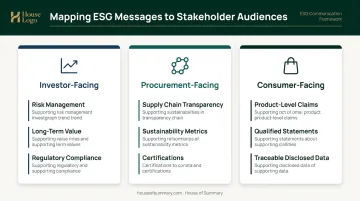
Selecting a channel before mapping the audience often results in the right message landing in front of the wrong readers — or the right readers in the wrong context.
Frequently Asked Questions
What are the four types of ESG?
Standard ESG frameworks use three pillars: Environmental (climate, resource use, emissions), Social (labor practices, DEI, community impact), and Governance (board accountability, executive pay, anti-corruption). A fourth category — sustainability disclosure frameworks like GRI or CSRD — is sometimes added to describe how the three are reported and verified, though this isn't a universally recognized fourth pillar.
What does ESG mean in marketing?
ESG in marketing refers to communicating a company's environmental, social, and governance commitments through advertising and content. Unlike internal ESG reporting, marketing claims are regulated by advertising standards authorities and must be substantiated, accurate, and non-misleading — aspirational language without evidence is increasingly subject to enforcement.
What are the rules around ESG claims in advertising?
The primary frameworks are the FTC Green Guides (US), the EU Green Claims Directive (EU, currently in legislative process), and ASA/CAP guidelines (UK). Claims must be specific, accurate, and backed by evidence — vague terms like "sustainable" or "eco-friendly" without qualification are increasingly challenged by regulators across all three jurisdictions.
What is greenwashing and how can brands avoid it?
Greenwashing means making misleading or unsupported environmental or social claims in advertising. Brands avoid it by:
- Only advertising claims backed by audited data
- Ensuring messaging aligns with disclosed ESG reports
- Running all ESG-related advertising copy through legal and compliance review before publication
What's the difference between ESG reporting and ESG advertising?
ESG reporting is a structured, often mandatory disclosure of performance to investors and regulators using frameworks like CSRD or GRI. ESG advertising communicates those commitments to consumers through paid and earned media. Gaps or contradictions between the two are a primary source of regulatory and reputational risk.