The problem isn't budget. It's precision. A clinical director reading a peer-reviewed journal during a 20-minute break isn't the same audience as a professional scrolling LinkedIn at 9am. Standard digital tactics miss that distinction entirely.
This guide breaks down who these buyers actually are, which advertising channels reliably reach them, how to craft messaging that earns attention in a regulated industry, and what metrics actually tell you whether your campaigns are working.
Key Takeaways
- Healthcare decision-makers are a small, specialist audience that broad programmatic campaigns routinely miss — precision targeting is essential
- Top-performing channels include LinkedIn ABM, industry publication placements, conference sponsorships, and professional newsletter advertising
- Messaging must lead with outcomes, cite clinical evidence, and comply with FDA promotional guidelines — credibility, not urgency, drives conversion
- Sales cycles are long — track pipeline influence and engagement depth, not just clicks or short-window conversions
Who Are Healthcare Decision-Makers in Biotech?
Before you can reach this audience, you need to understand that "healthcare decision-maker" isn't a single persona. It's a committee.
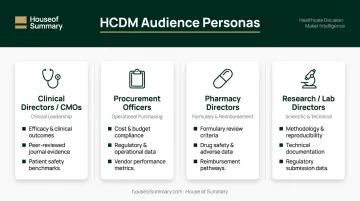
The Four Core Personas
Each persona has different media habits, different purchase triggers, and different definitions of a compelling message:
- Clinical directors and CMOs — focused on efficacy, patient outcomes, and clinical evidence; read peer-reviewed journals and attend specialty conferences
- Procurement and supply chain officers — focused on cost, vendor reliability, and compliance; respond to operational and economic data
- Pharmacy directors — focused on formulary access, safety data, and reimbursement; rely heavily on clinical and health economic evidence
- Research and lab directors — focused on methodology, reproducibility, and innovation; engage with technical documentation and peer publications
The Committee-Based Buying Reality
In most healthcare institutions, purchasing decisions don't rest with one person. Forrester's 2026 State of Business Buying report found that the average B2B buying decision is influenced by 13 internal stakeholders and 9 external participants. A 2024 clinical review on value analysis committees recommends up to 20 voting members for high-cost purchasing decisions.
You're not targeting a buyer — you're building awareness and credibility across an entire decision-making group at once.
That group is also doing more of its own homework. Gartner research found that 61% of B2B buyers prefer a rep-free buying experience. Healthcare decision-makers are researching independently, which means your advertising needs to do the work a sales rep once handled directly.
Why Reaching Healthcare Decision-Makers Is Harder Than Standard B2B Advertising
Three structural problems make this audience difficult to reach through standard digital campaigns.
The Targeting Gap
Most programmatic platforms can't get specific enough. Filtering for "clinical directors at hospitals with oncology units" or "pharmacy directors at regional health systems" simply isn't available through standard display or search campaigns. Generic B2B job-title targeting delivers low-intent audiences and wasted spend.
The signal problem is getting worse. The IAB's 2024 State of Data report found that 95% of data and advertising decision-makers expect signal loss and privacy legislation to keep affecting digital advertising — and 76% of brands and agencies are already investing in new multi-touch attribution approaches that don't rely on third-party cookies.
The Regulatory Constraint
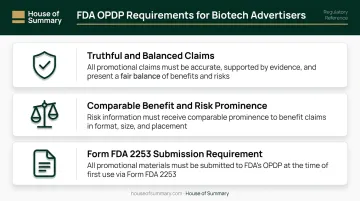
Biotech advertisers can't use the standard creative toolkit. FDA's Office of Prescription Drug Promotion imposes strict requirements on all prescription drug promotion:
- All claims must be truthful, balanced, and accurately communicated
- Benefit and risk information must appear with comparable prominence and readability
- Promotional materials require Form FDA 2253 submission at initial dissemination
That rules out urgency tactics, unsubstantiated superlative claims, and the kind of emotional persuasion that consumer brands rely on. Every creative asset needs legal and regulatory sign-off before it runs.
The Ad Environment Problem
Those creative constraints matter more because the ad environment is already saturated. Major pharma and medical device companies flood this audience with advertising, which means undifferentiated display ads and broad Google campaigns simply don't register. Healthcare decision-makers filter out anything that looks like generic advertising — especially in digital environments where the surrounding content provides no signal of relevance.
The Best Advertising Channels to Reach Healthcare Decision-Makers
Conferences, Trade Shows, and Industry Events
Live events remain one of the most efficient ways to concentrate access to healthcare decision-makers with actual purchasing authority.
HIMSS 2023 drew 42,000 attendees, with 70% identified as decision-makers or influencers. BIO International Convention 2026 expects 20,000 industry leaders across 130+ sessions. These aren't casual attendees — they're professionals who cleared their calendars to be there.
The channel options within events vary significantly by objective:
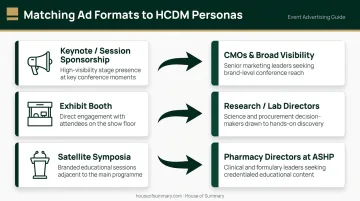
- Keynote and session sponsorships — highest visibility, strongest thought leadership signal
- Exhibit booths — product demonstrations and direct conversation with qualified buyers
- Satellite symposia — deep scientific education for clinical audiences; best format for building genuine credibility with CMOs and research directors
Match the investment to the persona. A satellite symposium at ASHP Midyear is the right vehicle for pharmacy directors. An exhibit presence at BIO International makes more sense for research and lab director outreach.
Industry Publication Advertising
Peer-reviewed journals and trade publications carry authority that general digital channels can't match. BioPharma Dive reaches over 440,500 biotech and pharma industry decision-makers. STAT reports 3.3 million monthly page views across an audience that includes business executives, finance professionals, and medical doctors.
HCDMs actively read these publications for professional development. Placement here creates a credibility signal by association that programmatic display cannot manufacture. Effective creative in this channel leads with a specific, evidence-backed value claim — not a brand awareness message — and pairs it with a call to action appropriate to the purchase stage.
LinkedIn Account-Based Advertising
LinkedIn is the most accurate professional targeting platform available for biotech. It supports filtering by job title, seniority, company size, and industry sector. More precisely, LinkedIn's Matched Audiences lets advertisers upload target account lists — specific hospital systems or health networks — and serve ads exclusively to decision-makers within those organizations. Account targeting matches company lists against more than 8 million Company Pages.
Recommended formats for HCDM outreach:
- Sponsored Content — thought leadership and clinical data highlights in the feed
- Message Ads — personalized direct outreach at scale
- Document Ads — white papers, clinical summaries, and study highlights distributed directly
LinkedIn CPCs in healthcare run high. Message precision directly determines whether the spend is justified — a generic ad to a technically accurate audience still fails.
Newsletter and Inbox Advertising
Specialized professional newsletters occupy a distinct position in a healthcare decision-maker's attention environment. Newsletter placements bypass ad blockers entirely, reach readers outside the algorithmic noise of social feeds, and carry an implied endorsement — the reader opted in. Display and programmatic can't manufacture that.
Engagement data reflects this: Campaign Monitor's 2022 benchmark puts healthcare services email at a 23.7% average open rate and a 3.0% click-through rate — meaningful numbers when standard web display CTRs routinely fall below 0.1%.
House of Summary's newsletter network reaches 500,000+ subscribers, with 254,866+ emails opened daily and 66% of that audience concentrated in the US. For biotech advertisers, the platform provides direct inbox access to decision-makers and policy professionals — no algorithms, no ad blockers, no visual clutter.
The platform reports click-through rates 4x higher than Google AdWords, with sponsored content and native editorial formats built for brands whose message requires scientific context rather than a banner impression.
For biotech advertisers dealing with regulatory constraints, the sponsored editorial format is particularly well-suited: it allows the scientific context and evidence framing that a standard display unit can't accommodate, within a compliance-friendly placement environment.
Native Advertising and Sponsored Content
Native advertising — sponsored articles placed within respected industry publications that match surrounding content in format and tone — gives biotech the space that banner ads don't.
A well-structured sponsored article in a relevant trade publication delivers enough scientific context to move a decision-maker from awareness to active consideration — something a 300x250 display unit simply cannot do. According to Content Marketing Institute's 2025 B2B report, 34% of B2B marketers use native advertising or sponsored content, making it an established and accepted format in professional environments.
Effective biotech native advertising avoids hard sales language. It educates, references data, and draws a clear line between scientific findings and the clinical or operational outcomes that matter to the specific reader.
How to Craft Biotech Ad Messaging That Converts
Getting in front of the right audience is half the problem. The message has to do the rest.
Lead With Outcome, Not Mechanism
Healthcare decision-makers don't need to understand CRISPR pathways in an ad. They need to know what changes for their patients, their institution, or their budget. Identify the single most relevant outcome for each persona and make it the headline.
A procurement officer needs to see cost and compliance impact. A clinical director needs patient outcome data. Same product — two different headlines, two different conversion paths.
Use Clinical Evidence as a Trust Signal
Specific claims backed by cited research consistently outperform generic benefit statements with this audience. A 2019 survey in Value in Health found that only 7% of medical directors considered health economic information shared by manufacturer representatives to be "very credible." The implication: third-party published data, clinical trial references, and peer-reviewed endpoints carry more weight than brand-originated claims.
Even in limited ad space, include:
- Clinical trial phase and patient cohort size
- Measurable endpoint improvements
- Compliance with FDA promotional guidelines before publication
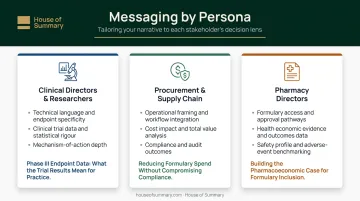
Calibrate Language by Persona
- Clinical directors and researchers: precise, technical language with endpoint specificity
- Procurement and supply chain: operational, cost, and compliance framing
- Pharmacy directors: formulary access, health economic evidence, safety data
LinkedIn ABM and newsletter placements make persona-level variant messaging achievable. Running distinct creative by role — rather than one generic version — typically produces higher engagement rates and shorter sales cycles with this audience.
Choose the Right Call to Action
Direct sales CTAs rarely work on first exposure in a long-cycle healthcare purchase. Effective CTAs offer low-commitment, high-value next steps:
- Download a clinical summary or white paper
- Register for a CE-accredited webinar
- Request a sample or pilot program
- Access a peer-reviewed abstract
These advance the relationship without demanding a buying decision the healthcare decision-maker isn't ready to make.
Measuring Biotech Advertising Effectiveness Across Long Sales Cycles
Standard 30-day conversion metrics don't work for biotech. Healthcare purchasing cycles are extended — Gartner enterprise procurement data shows 25% of purchase cycles extend beyond 11 months, and healthcare decisions involving clinical, financial, and compliance stakeholders typically run longer.
The Right Measurement Framework
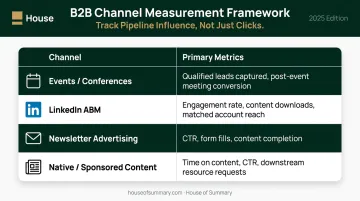
Track pipeline influence rather than immediate conversions:
- Did an HCDM who engaged with an ad later appear in a sales conversation?
- Did they attend a webinar or download a clinical resource?
- Are matched accounts from your LinkedIn ABM list progressing through your pipeline?
Set up UTM tracking and CRM integration from the first campaign, not as an afterthought.
Channel-Specific Metrics Worth Tracking
| Channel | Primary Metrics |
|---|---|
| Events/conferences | Qualified leads captured, post-event meeting conversion rate |
| LinkedIn ABM | Engagement rate, content downloads, matched account reach |
| Newsletter advertising | CTR, follow-on form fills, content completion |
| Native/sponsored content | Time on content, CTR, downstream resource requests |
The Iterative Model
Biotech advertising rarely converts on first impression. The real data goal is identifying which channels and messages drive the deepest engagement with the right personas. Use those signals to shift budget toward what's working, refine messaging for underperforming segments, and build the kind of cumulative brand presence that earns a seat at the table when a 11-month purchasing process finally reaches a decision.
Frequently Asked Questions
What makes healthcare decision-makers different from typical B2B buyers?
HCDMs operate within committee-based purchasing structures involving multiple stakeholders with different priorities, are subject to institutional compliance requirements, and rely heavily on peer validation and clinical evidence. Generic advertising that works in standard B2B environments consistently underperforms with this audience.
Which advertising channels deliver the best ROI for reaching clinical and procurement decision-makers?
LinkedIn ABM targeting, specialized industry publications, professional newsletter placements, and conference sponsorships outperform broad programmatic for this audience by a significant margin. The right mix depends on which HCDM persona you're prioritizing — clinical directors and procurement officers respond to different formats and contexts.
How much should a biotech company budget for advertising to healthcare decision-makers?
Healthcare marketing benchmarks from MM+M's 2025 Trend Report put mean overall budgets at $7.2M, though this reflects larger healthcare organizations. For biotech, precision targeting on a focused budget routinely beats high-volume broad campaigns. Channel selection — not total spend — is the variable that drives results.
How do FDA and regulatory guidelines affect biotech advertising campaigns?
FDA guidelines restrict unsubstantiated efficacy claims, require fair balance between benefit and risk information, and mandate Form FDA 2253 submission of promotional materials at initial dissemination. Legal and regulatory review of all ad creative is mandatory before any campaign launches — not optional.
How long does it typically take for biotech advertising to generate measurable results?
Expect a 6–12 month horizon before advertising meaningfully influences purchase decisions. Healthcare purchasing cycles are long, so meaningful metrics are pipeline influence and engagement depth — not immediate conversions. Brand recognition builds across multiple touchpoints before it moves a deal.
Can early-stage biotech companies compete with large pharma in advertising to healthcare decision-makers?
Yes — by choosing precision channels over mass media. A well-crafted, evidence-backed message in a targeted newsletter placement, niche trade publication, or focused LinkedIn ABM campaign will outperform a bigger but unfocused spend. Early-stage companies that can't match pharma's budget can still dominate the specific, high-intent channels where their message lands with the right readers.