Introduction
FemTech—short for female technology—is a rapidly expanding healthcare sector using digital tools, AI, wearables, and telehealth to address women's health needs. Coined in 2016 by Danish entrepreneur Ida Tin, co-founder of the period-tracking app Clue, Allied Market Research projects the sector will grow from $6.9 billion in 2023 to $26.1 billion by 2033 — a 15.2% compound annual growth rate.
That growth is reshaping where health brands can reach decision-makers. Social platforms are closing the door: nearly 70% of FemTech businesses report having Google ads rejected, and over 60% face Meta post removals. Brands that once relied on targeted social campaigns are now looking elsewhere.
For media buyers, investors, and marketing decision-makers, this article examines where that advertising spend is moving — and why executive newsletters are emerging as one of the most effective alternative channels.
Key Takeaways
- FemTech is projected to reach $26.1 billion by 2033, growing at a 15.2% CAGR
- Key growth areas: AI-powered fertility tracking, menopause tech, and digital therapeutics
- The sector raised $2.6 billion in VC investment in 2024 — a 55% jump over 2023
- Social media restrictions on women's health content are driving brands toward inbox-based channels that reach readers without algorithmic interference
- Executive newsletters offer FemTech brands a restriction-free, high-attention advertising channel
FemTech's Fastest-Growing Market Segments
FemTech has expanded well beyond its origins in period-tracking apps. Multiple sub-sectors are scaling simultaneously — driven by clinical validation, investor confidence, and growing consumer demand — making this one of the more commercially diverse categories in digital health right now.
Menstrual Health and Cycle Tracking
Menstrual tracking apps serve as the entry point for the broader FemTech ecosystem. Platforms like Flo, Clue, and Natural Cycles now use AI to detect conditions like PCOS and endometriosis before clinical diagnosis. Yet major awareness gaps remain: only 39% of schools worldwide provide menstrual health education, creating a massive educational opportunity for digital health platforms.
Natural Cycles earned FDA clearance as a digital contraceptive in 2018 and raised $54.86 million in Series C funding in May 2024, demonstrating the commercial viability of regulated cycle-tracking technology.
Fertility and Pregnancy Support
FemTech is addressing rising global infertility rates through innovation. Approximately 17.5% of adults worldwide—roughly 1 in 6 people—experience infertility, according to WHO data from 2023.
The sector is responding with:
- At-home hormone testing kits (Mira, Modern Fertility)
- Wearable ovulation trackers (Ava bracelet, Oura Ring)
- Digital fertility clinics (Kindbody, Maven Clinic)
- AI-powered conception planning platforms
Maven Clinic raised $125 million in Series F funding in October 2024, reflecting strong investor confidence in virtual fertility care.
Menopause and Aging Care
"Menotech" has emerged as one of FemTech's fastest-scaling sub-sectors. More than 1 billion people globally experience menopausal symptoms, yet the category was historically underserved and commercially taboo.
Commercial investment has accelerated sharply — driven by both unmet clinical need and a newly vocal consumer base:
- Midi Health raised $100 million in Series D+ funding in February 2026
- The menopause care segment generated $3.04 billion in revenue in 2024
- Digital hormone balancing apps are growing at a 17.4% CAGR
- Celebrity investors including Serena Williams, Halle Berry, and Naomi Watts are backing menotech companies

Chronic Conditions and Autoimmune Disorders
FemTech is filling diagnostic gaps for conditions that disproportionately affect women. Up to 70% of women with PCOS remain undiagnosed, while endometriosis affects approximately 10% of women of childbearing age. Diagnostic delays are common, with nearly half of suspected cases initially misdiagnosed.
Autoimmune diseases present a similar challenge: 80% of those affected are female, yet diagnosis often takes years. FemTech platforms now offer AI-powered symptom tracking and at-home lab testing for conditions including:
- PCOS and endometriosis
- Thyroid disorders (women are 5-8 times more likely to have thyroid problems)
- Lupus and other autoimmune conditions
- Hormone imbalances affecting reproductive health
Digital Therapeutics and Telehealth
Virtual care platforms like Maven Clinic, Nurx, and Tia are expanding access to care across fertility, contraception, and mental health. This segment is attracting growing employer-sponsored healthcare investment, with 42% of US employers now offering fertility benefits, up from 30% in 2020.
Telehealth removes geographic barriers and provides privacy for sensitive health concerns. For professional women aged 25-55, those factors — combined with on-demand access — are key drivers of sustained platform adoption.
AI and Wearables Are Personalizing Women's Health at Scale
AI and connected devices are transforming FemTech from reactive symptom logging into predictive, proactive health management. This shift dramatically expands the total addressable market by reaching women who would not engage with traditional healthcare.
Wearables like the Oura Ring, Ava bracelet, and Bellabeat IVY now passively collect biometric data:
- Skin temperature variations
- Heart rate variability (HRV)
- Sleep quality and breathing patterns
- Physical activity levels
The Oura Ring's Cycle Insights feature, updated in November 2025, delivers 96% ovulation accuracy without manual data entry. It now includes:
- Fertile window prediction
- Irregular cycle and perimenopause support
- Birth control integration for tailored tracking
- Shareable reports for healthcare providers
The Ava bracelet tracks five physiological signals and records wrist skin temperature every 10 seconds during sleep—far more granular than single-point basal body temperature measurement.
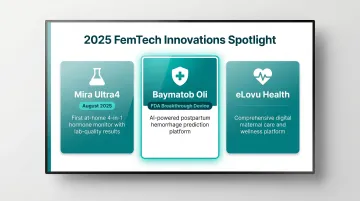
That same AI-driven precision is showing up across new product categories. Recent launches signal how quickly the market is broadening beyond fertility tracking:
- Mira Ultra4 (August 2025): First at-home monitor with lab-quality 4-in-1 hormone testing
- Baymatob Oli: FDA Breakthrough Device Designation for AI-powered postpartum hemorrhage prediction
- eLovu Health: Digital maternal care platform built by founders with prior exits in digital health
AI is pushing FemTech into mainstream consumer health, not just improving what clinical tools already do. Health system partnerships now account for 23% of all FemTech collaborations, surpassing big pharma for the first time in 2024.
Menopause, Mental Health, and Chronic Conditions Join the FemTech Mainstream
FemTech's original identity centered on reproductive health, but the sector is now expanding into cardiovascular health, cancer screening, bone health, and mental wellness—conditions affecting women at disproportionate rates.
The menotech investment wave shows that once-avoided topics now attract serious investment. Celebrity backing from Halle Berry (Respin), Serena Williams (Midi Health investor), Amy Schumer, and Emma Watson has helped normalize menopause conversations at scale — and that cultural shift is opening doors for brands far outside the traditional health space.
Medical device approvals are accelerating in parallel across multiple categories:
- Female cancers and diagnostics
- Urinary incontinence and pelvic floor disorders
- Pregnancy-related complications
- Systemic lupus erythematosus
- Iron-deficient anemia
This broadening clinical scope expands the FemTech advertising audience well beyond direct consumers. Brands in wellness, nutrition, insurance, and financial services now find relevant, high-intent audiences within FemTech content ecosystems.
Yet significant funding gaps remain. Galen Growth identified cardiovascular disease, mental health, chronic pain, and autoimmune disorders as underfunded "ghost markets" in FemTech — large patient populations that venture capital has largely ignored. For advertisers, that gap represents early-mover opportunity in categories that are just beginning to gain mainstream editorial attention.
What's Fueling FemTech's Investment Surge
FemTech investment is accelerating. The sector raised $2.6 billion in core women's health funding in 2024, a 55% increase over 2023. When expanded to include all health issues disproportionately affecting women, total investment reached $10.7 billion. Europe hit a record €339 million in FemTech investment with 157% year-over-year growth.
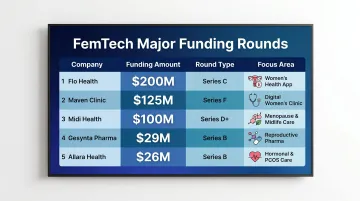
Notable 2024-2025 funding rounds:
| Company | Amount | Round | Focus |
|---|---|---|---|
| Flo Health | $200M | Series C | Period/pregnancy tracking (first FemTech unicorn) |
| Maven Clinic | $125M | Series F | Virtual women's & family health |
| Midi Health | $100M | Series D+ | Menopause care |
| Gesynta Pharma | $29M | Series B | Endometriosis treatment |
| Allara Health | $26M | Series B | Hormonal health telehealth |
Several structural forces are driving this investment surge:
- President Biden's March 2024 Executive Order directed a $12 billion Fund for Women's Health Research at the NIH, putting federal policy weight behind the sector
- Employer benefits expansion is creating B2B revenue channels — more companies now include fertility coverage in benefits packages
- FemTech startups produce twice the clinical trials, regulatory filings, and peer-reviewed publications compared to the digital health average
- FDA Breakthrough Device designations are lowering investment risk for key products: Baymatob Oli (postpartum hemorrhage), Focal One (deep infiltrating endometriosis), and Natural Cycles (software-based contraception)
The FDA's clearer regulatory frameworks for Software as a Medical Device (SaMD) are compressing go-to-market timelines — and that speed is exactly what's drawing institutional capital off the sidelines.
Why FemTech Brands Should Advertise in Executive Newsletters
FemTech brands face a critical reach problem. Social platforms frequently restrict women's health content under broad moderation policies. A February 2025 report surveying nearly 160 women's health businesses found:
- Nearly 70% had Google ads rejected
- Over 60% had Meta posts removed
- More than 50% had TikTok content removed
- Over one-third had Amazon accounts suspended
These restrictions affect even clinically validated products discussing menstruation, fertility, sexual health, or anatomy. Running consistent campaigns becomes nearly impossible.
Target Audience Alignment
FemTech's core customer is increasingly a high-income, educated, career-focused professional woman—precisely the demographic reading executive newsletters. Newsletter readers skew toward higher income (38% upper-income vs. 27% lower-income) and higher education (35% college graduates vs. 25% high school or less).
Trusted editorial channels reach this audience directly — without the suppression risk that makes social campaigns unreliable for women's health content.
Structural Advertising Advantages
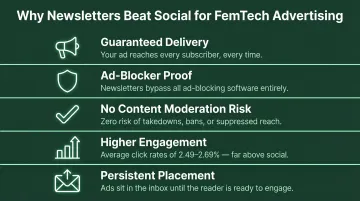
Newsletter advertising offers unique benefits that social and display channels cannot match:
- Guaranteed delivery: Every subscriber receives every issue — no feed prioritization, no suppressed reach.
- Ad-blocker proof: Blocking software targets web browsers, not email clients. Newsletter ads reach 100% of subscribers.
- No content moderation risk: Fertility, menopause, hormonal health, and reproductive wellness can all be discussed without fear of removal.
- Higher engagement: Ads arrive in primary inboxes during focused reading moments. Average email click rates for health industries range from 2.49% to 2.69% — well above display advertising benchmarks.
- Persistent placement: Unlike social posts, newsletter ads stay in inboxes until actively deleted.
Reaching Institutional Decision-Makers
As FemTech matures beyond direct-to-consumer apps, institutional decision-makers become critical:
- Investors evaluating funding opportunities
- Policymakers shaping healthcare regulation
- Healthcare systems considering partnerships
- Employer benefits managers selecting coverage
These audiences read executive newsletters. House of Summary's network — including Presidential Summary, Geopolitical Summary, London Summary, and Dubai Summary — serves over 500,000 subscribers in wealth-dense metros: 66% in the United States (primarily New York and Los Angeles), with strong audiences in London and Dubai.
Appearing alongside verified geopolitical analysis and business news builds a kind of credibility social campaigns cannot manufacture. For FemTech brands, that institutional legitimacy directly supports B2B sales conversations, partnership discussions, and investor relations.
Future Signals: Where FemTech Is Headed Next
Several trends will shape FemTech's evolution over the next one to three years:
EHR integration will move FemTech data into clinical workflows, transforming consumer apps into decision-support tools that qualify for insurance coverage and provider adoption.
Precision medicine built on hormonal mapping and genomics will enable individualized treatment, with cycle tracking as the foundation for personalized interventions across fertility, menopause, and chronic disease.
Category expansion into cardiovascular health, cancer screening, bone density monitoring, and longevity medicine broadens FemTech's market reach and pulls in mainstream health brand advertisers.
B2B shift: as FemTech moves from consumer apps toward employer benefits and hospital systems, advertising strategy pivots from end-user acquisition to institutional decision-maker outreach.
Reaching the people who negotiate enterprise contracts, approve hospital partnerships, and allocate employer benefits budgets requires channels built for decision-makers — not mass-market consumer platforms.
Frequently Asked Questions
What is the FemTech market?
FemTech (female technology) refers to products, services, apps, wearables, and digital health platforms designed to address health needs affecting women exclusively or disproportionately. Coverage spans menstrual tracking, fertility monitoring, pregnancy care, menopause management, chronic disease support, and mental wellness.
What is the projection for the FemTech market?
Allied Market Research values FemTech at $6.9 billion in 2023, projecting growth to $26.1 billion by 2033 at a 15.2% CAGR. Figures vary based on how broadly "FemTech" is defined: Grand View Research estimates $97.25 billion by 2030 using a broader market definition.
What are examples of FemTech?
Examples span multiple categories: cycle tracking apps (Flo, Clue), wearable fertility monitors (Ava bracelet, Oura Ring), at-home hormone testing kits (Mira, Modern Fertility), virtual women's health clinics (Maven Clinic, Tia), AI-powered diagnostic tools, and smart breast pumps (Elvie, Willow). Products range from consumer wellness apps to FDA-cleared medical devices.
How is FemTech improving fertility?
FemTech improves fertility outcomes through continuous biometric monitoring for ovulation prediction, at-home hormone testing that was previously clinic-only, and digital fertility platforms that reduce barriers to diagnosis. AI algorithms analyze patterns across thousands of cycles to deliver personalized reproductive health insights.
What are the biggest barriers to FemTech advertising on social media?
Social platforms routinely flag women's health content covering menstruation, fertility, and anatomy, making consistent campaign execution unreliable. With 70% of FemTech businesses reporting Google ad rejections and 60% facing Meta post removals, many brands are actively seeking alternatives.
Why are executive newsletters an effective advertising channel for FemTech brands?
Executive newsletters reach high-intent readers during focused reading moments with no algorithm interference, no ad blockers, and no content moderation risk. For FemTech brands expanding into institutional partnerships, they offer direct access to investors, healthcare decision-makers, employer benefits managers, and professional women.