
The stakes are real. The influencer marketing industry alone is projected to reach $32.55 billion in 2025, growing at 35.63% annually. That kind of growth means more competition for attention, more budget pressure, and more room for expensive mistakes when you pick the wrong channel.
This guide breaks down both strategies clearly — what each is, when each wins, and how to decide which one belongs in your next campaign.
Key Takeaways
- Branded content is editorially integrated into a publisher's channel — it IS the content, not an interruption to it
- Influencer marketing pays individuals to promote products directly to their social media followers
- Branded content wins on trust and long-term credibility; influencer marketing wins on speed and reach
- Neither always outperforms the other — your audience, goal, and measurement approach determine which fits
- For executive audiences, newsletter-based branded content delivers stronger engagement and conversion quality than social influencer posts
Branded Content vs. Influencer Marketing: Quick Comparison
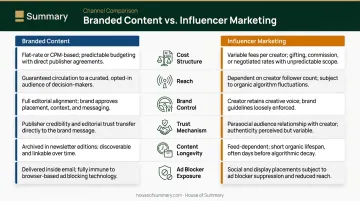
Here's how the two approaches stack up across the factors that matter most to media buyers and marketing teams:
| Factor | Branded Content | Influencer Marketing |
|---|---|---|
| Cost Structure | Flat sponsorship or editorial fee | Scales with follower count and engagement tier |
| Reach | Depends on publisher's existing audience | Built-in social distribution |
| Brand Control | High — brand retains editorial control | Lower — creative direction ceded to creator |
| Trust Mechanism | Borrows publication's credibility | Borrows creator's personal relationship with followers |
| Content Longevity | Longer shelf life (especially newsletter/editorial) | 24–48 hours before algorithm burial |
| Ad Blocker Exposure | None (email-delivered content bypasses blockers) | Algorithm-dependent; limited organic reach |
What Is Branded Content?
Branded content is material produced in collaboration between a brand and a publisher or creator, where the brand's message is woven into editorial-style content rather than placed beside it. The brand doesn't interrupt the experience; it becomes part of it.
Common formats include:
- Sponsored newsletter features
- Native articles in trade or niche publications
- Brand-funded podcast episodes
- Sponsored editorial videos
Why Audiences Actually Engage With It
Because branded content fits the look, feel, and voice of its publishing channel, readers consume it rather than skip it. Research from IPG Media Lab and Sharethrough found that consumers looked at native ads 53% more frequently than display ads, with 18% higher purchase-intent lift — a gap explained largely by the absence of the "this is an ad, ignore it" reflex that display formats trigger.
That reflex is a genuine problem for traditional digital advertising. Nearly 1 in 3 global consumers use ad blockers, including 21% who use them regularly. Nielsen Norman Group's research on banner blindness confirms that users have learned to ignore anything that looks like, sits near, or occupies the position of a traditional ad. Branded content sidesteps this entirely. Email delivery makes it even more effective: no algorithm filters the content, no ad blocker strips the placement, and no competing content pulls the reader's attention away.
The Trust Transfer Effect
When a brand appears in a publication its target audience already trusts, some of that credibility transfers. Readers associate the publisher's authority with the featured brand. This effect is most powerful in niche or specialized publications where the audience is self-selected and already highly engaged.
Newsletter-based branded content takes this further. The reader has opted in, and your message arrives alongside content they genuinely wanted. Specialized publications like those in the House of Summary network deliver this combination directly to the inbox, where attention is undivided and the editorial environment reinforces your brand's credibility.
When Branded Content Performs Best
- Building authority with executive or professional audiences
- Driving consideration for complex, high-ticket purchases
- Entering a niche market where editorial credibility matters
- Long-form storytelling campaigns that require context
What Is Influencer Marketing?
Influencer marketing pays individuals — from celebrity mega-influencers to niche nano-creators — to promote products or services directly to their established social media following through posts, stories, videos, or live content.
Influencer Tier Breakdown
| Tier | Followers | What It Delivers |
|---|---|---|
| Mega | 1M+ | Mass awareness, broad reach |
| Macro | 500K–1M | Wide niche distribution |
| Mid-tier | 50K–500K | Engaged niche communities |
| Micro | 10K–50K | Higher trust, stronger engagement rates |
| Nano | 1K–10K | Hyper-local, peer-level authenticity |
As follower count rises, engagement rates fall. Nano and micro influencers outperform mega-influencers on engagement percentage, even though their raw reach is smaller. Cost moves in the opposite direction — nano posts can start around $25, while mega-influencer placements can exceed $25,000.
The Core Strength
The appeal is personal recommendation from a voice the audience chose to follow. According to Sprout Social's 2024 research, 81% of social media users have made a purchase based on influencer content, and nearly half do so at least monthly. For brands chasing lower-funnel results, that conversion signal matters.
The Real Risks
- Inflated follower counts and fake engagement remain a measurable problem — third-party audit tools are essential before committing budget
- Disclosure fatigue — consumers increasingly recognize paid partnerships, which erodes the authenticity that makes influencer content work
- Post visibility isn't guaranteed, even to a creator's own followers, due to algorithm throttling
- Short shelf life — most social posts lose meaningful reach within 24–48 hours
When Influencer Marketing Performs Best
- Product launches requiring rapid consumer awareness
- D2C e-commerce in trend-driven categories (beauty, fashion, fitness, food)
- Time-sensitive campaigns with discount codes or limited-time offers
- Reaching younger demographics whose media consumption is primarily social
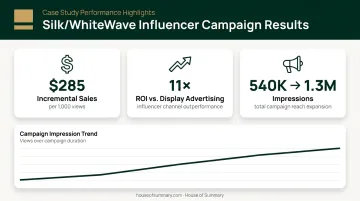
The results in those contexts can be striking. A TapInfluence and Nielsen Catalina Solutions study of a Silk/WhiteWave influencer campaign found $285 in incremental sales per 1,000 views and 11x the ROI of average display advertising over 12 months. The campaign used 258 fitness and food influencers for Meatless Monday content — impressions grew from 540,000 to 1.3 million with no additional paid distribution.
Which Strategy Actually Drives Better Results?
"Better results" is entirely goal-dependent. Here's how the two approaches compare across four dimensions that actually matter.
Dimension 1: Trust and Credibility
Branded content in a respected publication carries editorial credibility that paid influencer posts struggle to replicate for professional or skeptical audiences. When a reader encounters a sponsored feature in a newsletter they already read daily, the publication's authority extends to the brand being featured.
Influencer marketing delivers personal relatability. For younger, social-media-native audiences, a creator recommendation feels more like a friend's endorsement than an advertisement. Both forms of trust are real — they just work on different audiences.
Dimension 2: Attention and Engagement
Branded content captures deliberate, intent-driven attention. A reader working through a newsletter feature gives that content sustained focus — they're reading with purpose. Influencer posts capture fast, scroll-driven attention that competes with everything else in the feed simultaneously.
The Outbrain-commissioned Savanta research on native advertising found +28% average time spent on native content compared to social formats — a meaningful gap when the goal is brand consideration rather than just impression delivery.
Dimension 3: Measurability and ROI
Both channels are measurable. The methods differ:
Branded content metrics:
- Click-throughs from newsletter placements
- Referral traffic and time-on-page
- Open rates and click-to-open rates
- Conversion rates from publisher-tracked links
Influencer marketing metrics:
- Impressions and reach
- Engagement rate (likes, comments, shares)
- UTM-tracked website traffic
- Discount code redemptions
The meaningful difference is vanity metric exposure. Influencer campaigns are more susceptible to inflated impression counts and fake engagement — risks that require third-party auditing to manage. Branded content metrics are harder to game: an email open is an email open, a click is a click.
That transparency matters at the reporting stage. House of Summary provides advertisers with ad click activity, email opens, geographic distribution, and demographic data — metrics that reflect genuine audience engagement rather than algorithm-amplified impressions.
Dimension 4: Audience Fit and Context
Audience context determines which channel works — and it's where most campaign decisions go wrong.
- Branded content in newsletters or trade publications → B2B buyers, executives, policy professionals, high-intent niche audiences
- Influencer marketing on Instagram, TikTok, or YouTube → B2C audiences making visual, lifestyle-driven purchase decisions
A financial services brand targeting CFOs will see little return from a TikTok influencer campaign. A D2C skincare brand targeting Gen Z is equally mismatched with a sponsored newsletter feature in a business publication. The channel only works when the audience already lives there.
When to Use Each
Choose branded content when:
- Targeting professionals, executives, or high-intent niche readers
- Building long-term brand credibility in a specialized category
- Running campaigns where consideration quality matters more than raw reach
Choose influencer marketing when:
- Needing fast top-of-funnel awareness for a consumer product
- Operating in a trend-driven D2C category
- Trying to tap into a creator's existing niche community quickly
Use both when budget allows. Influencers can generate the initial awareness; branded content in trusted publications reinforces credibility and converts the high-intent readers who need more than a 30-second video to make a decision.
Conclusion
Branded content and influencer marketing aren't competing strategies — they serve different moments in the buyer journey and work on different audiences. Declaring one universally superior gets brands into trouble.
For brands targeting professional or executive audiences, the editorial credibility and attention quality of branded content typically delivers stronger long-term returns. For brands chasing rapid consumer awareness, influencer marketing remains a proven accelerator when the audience, platform, and creative align.
The practical rule: match the channel to the audience's context. A reader who opens a specialized newsletter every morning is in a different mindset than someone scrolling a social feed. Reaching both is possible. Reaching both effectively means choosing the format that fits how that audience actually consumes information — and what they're willing to trust when they do.
Frequently Asked Questions
What are the 4 R's of influencer marketing?
The four R's are Reach, Relevance, Resonance, and Return. Reach measures audience size; Relevance assesses content alignment with your brand; Resonance evaluates quality of audience engagement; Return tracks measurable campaign outcomes.
What is the difference between branded content and influencer marketing?
Branded content is woven into a publisher's channel — newsletters, articles, podcasts — where the brand's message becomes part of the content itself. Influencer marketing places brand promotions on a creator's personal social media, relying on their follower relationship rather than a publication's editorial authority.
Which is more cost-effective: branded content or influencer marketing?
It depends on audience fit. Branded content in niche publications can deliver higher-quality engagement per dollar for professional or executive audiences. Influencer marketing offers broader reach at varying price points, with micro and nano tiers often providing the strongest engagement rates relative to cost for consumer audiences.
What type of brands benefit most from branded content?
B2B brands, financial services, and luxury companies targeting executives or high-intent niche audiences see the strongest results. Credibility transfer from a trusted editorial environment matters most when purchase decisions require deliberate consideration.
Can branded content and influencer marketing be used together?
They work well in combination. Influencer marketing generates rapid awareness and drives initial traffic; branded content in trusted publications reinforces credibility and converts high-intent readers further down the funnel. The two strategies address different stages of the buyer journey rather than competing for the same role.
How do you measure the ROI of branded content vs. influencer marketing?
Branded content ROI is measured through click-throughs, referral traffic, time-on-page, and conversion rates from publisher placements. Influencer marketing ROI is tracked through impressions, engagement rate, UTM-tracked traffic, and discount code redemptions. Branded content metrics are less susceptible to the vanity metric inflation that can distort influencer campaign reporting.