
Introduction
Most bloggers assume sponsorship deals are reserved for accounts with hundreds of thousands of followers. They're not. Brands targeting niche, engaged audiences actively seek authentic voices that reach the right readers, not just the most readers.
The real barrier isn't audience size. It's not knowing where to start: what types of deals exist, where to find them, how to pitch, and what to charge. All of that is solvable — and this guide walks through each one.
You'll learn the main formats of sponsored content, which platforms connect bloggers with brands, how to write a pitch that gets responses, what the market actually pays, and the FTC rules you cannot ignore.
Key Takeaways
- Sponsored content is paid editorial: a brand funds content you create and distribute to your audience
- Main formats: sponsored posts, product reviews, newsletter sponsorships, native placements, and hybrid affiliate deals
- Start with marketplaces like IZEA and Intellifluence for quick access — direct outreach typically pays more
- Niche relevance and engagement rate matter more than raw audience size
- All sponsored content requires a prominent disclosure — "Sponsored" or "#ad" near the top
What Is Sponsored Content for Bloggers?
Sponsored content is paid editorial-style content that looks and reads like your regular work — but is funded by an advertiser. The FTC defines native advertising as digital content similar to the news, feature articles, product reviews, or entertainment surrounding it. What makes it advertising — and legally sensitive — is that it's paid for.
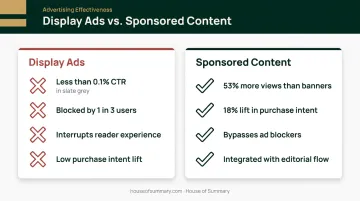
This is different from display ads at the core. A banner sits beside your content. Sponsored content is the content, written in your voice, published in your format.
That integration is why it works. According to eMarketer, native ads are viewed 53% more frequently than banner ads and produce an 18% lift in purchase intent. Readers engage with them because the content fits their context rather than interrupting it.
There's also an ad-blocking problem that sponsored content sidesteps. GWI reports that nearly 1 in 3 global consumers use ad blockers, with 63% citing too many ads as their reason. Sponsored blog posts and newsletter placements operate inside editorial environments that ad blockers weren't built to stop.
This staying power isn't accidental. Brand-funded serial dramas — the original "soap operas" — appeared on radio in the early 1930s, and the model has held up across print, TV, podcasts, and now newsletters precisely because it respects the audience's attention. For bloggers today, that track record matters: sponsored content is a proven format, not an experiment.
Types of Sponsored Content Opportunities for Bloggers
Sponsored Blog Posts
A sponsored post is an article you write (sometimes co-created with the brand) that promotes a product, service, or message. It lives on your site, follows your editorial format, and can generate SEO value long after publication — for you and for the brand.
This is the most common and direct format. Brands pay for the content creation, your audience, and the permanent placement.
Product Reviews and Roundups
Brands pay bloggers to review their product honestly, or to include them in "best of" roundup articles. Roundups are particularly high-value: readers searching "best project management tools for freelancers" are already in buying mode. Being featured in that article is far more targeted than a display impression.
Native and In-Content Placements
Rather than a standalone article, an in-content placement weaves a sponsor mention into an existing piece, similar to how YouTube creators handle mid-roll sponsor reads but adapted for written content. The reader's experience stays intact; the brand gets contextual exposure.
Newsletter Sponsorships
Newsletter sponsorships are one of the fastest-growing formats in digital advertising. A brand message lands directly in a subscriber's inbox, inside content they opted in to receive.
The engagement numbers support the premium. Mailchimp's December 2023 benchmarks show an average email open rate of 35.63% and click rate of 2.62% — far above what web display ads deliver. For comparison, most display ad click-through rates sit below 0.1%.
Premium newsletter networks like House of Summary — which reaches 500,000+ subscribers across Presidential Summary, Geopolitical Summary, Dubai Summary, and London Summary — report click-through rates 4x higher than Google AdWords for advertisers, according to documented client feedback.
That performance gap comes down to audience quality. Newsletters reach decision-makers and executives who've chosen to receive the content, making who's reading as important as how many.
What makes newsletter sponsorships stand out from other formats:
- No ad blockers — inbox placements bypass the tools that strip web display ads
- High signal audiences — subscribers opted in, so engagement reflects genuine interest
- Direct placement — no algorithm decides whether your message gets seen
- Durable attention — readers spend time with newsletters rather than scrolling past
Affiliate-Linked Sponsored Content (Hybrid)
Some deals combine a flat sponsorship fee with affiliate tracking links, so the brand pays both upfront and on performance. This differs from pure affiliate marketing, where you earn only on conversions with no guaranteed fee. The sponsored arrangement guarantees compensation regardless of clicks or sales.
Hybrid deals work well when you have strong audience trust in a product category, but they shift some revenue risk to you. Understand the distinction before agreeing to one.
Top Channels to Find Blog Sponsorship Opportunities
There are two main paths to sponsorship deals: joining marketplaces (inbound) and reaching out to brands directly (outbound). The most effective approach combines both.
Sponsored Post Networks and Marketplaces
Marketplaces act as matchmakers between bloggers and brands. You create a profile, list your niche and audience stats, and either apply for open campaigns or receive offers directly.
Key platforms to know:
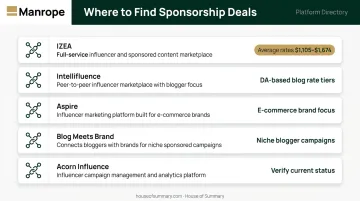
- IZEA — Active creator marketplace; IZEA's 2023 analysis of $70M+ in influencer payments shows average sponsored-post prices of $1,105 for nano creators and $1,674 for micro creators
- Intellifluence — Active influencer marketplace with blog-specific rate data by Domain Authority
- Aspire (formerly AspireIQ) — Rebranded platform connecting creators with e-commerce brands
- Blog Meets Brand — Has an active site; verify current campaign activity before applying
- Acorn Influence — Acquired by New Engen in 2022; check current status before applying
Sign up for several. Requirements and payout structures vary, and deal volume across platforms fluctuates.
Newsletter Sponsorship Platforms and Networks
If you publish a newsletter alongside your blog, this channel deserves serious attention. Brands pay a premium for inbox access to opted-in audiences because newsletters reach readers directly, without the algorithmic gatekeeping that limits social and search.
Paved reports that healthy newsletters commonly command $10–$30 CPM, with top-performing niche publications commanding significantly more. A newsletter with 3,000 subscribers can reasonably price placements at $75–$150 per issue using a simple flat-fee model (2.5%–5% of subscriber count).
Premium newsletter networks like House of Summary — covering global news, geopolitics, Dubai, and London — sell directly to brands like BSH Hausgeräte and serve categories including luxury, fintech, healthcare, and wealth management. Understanding how these networks price and package inventory gives bloggers with newsletters a clear benchmark for their own rate cards.
Direct Brand Outreach
Cold outreach removes the platform middleman and yields higher rates and more relevant deals. The process:
- Identify 10–20 brands whose products genuinely fit your audience
- Research the brand — know their recent campaigns, messaging, and target customer
- Write a concise pitch — personal opener, audience description, a specific partnership idea, key metrics, and one clear ask
- Follow up once if you don't hear back in 7–10 days
That last step matters more than most bloggers expect. Backlinko's analysis of 12 million outreach emails found that personalized subject lines and body copy correlated with above-average response rates. Generic "let's collaborate" emails get ignored. Specific ones — "I want to write a sponsored review of your X product for my audience of Y readers who care about Z" — get meetings.
Your "Work With Me" Page and Media Kit
A dedicated page on your site tells brands exactly how to work with you and saves both sides time. Your media kit (a one-to-two page PDF or web page) should include:
- Monthly sessions and traffic sources
- Email subscriber count, average open rate, and click rate
- Social reach and engagement rate
- Audience demographics (age, gender, location, professional background)
- Content formats you offer and sample sponsorship packages
- Past brand collaborations (even barter deals count early on)
- Clear rates or a "contact for rates" prompt
Brands scan engagement rate before follower count, according to GRIN's media kit guidance. Lead with the metrics that show audience quality, not just size.
How to Pitch Brands and Land Sponsorship Deals
Build Your Sponsor-Readiness Baseline
Before pitching, make sure you can demonstrate:
- A clearly defined niche (not "lifestyle" — be specific)
- Consistent publishing history (at least 3 months of regular posts)
- Basic analytics you can share: monthly sessions, email subscribers, engagement rate
- At least one previous collaboration — even a product exchange establishes proof of concept
These aren't gatekeepers. They're the minimum evidence a brand needs to justify internal approval.
Craft a Winning Cold Pitch
Keep it under 150 words. Every element should earn its place:
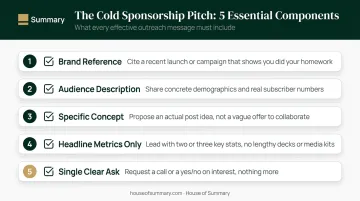
- Reference something specific about the brand: a recent product launch, campaign, or stated value
- Describe your audience in concrete terms ("28,000 monthly readers, 60% remote-work professionals based in the US and UK")
- Propose a specific sponsored post concept — not a vague offer to "work together"
- Include headline metrics only; don't attach a 12-page deck to a first email
- Close with one ask: a 15-minute call or a yes/no on interest
A tight pitch respects the brand's time — and that alone sets you apart from most bloggers in their inbox.
Follow Up and Negotiate Professionally
Most sponsorships don't close on the first email. Established brands have internal approval processes that take weeks. A polite follow-up after 7–10 days is appropriate: firm, not apologetic.
Know your floor rate before any negotiation starts. Counter-offers are expected. If a brand's initial offer falls below your minimum, say so directly and explain your reasoning. Rates are starting points, not verdicts.
FTC Disclosure Is Non-Negotiable
The FTC requires that any material connection to a brand — payment, free products, or other compensation — be disclosed clearly and prominently.
What this means in practice:
- Use "Sponsored," "Ad," or "#ad" — not vague terms like "spon" or "collab"
- Place the disclosure near the top of the post, not buried in a footnote or hashtag cluster
- Make it impossible to miss — not behind a "more" click, not in fine print
The FTC's 2016 action against Lord & Taylor is instructive: the brand funded a native article without proper disclosure and paid for it in both legal and reputational terms. Clear disclosure doesn't erode reader trust. It builds it.
How Much to Charge for Sponsored Content
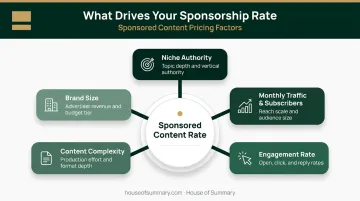
Sponsored content rates vary based on a combination of audience quality, content scope, and brand size. The inputs that move the needle most:
- Niche authority — a highly targeted audience commands more than a broad general one
- Monthly traffic and email subscribers — raw numbers plus growth trajectory
- Engagement rate — open rates, click rates, comments, shares
- Content complexity — a 200-word mention costs less than a 1,500-word sponsored article series
- Brand size — enterprise brands with larger marketing budgets warrant higher rates
Blog Post Rate Benchmarks
Intellifluence's 2023 survey of 1,700 creators gives blog-post rates by Domain Authority for 500–800 word posts:
| Domain Authority | Average Rate |
|---|---|
| DA 1–10 | $161 |
| DA 11–24 | $250 |
| DA 25–49 | $193 |
| DA 50+ | $260 |
These are minimum benchmarks. IZEA's broader market data shows mid-tier creator sponsored posts averaging $3,396 — a gap that reflects audience size, platform reach, and negotiation leverage.
Newsletter placements follow a different pricing logic, typically tied to subscriber count rather than domain metrics.
Newsletter Rate Benchmarks
- CPM model: $10–$30 per 1,000 subscribers for a primary placement (Paved, 2024)
- Flat fee (starter): 2.5%–5% of subscriber count — so 3,000 subscribers = $75–$150 per issue
- Secondary placements: 50%–65% of primary rate
- Dedicated email sponsorships: 2–5x the primary placement rate
Flat Fee vs. Performance-Based
Flat fees work best for content-heavy work. You get paid for your time and audience access regardless of how many clicks the brand gets.
Performance-based deals (CPC or affiliate commission) shift the risk onto you. They can pay off when you have genuine audience trust in a product category and solid tracking in place. That said, avoid performance-only arrangements for work that requires significant content creation time — the math rarely works in your favor.
Frequently Asked Questions
What are the main types of sponsorships?
The primary formats are sponsored posts, product reviews and roundups, native in-content placements, newsletter sponsorships, and hybrid affiliate-sponsored deals. Each differs in deliverable, audience access, and payment structure, ranging from flat fees to performance commissions.
How much should I charge for a sponsored blog post?
Rates vary by niche, traffic, and content complexity. Entry-level rates start around $150–$260 for smaller blogs, climbing into the thousands as audience size and authority grow. Factor in research, writing, revisions, and the long-term placement on your site — never price below the value of your time.
Do I need to disclose sponsored content on my blog?
Yes. FTC guidelines require clear, prominent disclosure of any material connection to a brand. The disclosure must appear near the top of the content — not in a footnote, buried hashtag, or behind a click. "Sponsored" and "#ad" are both acceptable; "spon" or "collab" are not.
What is the difference between sponsored content and native advertising?
Native advertising is the broader category, covering paid search ads, content recommendation widgets, promoted listings, and more. Sponsored content is a subset: a brand funds editorial-style content created by a publisher or blogger.
Can beginner bloggers with small audiences get sponsorships?
Yes. Audience size is one factor, not the only one. A highly engaged niche audience of 2,000 readers can be more valuable to a specific brand than a disengaged general audience of 50,000. At the early stage, niche clarity, consistent publishing, and a professional media kit matter more than raw traffic numbers.