Yet some organizations are producing genuinely impressive results. According to Press Ganey's State of HX report, 84% of healthcare consumers would not consider a physician rated below 4 stars — which means digital reputation and marketing aren't optional; they're the first filter patients apply before ever picking up the phone.
This post walks through real-world healthcare marketing case studies across both patient-facing and B2B contexts, extracts the lessons behind each win, and gives marketers a practical framework to apply these insights regardless of organization size or budget.
Key Takeaways
- Patient campaigns built around emotional storytelling consistently outperform feature-led messaging
- B2B healthcare marketing works best with account-based strategies, intent data, and sales-marketing alignment
- Top campaigns measure outcomes — appointments booked, referrals generated, deals closed — not impressions
- Channel mix matters: high performers combine SEO, paid media, social, and direct-to-inbox channels
- Newsletter advertising remains underutilized in healthcare, yet it bypasses ad blockers and lands directly with opted-in, high-intent readers
What Makes Healthcare Marketing Uniquely Challenging
Healthcare marketing sits at an unusual intersection: heavy regulation, intense competition, and audiences that couldn't be more different from each other.
First, the saturation problem. The AHA's 2025 Fast Facts counts 6,093 U.S. hospitals, with 3,525 of them operating as part of a larger system. Add ambulatory clinics, private practices, and telehealth platforms, and the competitive landscape is enormous.
Second, the regulatory constraint. HHS guidance on online tracking technologies makes clear that HIPAA-covered entities may not disclose protected health information to ad-tracking vendors without strict conditions met. This rules out many standard retargeting and pixel-based approaches that other industries take for granted.
Third, the dual audience problem. Healthcare marketers frequently serve two completely different buyers:
- Patients making emotionally charged, often fear-driven decisions about their health
- B2B buyers (hospital CIOs, procurement leads, referring physicians) navigating long sales cycles with multiple stakeholders and institutional gatekeepers
Most marketing frameworks are built for one audience type or the other. Healthcare marketers need both — and reaching each requires a different message, channel mix, and way of measuring success.
Case Studies: Patient-Facing Healthcare Marketing That Worked
These campaigns targeted patients and the general public across different organization sizes and specialties. In each case, emotional resonance outperformed clinical credentials.
Emotional Storytelling: New York Presbyterian and Dana-Farber
NewYork-Presbyterian's "Amazing Things" campaign is one of the most documented examples of patient storytelling in hospital marketing. The campaign built a YouTube playlist of 55 patient-story videos featuring real patients, doctors, and nurses — individual stories like Michael Kiernan's account accumulated 881,000 views, with other stories reaching between 366,000 and 499,000 views each.
In healthcare, peer stories reduce fear and build trust faster than any clinical credential. Watching someone who looks like you describe their hospital experience — and emerge healthy — is more persuasive than a list of accreditations.
Dana-Farber Brigham Cancer Center took a similar approach with its "You Have Us" campaign, producing patient-journey videos centered on the vulnerability of a cancer diagnosis. The slogan addressed what patients most fear: facing a frightening process alone.
By positioning the care team as a constant presence throughout treatment, the campaign matched its message to patients' actual psychological state. That alignment is what made it work — and what separates resonant healthcare marketing from mere awareness-raising.
Hashtag and Social Campaigns: Arkansas Children's and Carilion Clinic
Arkansas Children's Hospital's #100DeadliestDays campaign addressed a real, documented safety concern — the elevated risk of child injury between Memorial Day and Labor Day — with a memorable, slightly alarming hook. Other providers and physicians picked up the hashtag to share safety tips, amplifying reach organically. Parents had a genuine reason to engage, not just a brand message to scroll past.
Carilion Clinic's #YesMamm campaign took a different approach. Rather than broadcasting messaging, Carilion held a live Twitter Q&A session in October 2014 where clinicians answered real breast-health questions in real time. The result: people got answers they actually needed, and Carilion's mammogram scheduling page — branded with the YesMamm name — created a direct path from social conversation to appointment booking.
Both campaigns share a common principle: social works when it solves something real for the audience, not when it simply raises awareness.
Digital Advertising and Local SEO: KC Wellness Center
KC Wellness Center ran a targeted local digital campaign promoting a prescription weight-loss injection, using geofencing, Google Ads, and social media to reach patients in a specific geographic area.
Verified results from the campaign include:
- 137,461 impressions from geofencing ads
- 135,000 video views
- $3.61 CPM — well below standard geofencing benchmarks
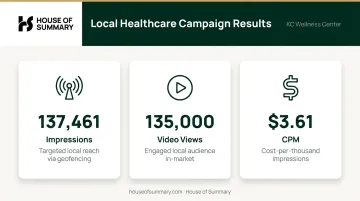
Local, high-intent patient acquisition doesn't require a large-scale media budget. The right targeting setup, matched to a specific service and geography, produces efficient reach at a fraction of what broad digital campaigns cost.
Case Studies: B2B Healthcare Marketing Success Stories
B2B healthcare marketing targets a fundamentally different buyer — one who operates through institutional processes, committee approvals, and long evaluation cycles. The campaigns that succeed in this context look nothing like patient-facing marketing.
Clinical Case Studies as a Physician Referral Tool
Central Texas Spine Institute, led by Dr. Randall Dryer, used a disciplined content approach to build referral relationships with primary care physicians, internists, orthopedists, and chiropractors.
Every eight weeks, the practice produced a one-page clinical case study — structured around History, Diagnosis, Treatment, and Results — printed on high-quality paper and distributed directly to referring providers.
The outcome: unsolicited follow-up calls from physicians requesting more case studies, and improved referral relationships without requiring Dr. Dryer to leave his practice for marketing activities.
For any specialty practice, clinical content framed around outcomes outperforms promotional messaging with referring physicians. A case study functions as both a leave-behind and a credibility signal — competence shown through evidence, not asserted through advertising.
Account-Based Marketing: Caregility and Nuvolo
Caregility, a healthcare technology company, built an ABM model targeting approximately 300 enterprise-level accounts using Salesforce, Demandbase, and Pardot. Their framework tracked accounts through four stages: anonymous research, initial lead, stakeholder expansion, and purchase.
One documented deal involved a hospital buying journey lasting over 13 months, a presentation to more than 30 decision-makers and influencers, and the eventual purchase of two solutions in Q1 2023. The key insight from Caregility's CMO: at any given time, only about 20% of target accounts are actively buying — which makes intent data essential for identifying which accounts deserve sales attention now versus which need nurturing.
Nuvolo took an even more targeted approach with two distinct tactics:
- 1:1 ABM outreach: Custom-branded landing pages built around each account's demonstrated interests
- Stakeholder-specific messaging: Account-specific content for complex, multi-stakeholder deals where generic pitches would have been dismissed
ABM Pilot with Measurable ROI
A large healthcare technology firm (anonymized in the source) ran a 120-day ABM pilot focused on cross-selling Remote Patient Monitoring to its existing customer base of roughly 600 organizations. The pilot used intent data and LinkedIn campaigns under a "Think Crawl Walk Run" phased framework.
Results from the pilot and the six months following:
- 31 meetings booked during the pilot
- 17 qualified opportunities identified
- $2.7 million in closed deals within six months of completion
- 300+ leads identified from intent data signals
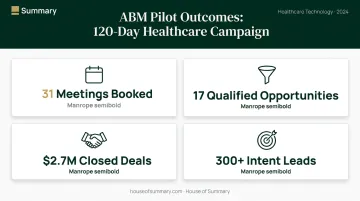
The core lesson: a tightly scoped pilot with defined success metrics is the most defensible path to organizational buy-in — prove ROI at small scale before asking for cross-functional commitment.
Key Lessons from These Healthcare Marketing Case Studies
Lesson 1: Lead with Trust, Not Features
Across every case study above — patient-facing or B2B — the campaigns that performed best led with outcomes, peer proof, and credibility. NewYork-Presbyterian's patient videos, Dana-Farber's journey storytelling, Central Texas Spine Institute's clinical case studies: none of them led with a feature list or a brand claim.
Real patients, real physicians, real data — results do the talking. The brand's role is context, not the headline.
Lesson 2: Match Message to Buyer Stage
Both B2B and patient marketing benefit from thinking in stages:
- Awareness content (educational blogs, hashtag campaigns, safety messaging) introduces the brand and establishes relevance
- Consideration content (testimonials, case studies, Q&A sessions) builds credibility and differentiates
- Decision content (personalized outreach, clinical evidence, appointment pathways) converts
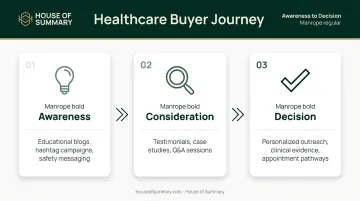
Healthcare marketers who serve awareness content to people ready to decide — or decision content to people who've never heard of them — waste budget at both ends.
Lesson 3: Measure Outcomes, Not Vanity Metrics
The campaigns in these case studies tracked things that matter:
| Organization Type | Outcome Metrics That Matter |
|---|---|
| Hospital / health system | Appointment bookings, patient acquisition cost |
| Specialty practice | Referral calls received, new patient volume |
| Healthcare technology firm | Qualified opportunities, pipeline value, deals closed |
| Medical device / pharma | Rep meeting bookings, account engagement scores |
Impressions and follower counts belong in reporting, but they shouldn't be the primary success criteria for any campaign with a real budget behind it.
Lesson 4: Personalization Scales in B2B, Storytelling Scales in B2C
The contrast is clear in the data:
- B2B healthcare (ABM, physician referral marketing): account-level personalization — custom landing pages, intent-triggered outreach, stakeholder mapping — is the deciding factor
- Patient-facing marketing: emotional storytelling that feels personal at scale drives conversions, not personalized targeting
B2B audiences need to feel seen at the account level. Patient audiences need to feel understood at the human level. Conflating the two dilutes both.
Lesson 5: Patience and Consistency Win Long Cycles
Caregility's documented deal took over 13 months to close. The RPM ABM pilot took six months post-completion to generate its $2.7M return. Arkansas Children's #100DeadliestDays built awareness across multiple summers before it became widely recognized.
Healthcare marketing is not a one-campaign discipline. Consistent presence — the same message, the same channels, the same quality — builds the familiarity that eventually converts to referrals, deals, and appointments.
Choosing the Right Marketing Channels for Healthcare
Channel selection is where many healthcare marketers stall. The proven channels from the case studies above include:
- Local SEO and Google Ads — effective for patient acquisition at the practice level (KC Wellness Center)
- Social media campaigns — work best with a direct path to action, not just awareness (Carilion #YesMamm, Arkansas Children's)
- Video marketing — the strongest trust-building format for patient-facing campaigns (NewYork-Presbyterian, Dana-Farber)
- Clinical content marketing — high credibility with referring physicians and B2B decision-makers (Central Texas Spine Institute)
- ABM platforms — essential for complex B2B sales with multiple stakeholders (Caregility, Nuvolo)
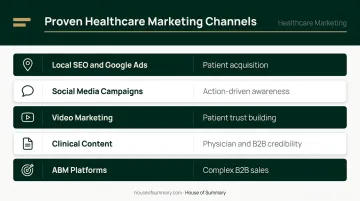
One channel consistently underused in healthcare marketing warrants a closer look: direct-to-inbox newsletter advertising.
The Case for Newsletter Advertising in Healthcare
The reason is structural. With 827 million active ad-block users globally, display advertising has an increasingly leaky reach problem.
Newsletter ads bypass this entirely — because ad blockers target website-delivered ads, not inbox content. When your ad appears inside a newsletter someone subscribed to and actively opened, it reaches them without algorithmic interference and without banner blindness.
For healthcare brands specifically, this matters because the audience of premium newsletters skews heavily toward the executive and professional readers who are both healthcare decision-makers in their organizations and high-income consumers of premium healthcare services.
House of Summary's newsletter network — spanning Presidential Summary, Geopolitical Summary, Dubai Summary, and London Summary — reaches 500,000+ subscribers with 254,866+ emails opened daily. The audience is 66% US-based (concentrated in New York and Los Angeles), with significant reach in London and Dubai. The reader profile consistently includes decision-makers, executives, and policy professionals: exactly the audience healthcare brands targeting affluent consumers, hospital executives, or health system purchasing leaders need to reach.
Regulatory constraints add another reason to consider this channel. Newsletter advertising sits inside brand-safe, human-written content — a more compliance-friendly context than the open web, where unpredictable content adjacency creates real brand risk.
A Simple Channel Framework
| Audience | Budget Stage | Recommended Starting Channels |
|---|---|---|
| Local patients | Testing | Local SEO + Google Ads |
| National patients | Scaling | Video + social + content marketing |
| Referring physicians | Any | Clinical case studies + direct mail |
| Hospital executives / B2B | Testing | ABM platforms + newsletter advertising |
| Hospital executives / B2B | Scaling | Full ABM + content + newsletter placements |
Start with one or two channels where the audience match is clearest. Then expand based on what's actually working.
Frequently Asked Questions
What makes healthcare marketing different from other industries?
Healthcare marketing operates under HIPAA compliance requirements, heightened trust sensitivity from both patients and clinicians, and long B2B sales cycles involving multiple institutional stakeholders. These constraints require more credibility-driven, outcome-focused strategies than most other sectors, where promotional claims face less scrutiny.
Which healthcare marketing channels tend to deliver the best ROI?
Local SEO and paid search perform well for patient acquisition; ABM tools, clinical content, and newsletter advertising consistently outperform for B2B healthcare targets. ROI depends heavily on how well the channel matches buyer intent — a mismatch between channel and audience stage is the most common cause of weak returns.
How do you measure success in a healthcare marketing campaign?
Effective healthcare marketers track outcome metrics: appointments booked, referrals generated, qualified opportunities created, and deals closed. Dashboards that connect marketing activity to real business results — rather than stopping at impressions or clicks — give leadership a defensible view of marketing's contribution.
What is account-based marketing (ABM) and why does it work in healthcare?
ABM focuses resources on a defined list of high-value target accounts using personalized content and multi-channel outreach. It fits B2B healthcare well because buying decisions involve multiple stakeholders, long evaluation cycles, and high deal values — conditions where broad-reach advertising wastes budget and targeted engagement closes deals.
Can small medical practices benefit from these types of campaigns?
Several case studies here — KC Wellness Center, Carilion Clinic, Central Texas Spine Institute — involved smaller or regional practices that achieved strong results with focused tactics. The common thread: they picked one or two high-ROI approaches rather than attempting multi-channel campaigns before proving what worked.
How does newsletter advertising fit into a healthcare marketing strategy?
Newsletter advertising reaches opted-in readers who chose to receive the content — meaning no algorithms filtering delivery and no ad blockers stripping placements. For healthcare brands targeting executives or health-conscious professionals, this direct inbox access makes newsletters an efficient channel for messages that require context and trust to land.