
The answer isn't more spend. It's a smarter approach to how brands earn attention in the first place — and that's exactly what branded content strategy is built for.
This guide covers what branded content strategy actually is, the five pillars that make it work, a step-by-step framework to build one, the best formats and channels for distribution, and how to measure what matters.
Key Takeaways
- Branded content earns attention through storytelling and shared values — audiences seek it out rather than skip past it
- A joint study by Forbes, IPG Media Lab, and Syracuse University found branded content delivers 59 percentage points higher brand recall than display advertising
- The five pillars: audience intelligence, brand truth, emotional storytelling, platform fit, and participation
- Newsletters are among the highest-performing branded content channels — opt-in audiences, no ad blockers, no algorithmic filtering
- Measure branded content on engagement depth, sentiment, and brand recall rather than immediate click-through rates
What Is a Branded Content Strategy (and What It's Not)
A branded content strategy is a deliberate plan for telling a brand's story in ways that earn audience attention rather than demanding it. The focus is emotion, shared values, and genuine connection — not product promotion or sales messaging.
In practice, though, branded content gets confused with adjacent tactics that look similar on the surface but serve different purposes.
How It Differs from Adjacent Tactics
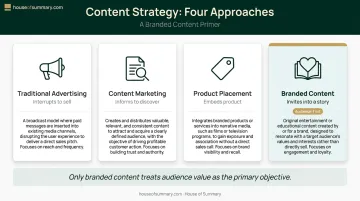
| Format | Purpose | Approach |
|---|---|---|
| Traditional advertising | Drive immediate action | Interrupts to sell |
| Content marketing | Educate and rank organically | Informs to build discovery |
| Product placement | Highlight a specific product | Embeds product within content |
| Branded content | Build identity and emotional connection | Invites audience into a story |
The IAB's Branded Content Creation and Distribution Guide defines branded content as brand-sponsored content that is non-promotional in nature — a meaningful distinction from advertising, which exists to drive a transaction.
The Defining Characteristic
What the table above makes clear is that only branded content treats audience value as the primary objective — not a side effect. The brand earns trust and recall as a byproduct, not the headline.
Audiences aren't pitched at; they're invited into something worth their time. When that invitation lands — whether through a story that moves them or information that helps them — people share it, return to it, and carry those associations with the brand long after the content disappears from their feed.
Why Branded Content Consistently Outperforms Traditional Advertising
A joint study by Forbes, IPG Media Lab, and the Syracuse University Newhouse School found that brand recall was 59 percentage points higher for branded content than for display and native ads. Consumers were also 14% more likely to seek out additional brand content after a single exposure.
Why Traditional Advertising Is Losing Its Grip
Ad avoidance isn't new, but it's accelerating. eMarketer reports 2024 YouGov data showing that 52% of consumers globally have installed or used an ad blocker — with the US figure at 45%. Add in platform-level ad skipping on streaming services, and the reach brands think they're buying is significantly smaller than it appears on paper.
Traditional advertising was built for captive audiences. Branded content works precisely because it doesn't need to trap anyone — it earns attention instead.
The Compounding Advantage of Branded Content
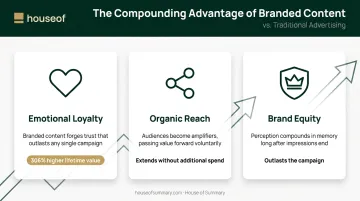
Branded content doesn't just perform better in the short term — it builds value over time in ways ads cannot.
- Emotional loyalty compounds: Motista's research found that consumers emotionally connected to a brand have 306% higher lifetime value than merely satisfied customers
- Organic reach extends without additional spend: Content people find genuinely valuable gets shared, discussed, and referenced — without a budget line
- Brand equity outlasts the campaign: A well-produced brand documentary or editorial series continues working months after publication; a display ad stops the moment the budget does
The Core Pillars of a Winning Branded Content Strategy
Audience Intelligence First
Strong branded content strategies don't begin with a campaign idea. They begin with a deep, specific understanding of the audience — their emotional drivers, the content they actually consume, the conversations they're already having.
Useful audience personas go beyond age and job title. Build them around:
- Motivations: What does this person want to feel, achieve, or avoid?
- Content behavior: What formats do they complete? What do they share?
- Active conversations: What tensions or questions are they navigating right now?
- Scroll-stoppers: What makes this specific person pause?
Demographics describe an audience. Behavior reveals what actually moves them — and that's where content strategy begins.
A Clear and Consistent Brand Truth
Every piece of branded content should connect back to a single, authentic brand idea — one that stays consistent across formats, platforms, and campaigns.
Red Bull is the textbook example. Across documentaries, events, athlete partnerships, and social content, every piece connects to the same underlying idea: energy and human possibility. Red Bull has never needed to push an individual product because the brand itself carries the story.
Fragmented messaging — different themes on different channels, inconsistent tone across formats — erodes trust rather than building it. Audiences sense when a brand doesn't know what it stands for.
Emotional Storytelling Over Rational Messaging
The IPA Effectiveness Databank analysis by Les Binet and Peter Field, covering nearly 1,000 campaigns, found that 29% of emotional campaigns generated very large profit growth versus 16% of rational campaigns. Over a three-year period, that gap widens further: 43% of emotional campaigns reported very large profit growth versus 23% of rational campaigns.
Rational campaigns can outperform on immediate direct effects. But for building brand equity and long-term business results, emotional content wins consistently.
This isn't about manipulation. It's about making people feel something real — a sense of recognition, shared values, or a reason to care beyond the product itself.
Platform and Format Fit
A powerful brand story delivered in the wrong format for the wrong channel will underperform. What "native" looks like varies significantly by platform:
- LinkedIn: Conversational, insight-driven, professionally grounded
- Instagram Reels / TikTok: Fast, visually punchy, culturally resonant
- YouTube / Podcasts: Long-form, narrative, slow-build storytelling
- Newsletter inbox: Focused, distraction-free, high-intent reading environment
Content repurposed without adaptation signals that a brand didn't think about how that audience actually shows up on that channel. A podcast episode dropped into a LinkedIn post without rethinking the format isn't cross-channel strategy — it's copy-paste. Getting format right is also about respecting how audiences choose to engage, which leads directly to the next pillar: giving them room to engage back.
Participation and Co-Creation
Modern branded content strategies build in mechanisms for audiences to participate — UGC campaigns, community input, creative open briefs, social call-outs. The difference this makes is significant.
Stackla's research found that consumers are 2.4 times more likely to view user-generated content as the most authentic content compared to brand-produced visuals. Participation turns passive viewers into active advocates. It extends reach organically and adds credibility that brand production alone can't manufacture.
How to Build Your Branded Content Strategy: A Step-by-Step Framework
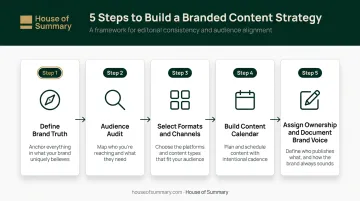
Step 1 — Define your brand truth
Identify the intersection of what your brand genuinely stands for and what your target audience actually cares about. This is the strategic foundation. Without it, every piece of content becomes disconnected from the next, and the cumulative brand impression never adds up to anything.
Step 2 — Conduct a thorough audience audit
Research where your audience spends focused attention, which content formats they complete, and what questions they're actively asking. Useful tools:
- Social listening platforms (Brandwatch, Sprout Social)
- Keyword and search intent data
- Community forums (Reddit, LinkedIn groups, Quora)
- Direct customer conversations — surveys, sales calls, support tickets
Step 3 — Select core formats and channels
Choose 2–3 primary formats and channels that match where your audience is and what your team can execute well. Consistent, well-made content on two channels outperforms thin, inconsistent presence across six.
Step 4 — Build a content calendar that mixes timely and evergreen
Reactive content captures real-time attention. Evergreen content builds brand equity for months. A simple planning structure:
- Monthly themes anchored to brand pillars
- Weekly content types (one longer piece, two or three social expressions)
- A monthly review cycle to assess what's resonating and adjust
Step 5 — Assign ownership and document brand voice
Branded content without a dedicated owner defaults to inconsistency. Brand voice documentation should include:
- Tone principles (what it sounds like, what it never sounds like)
- Language rules (words the brand uses, words it avoids)
- Storytelling approach (what kinds of stories the brand tells and how it tells them)
With this foundation in place, internal teams, freelancers, and media partners can all contribute without fragmenting the brand.
The Best Formats and Channels for Branded Content Distribution
Format Overview
| Format | Best For |
|---|---|
| Short-form video (Reels, TikTok) | Broad awareness, shareability, cultural reach |
| Long-form video / documentary | Deep brand storytelling, emotional impact |
| Podcasts | Thought leadership, long-duration engagement |
| Editorial / blog content | SEO-driven discovery, category authority |
| Newsletter placements | Direct access to high-intent, opted-in audiences |
Why Newsletter Advertising Belongs in Your Mix
Newsletter placements occupy a unique position in the branded content landscape. Unlike social media or display, newsletters reach readers who have actively chosen to subscribe, in a focused reading environment where:
- Ad blockers don't apply — email delivery bypasses browser-based blocking entirely
- No algorithmic filtering : the brand's message arrives as sent, every time
- No competing visual noise : the reader's attention is already engaged with the content
The DMA's 2023 Consumer Email Tracker found that 53% of consumers prefer email for receiving information about new products or services from brands. That preference has grown as email quality has improved — the same report shows that the share of consumers finding at least half of their brand emails useful doubled from 15% in 2021 to 32% in 2023.
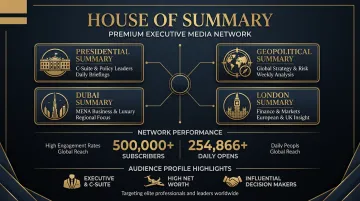
For brands targeting executives, decision-makers, and high-income professionals, specialized newsletter networks like House of Summary offer direct access to opted-in audiences who are genuinely hard to reach through programmatic or social channels.
The House of Summary network reaches 500,000+ subscribers across four publications — Presidential Summary, Geopolitical Summary, Dubai Summary, and London Summary — with 254,866+ emails opened daily. Readers skew toward C-suite executives, policy professionals, and high-net-worth individuals across the US, UK, and UAE.
BSH Hausgeräte's campaign with Dubai Summary delivered click-through rates 4x higher than Google AdWords. That result reflects what opt-in, editorially-aligned audiences actually do with branded content when it reaches them in the right context.
Content Atomization: One Piece, Many Expressions
A single core branded content piece — a brand documentary, a long-form article, a campaign film — can generate months of distribution:
- Pull quotes → LinkedIn and newsletter snippets
- Key findings → short-form social video
- Visual moments → Instagram and stories content
- Core narrative → email segment and podcast episode
This approach multiplies content ROI without starting from zero on each channel. More importantly, it keeps the brand message cohesive across channels rather than producing disconnected one-offs.
Follow Audience Behavior, Not Platform Trends
Channel selection should follow where your specific audience pays focused attention — not where they passively scroll. There's a meaningful difference between a platform someone opens out of habit and one where they actually read, listen, and engage.
Audit your audience's media consumption habits before choosing channels. Then build depth on the channels that earn real attention, rather than spreading thinly across every platform showing growth numbers.
How to Measure Branded Content Performance
Branded content requires a different measurement lens than direct-response advertising. Judging it by immediate click-through rates is like judging a documentary by its opening weekend box office — it measures the wrong thing entirely.
Tiered Measurement Framework
Short-term indicators (weeks 1–4):
- Engagement depth: time spent, video completion rates, scroll depth
- Social sharing and organic amplification
- Audience comments and qualitative responses
Long-term brand health signals (months 2–6+):
- Brand recall and awareness lift
- Sentiment shifts in social listening data
- Branded search volume changes (a reliable indicator of mental availability)
- Downstream influence on conversion — not immediate attribution, but trend correlation
Binet and Field's IPA analysis demonstrates why this longer lens matters: rational campaign effects largely plateau after one year, while emotional campaign effects continue building after three years. Pulling branded content spend because week-one ROI looks flat means abandoning the investment before it compounds — which is exactly where the value builds.
Set Measurement Objectives Before Launch
Before a campaign goes live:
- Define the specific goal: awareness, trust-building, or conversion influence
- Establish a baseline for the metrics you'll track
- Set a review cadence (monthly, not weekly)
- Align stakeholders on what success looks like at 3 months, not 3 weeks
Qualitative Signals Matter Too
Quantitative metrics take time to move. Unsolicited audience comments, media pickup, organic shares, and spikes in inbound inquiries signal real resonance well before dashboards catch up. Don't dismiss them as anecdotal. These are the early signals that tell you whether the content actually landed — and they reliably precede the numbers that follow.
Frequently Asked Questions
What is a branded content strategy?
A branded content strategy is a deliberate plan for using storytelling and brand values to earn audience attention and trust. Unlike interruptive advertising, audiences choose to engage with branded content — which is what makes it more memorable and more effective at building long-term brand equity.
What is the 3-3-3 rule for marketing?
The 3-3-3 rule is a content framework built around 3 core content themes or pillars, distributed across 3 primary channels or formats, published with consistent frequency. It's designed to keep content strategy focused and manageable rather than scattered across every possible topic or platform.
What is the difference between branded content and content marketing?
Content marketing typically aims to educate, inform, and drive organic search discovery — it's often SEO-driven. Branded content is more emotionally focused, designed to build brand identity and create connection through storytelling rather than information delivery. Use content marketing to capture demand; use branded content to build the identity that makes demand worth capturing.
How do you measure the success of branded content?
Key metrics include brand recall, engagement depth (time spent, completion rates), sentiment shifts, organic sharing, and downstream influence on conversion over time. Branded content KPIs require longer attribution windows than direct-response campaigns. Measuring over weeks rather than days will give you a more accurate read.
What formats work best for branded content?
Video, newsletters, podcasts, and long-form editorial content consistently perform well. The best format depends on where your target audience pays focused attention — not what format is currently trending. Chasing platform trends at the expense of audience fit is one of the most common — and costly — mistakes in branded content planning.