
Here's the counterintuitive reality: proper disclosure doesn't undermine a native ad's effectiveness. Research suggests it can actually strengthen brand perception among readers who notice the label. The brands most resistant to clear disclosure are often the ones leaving the most trust — and performance — on the table.
This article covers what the FTC actually requires, which disclosure terms pass legal muster and which don't, how placement affects whether anyone notices the label at all, and why newsletter advertising carries a structural disclosure advantage that web formats can't replicate.
Key Takeaways
- Native ads must be labeled before readers engage — not buried below the headline or disclosed only on the landing page.
- The FTC's approved terms are "Ad," "Advertisement," "Paid Advertisement," and "Sponsored Advertising Content" — vague labels like "Promoted" or "Presented By" don't meet the standard.
- Proper disclosure doesn't hurt performance — it increases perceived transparency and improves brand trust with readers.
- Both advertisers and publishers share legal responsibility for compliant disclosure — brands can't delegate this entirely to the platform.
- Newsletter native ads reach readers without ad blockers or algorithms — but explicit labeling is still legally required.
The Disclosure Paradox: Why Being Transparent Helps, Not Hurts
The instinct to minimize disclosure is understandable. Brands worry that a prominent "Ad" label will trigger skepticism and reduce engagement before the reader even reaches the message. The research tells a more nuanced story.
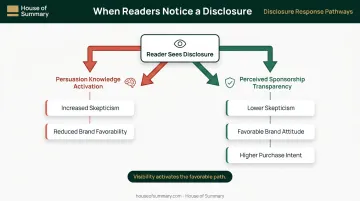
A 2023 study published in the Journal of Interactive Advertising by Van Reijmersdal, Brussee, Evans, and Wojdynski identified two competing mechanisms activated when readers notice a disclosure:
- Persuasion knowledge activation — the reader recognizes commercial intent, which can increase skepticism and reduce brand favorability.
- Perceived sponsorship transparency — the reader interprets the disclosure as a signal of honesty, which lowers skepticism and produces more favorable brand attitudes and higher purchase intent.
The transparency pathway can produce better outcomes for brands — but only when the disclosure is actually noticed. This is the practical implication most advertisers miss. Making a disclosure visible isn't a concession; it's a strategic decision that activates the more favorable response pathway.
The "Transparency Dividend"
A reader who knows upfront that content is paid for is less likely to feel deceived later. That absence of betrayal is consequential. The Reuters Institute's 2024 Digital News Report found that 59% of global news consumers are concerned about distinguishing real from fake content online, a climate in which any hint of deception carries outsized reputational damage.
The practical takeaway: treat disclosure prominence as a performance variable, not just a compliance checkbox. If readers don't see the label, you get the worst of both worlds — legal exposure without the trust benefit.
What the FTC Actually Requires: The Legal Foundation
The FTC's disclosure standard goes beyond a simple "label everything" rule. According to the FTC's Native Advertising Guide for Businesses and the Enforcement Policy Statement on Deceptively Formatted Advertisements, disclosure is required when an ad's format or presentation could mislead a reasonable consumer into thinking the content is independent, editorial, or non-commercial.
The Net Impression Standard
The FTC evaluates the overall effect of an ad — not individual elements in isolation. Format, visual design, subject matter, headline language, and surrounding context all factor into whether a reasonable consumer would recognize the content as advertising. A disclaimer buried in small text doesn't cure a headline designed to look like breaking news.
The Deceptive Door Opener Rule
Disclosure must happen before the click — not only on the landing page. If a headline or thumbnail on a publisher's site creates a misleading impression, the ad is deceptive even if the destination article is properly labeled. This "deceptive door opener" principle means the first consumer contact point must be compliant.
Shared Responsibility
The FTC holds both advertisers and publishers accountable. Brands cannot assume that labeling is solely the platform's job. The Lord & Taylor case in 2016 — where the company settled FTC charges over an undisclosed paid article in Nylon magazine — established that advertisers face direct enforcement exposure for content placed through publishers.
Disclosure Must Travel With the Content
When native content is shared, forwarded, or republished, the disclosure obligation follows it. That means:
- Social shares, email forwards, and search results all carry the same compliance requirements as the original placement
- The FTC explicitly names social media shares, email forwarding, and non-paid search results as covered contexts
- Embed disclosure language in URL slugs or title tags so it persists wherever the content travels
Disclosure Language: What to Say, What to Avoid, and Why It Matters
Most compliance failures in native advertising don't come from bad intentions — they come from vague language. The FTC draws a sharp line between terms that consumers actually understand and terms that merely sound transparent.
Approved Terms
These terms have clear, shared cultural meaning with consumers:
- "Ad"
- "Advertisement"
- "Paid Advertisement"
- "Sponsored Advertising Content"
Each of these communicates unambiguously that the content is commercial. The IAB's Native Advertising Playbook 2.0 reinforces that disclosure language should be large and visible enough for consumers to notice on any device.
Terms That Fall Short
| Term | Why It's Insufficient |
|---|---|
| "Promoted" / "Promoted Stories" | Ambiguous — may imply editorial endorsement rather than paid placement |
| "Presented by [Brand]" | Implies the brand funded independent content, not that it created or shaped it |
| "Brought to You by [Brand]" | Same funding-versus-creation ambiguity |
| "Sponsored by [Brand]" | Consumers may interpret this as editorial sponsorship, not advertising |
| Brand logo alone | A logo does not communicate commercial intent to all readers |
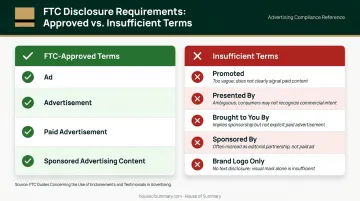
The FTC's concern with "Presented by" and similar phrases is specific: consumers may understand these to mean the advertiser underwrote independent publisher content, not that the advertiser created or influenced it. Once that misread happens, the disclosure has already failed — readers are evaluating the content by the wrong standard.
Consistency Across Placements
Choosing the right term is only half the equation. How consistently it appears across placements determines whether readers actually internalize it.
Readers learn to recognize a disclosure label through repetition — switching between "Ad" and "Sponsored" on the same platform breaks that pattern. All ads within a given publisher's environment should use the same term throughout.
Format-Specific Considerations
For video and audio: Disclosure must come before the content begins, not during or after. An audio disclosure spoken too quickly to follow fails just as badly as one that arrives late — by the time it registers, the commercial impression is already set.
For content recommendation widgets (such as "More from Around the Web" units): When a widget mixes editorial and sponsored items, each sponsored item must carry its own label. A single disclosure covering the entire widget is insufficient because readers can't determine which items it applies to.
Placement and Prominence: Making Your Disclosure Impossible to Miss
A technically present disclosure that no one reads is functionally no disclosure at all. The FTC's placement guidance is specific, and independent research confirms that placement location has a measurable effect on whether readers register the label.
Where to Place It
The FTC says disclosures should appear immediately in front of or above the native ad's headline — not below it, and not to the right where readers are less likely to look before clicking. Positioning it after the headline means many readers have already formed an impression before seeing the label.
An FTC staff eye-tracking study with 48 participants found that modified disclosure placements improved ad recognition from 47% to 68% — a 21 percentage point lift. Top-right disclosure locations were among the least likely to be noticed. The same logic extends to visual content: where the eye goes first, the disclosure must follow.
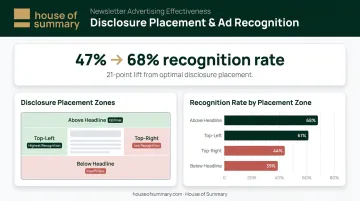
Image and Thumbnail Focal Points
When an image or video thumbnail is the primary focal point of the ad, the disclosure may need to appear directly on the image itself, not beside it. Readers frequently click images without processing surrounding text, which means a disclosure placed beside — rather than on — a compelling visual may go entirely unseen.
Visual Formatting Standards
Disclosure text must:
- Use a font size and color that contrasts clearly against the background
- Remain legible on mobile screens, not just desktop
- When shading differentiates ad blocks, ensure saturation is strong enough to be distinguishable by color-impaired readers
A gray label on a light background fails this standard — even if the text is technically present.
Disclosure in Newsletter and Email Native Advertising
Newsletter advertising operates in a fundamentally different environment than web-based native formats. When a reader opens an email, they've already opted in to that sender's content, and every message arrives attributed to a named source. There are no algorithmic feeds obscuring origin and no surrounding third-party content competing for attention.
This creates a different set of reader expectations and a different disclosure context. Readers who trust a newsletter may not anticipate that it carries paid placements alongside editorial content. That trust makes clear labeling more important, not less.
Opt-In Doesn't Eliminate Disclosure Obligations
The FTC explicitly mentions email in its native advertising guide as a distribution context where disclosure obligations follow the content. A reader who subscribed to receive editorial content hasn't consented to receive undisclosed advertising — the opt-in relationship covers the newsletter, not necessarily every format within it.
Effective disclosure in this context means labeling sponsored placements clearly within the email itself: "Sponsored," "Paid Advertisement," or a full attribution like "This content is brought to you by [Brand Name] as a paid advertisement."
The Newsletter Disclosure Advantage
Newsletter publishers distributing sponsored content — like House of Summary across its Presidential Summary, Geopolitical Summary, Dubai Summary, and London Summary titles — find that transparent disclosure works with the reader relationship, not against it.
The inbox environment offers structural advantages that make clear labeling straightforward:
- Newsletter ads bypass ad blockers entirely, unlike web and social placements
- No algorithm filters the placement before it reaches the subscriber
- Readers chose that specific source, so the attribution is already clear
- Explicit sponsorship labels reinforce editorial credibility rather than diluting it

Common Disclosure Mistakes Brands Make (and How to Fix Them)
Mistake 1: Disclosure Only on the Landing Page
The most frequent compliance failure: the content appears properly labeled on the destination article, but the publisher's feed or homepage where readers first encounter the headline carries no disclosure. This directly violates the deceptive door opener principle — the initial impression has already formed before the reader reaches the compliant page.
Fix: Require disclosure at every point of first consumer contact, including thumbnails, feed previews, and headline placements on the publisher's site.
Mistake 2: Technically Present, Cognitively Invisible
Small gray text on a white background, a label tucked outside the natural reading zone, a disclosure buried below the headline — each produces the same outcome: readers don't register it. The FTC's standard isn't whether the disclosure technically exists. It's whether a significant minority of reasonable consumers would miss it.
Fix: Test disclosure visibility on mobile. If it requires deliberate effort to find, it fails.
Mistake 3: Assuming Platform Labels Are Sufficient
A related pattern of passive compliance: some advertisers rely on automatic "Promoted" tags applied by ad networks without verifying whether those labels meet FTC standards. "Promoted" is explicitly flagged by the FTC as ambiguous. Platform-applied labels don't transfer legal responsibility. Brands remain accountable regardless of what the distribution platform adds automatically.
Fix: Review every placement independently. Don't assume the network's default label clears the bar.
Frequently Asked Questions
What words are FTC-approved for disclosing native ads?
The FTC's accepted terms are "Ad," "Advertisement," "Paid Advertisement," and "Sponsored Advertising Content." Vague alternatives like "Promoted," "Presented By," or "Brought to You By" are considered insufficient because they don't clearly communicate that the advertiser created or shaped the content.
Does disclosing a native ad hurt its performance?
Research published in the Journal of Interactive Advertising (2023) found that readers who notice a disclosure often perceive the brand as more transparent — which can reduce skepticism and improve brand attitudes. In other words, transparent labeling tends to strengthen brand perception rather than weaken it.
Where exactly should a disclosure label be placed in a native ad?
Immediately above or in front of the headline on the publisher's page — not below it, not to the right, and not only on the landing page. The disclosure must be present at every point where the reader first encounters the content.
What happens if a brand doesn't disclose its native advertising?
The FTC can pursue enforcement action under Section 5 of the FTC Act against advertisers, agencies, and publishers. Undisclosed ads that readers later identify as paid content also erode the trust that makes native advertising effective to begin with.
How does native advertising disclosure work differently in email newsletters?
Newsletter ads are delivered to opted-in readers, but disclosure is still legally required. Opting into a newsletter is not consent to receive unlabeled advertising. Sponsored placements must be clearly identified within the email itself.
Can a brand logo or company name substitute for a written disclosure label?
No. The FTC states that logos and brand names alone are not sufficient because not all consumers will infer commercial intent from a logo. A clear text label — "Ad" or "Paid Advertisement" — is required alongside any brand identity elements.