Introduction: Why Classic Car Advertising Is Its Own Art Form
Selling a classic car is nothing like listing a used sedan on a general classifieds site. The buyer isn't looking for transportation — they're buying into a story, a specific era, or a version of themselves. That means the rules of generic car advertising don't apply here.
The golden age of automotive print advertising — roughly the 1950s through the 1990s — produced some of the most effective ads ever written. David Ogilvy spent three weeks researching Rolls-Royce before writing a single word. Doyle Dane Bernbach turned "Lemon" into a trust signal for Volkswagen.
Those weren't lucky accidents. They followed principles that still hold up today.
Whether you're writing a private listing for a 1969 Mustang or planning a campaign for a classic car dealership, the same fundamentals apply. Lead with emotion. Tell the full story. Photograph the car properly, and put it in front of buyers who actually care.
Here's how to do each one well.
TLDR: Classic Car Advertising at a Glance
- Great ads sold a feeling first — the car was the proof, not the pitch
- Photography is non-negotiable; specialist platforms now require 50–200 photos
- Copy should cover the full story: ownership history, specs, and any known flaws
- Omitting the price deters serious buyers and signals trouble
- Specialist platforms and targeted newsletters outperform general classifieds for collector vehicles
What Made Classic Car Ads From the Golden Age So Effective
From the 1950s onward, print magazines were where automakers competed for attention. The budgets were serious, the copywriters were skilled, and the ads had to earn their space — there was no algorithm to boost weak creative.
Emotion Led, Features Followed
The best vintage ads didn't open with horsepower figures. They opened with an idea.
David Ogilvy's Rolls-Royce headline — "At 60 miles an hour the loudest noise in this new Rolls-Royce comes from the electric clock" — is a sensory proof point, not a spec sheet. It put the reader in the cabin before they'd read a single technical detail. Only after that emotional hook did the ad deliver 607 words of supporting evidence.
Porsche took the identity route: "Honestly now, did you spend your youth dreaming about someday owning a Nissan or a Mitsubishi?" No features listed. Just a direct challenge to the reader's self-image.
One Idea, Executed Completely
The iconic ads committed to a single creative position and made every word serve it:
- Rolls-Royce built every line of body copy around a single claim: quietness
- VW "Think Small" leaned into honesty about size in a market obsessed with large American cars
- Porsche sold aspiration and provenance — who you are, not what the car does
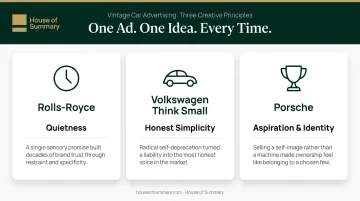
Splitting focus across multiple selling points weakened ads then, and it weakens listings now.
Honesty as a Trust Signal
That commitment to a single idea sometimes meant committing to an uncomfortable one. Volkswagen's "Lemon" ad, created by Doyle Dane Bernbach in the early 1960s, used an apparently negative word to dramatize VW's quality control. The headline described a car rejected before it could be sold — proving defects were caught, not shipped. A flaw, framed as proof of quality, became the strongest possible credibility statement.
Skoda's 2000 campaign by Fallon McElligott ran with the tagline "It's a Skoda, honest" — directly confronting its down-market reputation rather than papering over it. Campaign magazine called it a turning point for the brand.
Acknowledging a known weakness — explained clearly and on your own terms — builds more trust than pretending it doesn't exist.
Writing Ad Copy That Moves Buyers
Start With a Specific Headline
Vague headlines lose buyers before they read anything else. Specific headlines attract exactly who you want.
- ❌ "Gorgeous Classic American Muscle"
- ✅ "1965 Ford Mustang Fastback, Numbers Matching, 289 V8, 4-Speed Manual"
The second headline tells a collector whether this car is worth their time in under ten words.
Tell the Car's Full Story
Hagerty's Rob Siegel describes an accurate, detailed description as "the single biggest thing" a seller can do, particularly for vintage or needy cars. Serious buyers want:
- Full ownership history and how many previous owners
- Maintenance records and what work was done, and by whom
- Restoration details: what was restored, to what standard, and when
- Any modifications, including who performed them
- Mileage situation and odometer reliability
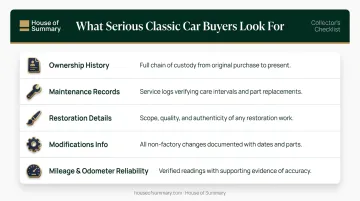
Generic listings suggest either a lazy seller or a car with something to hide — and serious collectors can spot both from a mile away.
Include Every Technical Specification
The story gives context; the specs give collectors the data they need to decide. Don't make them ask:
- Engine displacement, configuration, and whether it's original
- Transmission type (manual or automatic, number of speeds)
- Drivetrain (rear-wheel, front-wheel, four-wheel)
- Any performance modifications or comfort upgrades
- VIN details and matching-numbers status
Be Honest About Flaws
Disclosing known issues isn't just ethical — it's strategic. Transparent listings filter out buyers who would walk away at inspection, cut down on post-sale disputes, and signal to serious buyers that you're worth dealing with.
Specific flaws to disclose: rust (location and extent), non-working accessories, past accident repairs, deferred maintenance, and any items not functioning as they should.
Format and Tone
- Spell out all words — avoid newspaper-era abbreviations (no "pwr wndws," no "exc cond")
- Use short paragraphs, not one long block of text
- Standard capitalization throughout — all-caps reads as shouting
- Include your asking price (see Common Mistakes section)
- Close with a friendly, approachable line that invites contact
Photography That Sells the Dream
Poor photos cause buyers to skip a listing entirely — regardless of the car underneath. Strong photos generate serious inquiries; weak ones leave a listing ignored for weeks.
Location and Lighting
- Shoot outdoors in a clean, uncluttered setting: a park, an open stretch of road, an empty lot with a simple background
- Keep the sun behind the photographer to avoid shadows across the bodywork and glare on glass
- Avoid backgrounds with utility poles, other parked vehicles, trash, or garage clutter
- Wash and detail the car before the shoot — dirt in photos reads as neglect
Required Shots
Bring a Trailer's photo guide specifies the following, which serves as a reliable baseline for any listing:
- All four exterior corners and both full side profiles
- Full front and full rear
- Interior: driver's seat, passenger side, rear seat, dashboard, steering wheel centered
- Engine compartment (clean it first)
- Trunk or boot
- Odometer/gauge cluster
- Any notable features or known blemishes — close-ups of rust, dings, or wear
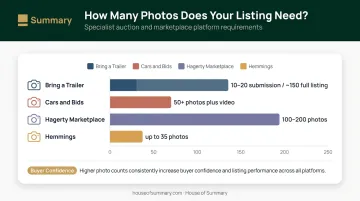
Once you know what to shoot, the next question is how many. Each platform sets its own floor — and some set it surprisingly high.
Platform Photo Requirements
Photo minimums vary significantly by platform:
| Platform | Minimum Photos |
|---|---|
| Bring a Trailer | 10–20 for initial submission; ~150 for full listing |
| Cars and Bids | 50+ high-resolution photos plus video |
| Hagerty Marketplace | 100–200 for auction listings |
| Hemmings (online) | Up to 35 |
What to Avoid
- Cutting off the front or rear of the car in frame
- Capturing your own reflection in the bodywork
- Watermarks or date stamps on photos
- AI-created or digitally altered images (BaT explicitly bans these)
- Lifestyle props — people, food, accessories — that distract from the vehicle
Where to Advertise Your Classic Car Today
Platform choice determines audience quality. A classic car listed on a general classifieds site competes against used family vehicles. The same car on a specialist platform reaches buyers who already understand its value.
Specialist Platforms
- Bring a Trailer — reached $1.4 billion in sales in 2023, with community commenting that creates buyer engagement and competitive bidding
- Hagerty Marketplace — tied to the Hagerty enthusiast audience, with seller workflows covering photos, VIN reports, and documentation
- Cars and Bids — strong for modern collectibles and enthusiast vehicles, with video requirements that add transparency
- Hemmings — founded in 1954, the heritage publication for serious hobbyists, with both print and digital listings
- ClassicCars.com — 4 million visits per month, with a median household income of $90,000 among its audience
Events and Communities
In-person swap meets, marque-specific clubs, and regional enthusiast events remain effective for local reach and niche vehicles. A forum thread in the right marque community often outperforms a broad marketplace listing.
Newsletter Advertising
Offline channels cover local reach. For dealers, restorers, and classic car brands targeting buyers beyond their region, specialist newsletters deliver high-intent, distraction-free reach that banner ads and social media cannot match.
House of Summary operates a network of newsletters — Presidential Summary, Geopolitical Summary, Dubai Summary, and London Summary — reaching 500,000+ subscribers with over 254,000 emails opened daily. The readership concentrates in three wealth-dense markets: the United States (66%, centered on New York and Los Angeles), the United Kingdom (London), and the UAE (Dubai).
For classic car advertisers, the Dubai Summary and London Summary properties are particularly relevant — both markets have established collector communities and high concentrations of buyers for premium automotive products.
Unlike web display ads, newsletter placements bypass ad blockers entirely and aren't subject to algorithmic filtering. Ads appear within the editorial reading flow, reaching an audience that has opted in for that content.
For brands targeting executives and high-net-worth individuals — the demographic most likely to purchase a classic car as an investment or lifestyle acquisition — programmatic and social channels rarely deliver that concentration efficiently. Newsletter placements do. Contact sales@houseofsummary.com to discuss placement options.

Common Mistakes That Kill Classic Car Ads
Most failed listings share the same handful of errors. Catching them before you publish makes a real difference in who responds — and how fast.
No Price Listed
"Price on request" is one of the most common reasons buyers skip a listing. It signals either inflated expectations or an unwillingness to be straightforward — both of which deter serious buyers before any contact is made. Include your asking price. If you're open to reasonable offers, say so.
Laziness Signals
Buyers read a listing in about 30 seconds before deciding whether to continue. These details communicate "not serious" immediately:
- A single blurry photo or a gallery shot in the dark garage
- One-line descriptions like "runs great, needs nothing"
- Heavy abbreviations throughout the copy
- All-caps formatting in the listing text
If the seller doesn't take the listing seriously, the assumption is they didn't take the car seriously either.
Hiding Problems
Concealing rust, mechanical issues, or accident history doesn't avoid problems — it relocates them. Buyers who discover undisclosed issues at viewing walk away. Those who discover them after purchase create disputes. The collector car community is smaller than it looks; a reputation for dishonest dealing travels.
Disclose what you know and explain the context. Honest information gives buyers something to work with — and it keeps your reputation intact in a community where word travels fast.
Frequently Asked Questions
Where is the best place to advertise a classic car for sale?
Specialist platforms like Bring a Trailer, Hagerty Marketplace, and Hemmings attract buyers who understand collector car value. For niche vehicles, marque-specific forums and clubs often outperform broad marketplaces. Newsletter advertising reaches high-net-worth readers in markets like New York, London, and Dubai where purchasing power is concentrated.
What are some catchy slogans for cars?
The most memorable vintage slogans each committed to one idea: Rolls-Royce's electric clock line (quiet luxury), VW's "Think Small" (honest positioning), and Porsche's "There is no substitute" (identity). What made them work was confidence in a single, specific claim — not a checklist of features.
How do I write a good ad for my classic car?
Start with a specific headline that names year, make, model, and key details. Follow with full ownership and restoration history, all mechanical specifications, honest disclosure of any known issues, and a clear asking price. Support it with high-quality photos from every angle.
Should I include the price in my classic car ad?
Yes. Listings without a price generate far fewer serious inquiries — buyers tend to assume the car is overpriced or the seller is difficult to negotiate with. If you're open to offers, state your asking price and note that you'll consider reasonable offers.
What photos should I include when advertising a classic car?
Exterior shots from all four corners and both sides, full front and rear, interior including dashboard and seats, engine bay, trunk, odometer, and close-ups of any known blemishes or wear. Platforms like Cars and Bids require a minimum of 50 photos plus video.
What made vintage car advertising more effective than modern car ads?
Golden-age ads led with emotion and identity rather than generic lifestyle imagery. Each ad picked one specific claim — quietness, honesty, aspiration — and built every word around it, leaving readers with a clear reason to care.