Introduction
President Donald Trump's State of the Union address on February 24, 2026, stretched to nearly 1 hour and 48 minutes—the longest in modern history. While most of the speech covered domestic priorities like the economy and immigration, one international topic dominated the foreign policy segment: Iran.
Iran occupied only a portion of the address, but Trump's warnings drew the sharpest attention. He flagged nuclear ambitions, missile development, and the regime's crackdown on protesters. He also issued what he framed as a direct warning to Tehran — a military ultimatum left deliberately vague.
This article breaks down the specific Iran-related takeaways from the address, examines what Trump claimed versus what the evidence shows, and explores what it all signals for US-Iran relations in the months ahead.
Key Takeaways
- Trump warned Iran is rebuilding its nuclear program and developing missiles that could soon threaten the United States
- He stated diplomacy is his preference but vowed never to allow Iran to acquire a nuclear weapon
- The speech came alongside the largest US military buildup in the Middle East in decades, signaling more than rhetoric
- Iran dismissed Trump's claims as "blatant falsehoods"
- No clear red line was defined — Congress still doesn't know what would trigger US military action
Trump's Claims: Iran's Nuclear Program, Missiles, and the Crackdown on Protesters
The Nuclear Contradiction
Trump made a striking assertion in his February 2026 State of the Union: Iran is "at this moment again pursuing their sinister ambitions" regarding nuclear weapons. This marked a sharp rhetorical shift from his December 2025 address, where he claimed to have "destroyed the Iran nuclear threat" following the June 2025 strikes on Iranian nuclear facilities.
The contradiction raises critical questions. If the June strikes, which Trump dubbed "Operation Midnight Hammer," truly obliterated Iran's program, why the renewed warnings eight months later?
The answer lies in what remains unknown. According to a March 2026 IAEA report, the June strikes forced inspectors to withdraw from seven declared facilities, including Fordow and Natanz. The agency lost "continuity of knowledge" over Iran's nuclear material.
That includes an unaccounted stockpile of 440.9 kg of 60% enriched uranium — dangerously close to weapons-grade levels.
Missile Capabilities: Europe Yes, US Not Yet
Trump stated that Iran has "already developed missiles that can threaten Europe and our bases overseas, and they're working to build missiles that will soon reach the United States of America."
That claim breaks into two parts worth separating:
- Missiles reaching Europe and US bases: verified. Iran possesses medium-range ballistic missiles like the Khorramshahr and Sejjil, with ranges of 2,000–2,500 km capable of striking Eastern Europe and regional US military installations.
- Missiles reaching the US homeland: exaggerated. Defense Intelligence Agency assessments project Iran could develop an intercontinental ballistic missile (ICBM) by 2035 using space-launch technology, only if it chooses to pursue that path. "Soon" overstates the actual timeline by nearly a decade.
Protester Deaths: Verified vs. Claimed
Trump cited a specific figure during the address: "at least 32,000 protesters" killed by Iranian forces during the recent crackdown. He was referring to the massive anti-government protests that erupted in late December 2025 and peaked in January 2026.
Independent verification paints a different, though still horrific, picture:
- UN Special Rapporteur: 5,000 to 20,000 deaths
- HRANA (Iranian NGO): 7,007 verified deaths, with 11,744 under investigation
- Iranian Government: 3,117 deaths (official Martyrs Foundation statement)
Even the lowest verified figure represents an unprecedented level of state violence. Trump's 32,000 figure, however, exceeds all authoritative estimates and appears to be an unverified rhetorical claim rather than a documented statistic.
"Number One Sponsor of Terror"
Trump called Iran "the world's number one sponsor of terror," accusing its proxies of spreading "terrorism, death and hate." This language isn't new. It reflects unbroken US policy since 1984, when the State Department first designated Iran as a State Sponsor of Terrorism. The designation has held through every administration since, including Obama, Trump's first term, and Biden.
The Ultimatum: Diplomacy Is the Preference—But the Alternative Was Left Unspoken
The Ultimatum: Trump's Diplomatic Preference With an Unspecified Military Backstop
Trump's central Iran statement functioned as a conditional ultimatum without explicit military terms:
"My preference is to solve this problem through diplomacy. But one thing is certain, I will never allow the world's number one sponsor of terror to have a nuclear weapon."
Strategic Ambiguity as Leverage
By refusing to define what would trigger US military action, Trump created maximum negotiating flexibility. Lawmakers and analysts noted publicly that the threshold for escalation remained undefined if diplomatic talks collapsed.
This ambiguity serves dual purposes:
- Negotiating leverage: Tehran doesn't know where the red line is, potentially making them more cautious
- Domestic cover: Trump avoids committing to specific military action that could alienate his base
The Political Tightrope
His MAGA base has historically opposed costly foreign interventions, yet his tough Iran posture requires projecting credible force — and the polling shows how thin that margin is. March 2026 data reveals the tension:
- 70% of Trump's 2024 voters support the June strikes
- 41% of "non-MAGA" Trump voters oppose further loss of American lives
- 63% of voters worry about rising gas prices from prolonged conflict
Pew Research adds a harder data point: 61% of Americans disapprove of Trump's handling of the Iran situation overall.
Active Diplomatic Track
That political pressure makes the active diplomatic track more significant. On February 22, 2026, Oman confirmed that US-Iran talks were scheduled in Geneva, with Oman serving as mediator. The US delegation included Special Envoy Steve Witkoff and Jared Kushner.
The Military Backdrop: US Forces Already Positioned in the Region
Those warnings carried weight. By early 2026, the US had assembled what multiple analysts describe as the largest military buildup in the Middle East since 2003.
June 2025: Operation Midnight Hammer
Between June 13-24, 2025, the US and Israel executed coordinated strikes on Iranian nuclear facilities. The operation involved:
- Over 125 aircraft, including B-2 Spirit stealth bombers
- 30,000-pound GBU-57 Massive Ordnance Penetrators targeting the deeply buried Fordow facility
- Tomahawk cruise missiles striking the Isfahan conversion facility
The strikes inflicted severe damage but created a verification black hole—the IAEA can no longer confirm the status or location of Iran's enriched uranium stockpile.
That unresolved verification gap is part of what shaped the force posture that followed.
2026 Force Posture
By February 2026, the US had assembled the largest regional force in over two decades:
Naval Assets:
- USS Abraham Lincoln carrier strike group
- USS Gerald R. Ford carrier strike group
- Combined air wings with over 130 strike aircraft
Air Power:
- 100+ fighter jets (F-35s, F-22s, F-15s) on high readiness
- B-52 and B-2 bombers positioned for sustained strike campaigns
That combination of naval and air assets means any diplomatic opening is being conducted against the backdrop of substantial, ready military capability.
Iran Fires Back: How Tehran Responded to Trump's Address
On February 25, 2026, Iranian Foreign Ministry spokesperson Esmaeil Baghaei issued a forceful rebuttal. In a statement posted to social media, Baghaei called Trump's claims "big lies" and compared US tactics to Nazi propaganda methods.
"Whatever they're alleging regarding Iran's nuclear programme, Iran's ballistic missiles, and the number of casualties during January's unrest, is simply the repetition of 'big lies,'" Baghaei stated.
Tehran's response reflects a dual-track approach. Foreign Minister Abbas Araghchi traveled to Geneva for Oman-mediated talks, signaling willingness to negotiate even while publicly rejecting Trump's characterizations. The harsh rhetoric and the diplomatic outreach are not contradictory — they are coordinated.
The independent record complicates both sides' claims:
- The IAEA confirms that strikes damaged Iran's nuclear facilities and that inspectors lost access
- The agency cannot verify current enrichment activities or stockpile locations
- This verification gap leaves both Tehran's denials and Washington's assertions unconfirmed by neutral evidence
What This Means for US-Iran Relations and Global Stability
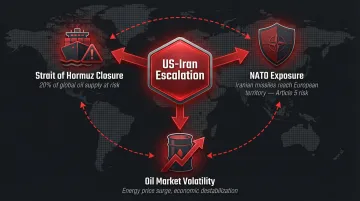
A US military strike on Iranian nuclear facilities would extend well beyond the immediate target — triggering economic, security, and diplomatic consequences across multiple regions.
Three interconnected risks stand out:
- Strait of Hormuz closure: Iran has threatened to block this waterway, through which roughly 20% of global oil supply passes. A sustained closure would drive energy prices sharply higher across importing nations.
- NATO exposure: Iran's existing missiles can reach European territory. Escalation that threatens NATO allies could force Article 5 consultations — a significant diplomatic escalation in itself.
- Oil market volatility: Markets remain sensitive to Middle East instability. Prolonged conflict would pressure prices at a moment when several major economies are still stabilizing.
What Comes Next
Several milestones will determine whether this remains a standoff or escalates:
- Geneva talks progress: Any breakdown in Oman-mediated negotiations would significantly raise military strike probability
- IAEA access restoration: Whether Iran permits inspectors to verify nuclear stockpiles
- Iranian provocations: Any move to enrich uranium beyond 60% or test missile systems
- US domestic politics: Shifting public opinion or Congressional pressure could constrain Trump's options
For readers following this situation as it develops, Presidential Summary and Geopolitical Summary by House of Summary deliver verified, concise briefings directly to your inbox, so you stay informed without sifting through contradictory headlines.
Frequently Asked Questions
What is the point of the presidential address?
The presidential address—including the State of the Union—gives the president a direct platform to address Congress and the American public. It's used to outline policy priorities and communicate positions on domestic and foreign issues to audiences at home and abroad.
How many people watched Trump's speech in 2026?
According to Nielsen data, an estimated 32.6 million viewers watched the February 24, 2026 State of the Union across 15 broadcast and cable networks. This represents a slight decrease from his 2025 address (36.6 million) but aligns with recent historical averages.
What exactly did Trump say about Iran's nuclear weapons at the State of the Union?
Trump stated that Iran is "pursuing their sinister ambitions" regarding nuclear weapons and declared, "I will never allow the world's number one sponsor of terror to have a nuclear weapon." He left undefined what specific actions would trigger a US response beyond diplomacy.
Did Trump threaten military action against Iran in the speech?
Trump did not issue an explicit military threat but framed his position as an ultimatum—stating diplomacy is his preference while refusing to rule out other options. The deliberate ambiguity leaves the nature and timing of any potential military response undefined.
How did Iran respond to Trump's warnings about its nuclear program?
Iran's Foreign Ministry spokesperson Esmaeil Baghaei dismissed Trump's claims as "blatant falsehoods" and "big lies," comparing them to propaganda tactics. Despite this public rejection, Iranian diplomats traveled to Geneva for Oman-mediated talks with US representatives.