

Introduction
European advertisers face a challenge that their US counterparts don't: reaching audiences across multiple languages, cultures, and regulatory frameworks — all at once. A campaign that works in London may need a different platform to reach Munich or Stockholm effectively.
Choose a platform with weak European publisher relationships and you pay for irrelevant traffic. Choose one that handles consent poorly and you're looking at GDPR exposure. European digital advertising surpassed €100 billion in 2024, and native formats are capturing a growing share of that spend.
This guide covers the best native advertising platforms for European campaigns in 2026, including what each does well, where it falls short, and which formats consistently deliver the strongest engagement for B2B and brand campaigns.
Key Takeaways
- Native ads achieve CTRs 8.8x higher than traditional banner ads, according to IAB Europe's native advertising guide
- The European market requires platforms with GDPR readiness, contextual targeting, and publisher depth across UK, DACH, Nordics, and France
- Top platforms for 2026: Taboola, Teads, Plista, ADYOULIKE, and Strossle — each suited to different European markets
- Evaluate platforms on: European publisher depth, TCF registration, cookie-free targeting, format range, and pricing transparency
- Newsletter-native placements outperform most web-based native formats on engagement — yet remain largely untapped by European advertisers heading into 2026
Native Advertising in Europe: What It Is and Why It's Growing
Native advertising is paid content designed to match the form and feel of its editorial environment. That means in-feed sponsored articles, content recommendation widgets, and newsletter placements — not banners that interrupt the reading experience.
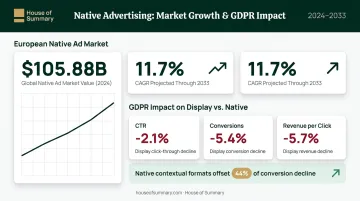
The distinction matters more in Europe than anywhere else. Research summarised by the American Marketing Association found that GDPR compliance reduced display CTR by 2.1%, conversion rates by 5.4%, and revenue per click by 5.7%. Contextual native formats — which don't rely on third-party cookies or user-level identifiers — offset roughly 44% of that conversion-rate decline.
This is the structural reason native is growing in Europe: it works within GDPR constraints, not around them.
The market data confirms it. Global native advertising was valued at $105.88 billion in 2024, with Europe projected to grow at an 11.7% CAGR through 2033. Advertisers who previously relied on behavioural targeting are moving toward contextual placements — and native formats are the natural home for that approach.
When evaluating European native platforms, three factors separate the ones that perform from the ones that don't:
- Direct publisher relationships in-region (not resold inventory routed through US-based networks)
- Contextual targeting that functions without third-party cookies
- Formats built for editorial environments where readers are actively engaged
Best Native Advertising Platforms in Europe 2026
Platforms here were evaluated on European publisher depth, GDPR and TCF compliance, targeting capabilities, format range, and suitability for both B2B and consumer audiences. No single platform leads equally across all European markets — the right choice depends on your target geography.
Taboola
Taboola is one of the largest open-web content discovery platforms globally, with a significant presence across UK, Germany, and France. For brands that need scale across multiple European markets simultaneously, it's the default starting point.
The platform's AI-driven campaign optimisation and contextual targeting tools reduce cookie dependency — a practical advantage for GDPR-sensitive campaigns running across multiple jurisdictions.
| Factor | Details |
|---|---|
| European Reach | Global 9,000+ publisher network; UK evidence includes Reach PLC (70+ sites, 110M monthly uniques), DIE WELT, Daily Mail |
| Pricing Model | CPC self-serve; minimum daily budget of $10 per Taboola's help centre |
| Key Ad Formats | Sponsored content tiles, native video, in-feed recommendation widgets |
| TCF Status | IAB Global Vendor List: Taboola Europe Limited, Vendor 42 |
Best for: Brands wanting multi-market European scale without managing separate platform relationships.
Teads
Teads — formed after Outbrain's acquisition of the original Teads and subsequent corporate renaming in June 2025 — holds premium publisher partnerships across both English-language and continental European editorial brands, making it one of the few platforms with verified exclusive deals in major markets.
Its exclusive UK and EEA deal with Guardian News Media signals the level of brand-safe inventory it can offer. For finance, insurance, and healthcare advertisers, that combination of editorial credibility and cookie-independent contextual targeting is difficult to replicate elsewhere.
| Factor | Details |
|---|---|
| European Reach | Global reach of 1.9 billion users; Europe partnerships include Guardian News Media (UK/EEA), DPG Media, Attitude UK |
| Pricing Model | CPC, CPM, and CPV available via Teads Ad Manager |
| Key Ad Formats | In-feed native, outstream video, in-article placements |
| TCF Status | IAB Global Vendor List: Teads France SAS, Vendor 132 |
Best for: Premium brand-safe placements in major European editorial environments, particularly for regulated industries.
Plista
Plista takes a deliberately regional approach, built primarily around the DACH market (Germany, Austria, Switzerland) and Poland. Acquired by GroupM in 2014, it has strong institutional backing and operates within premium German-language editorial environments.
For brands whose primary European audience is German-speaking, Plista offers something global networks can't replicate through programmatic access alone: direct relationships with German publishers who have chosen not to distribute through open exchanges. That exclusivity is what separates Plista from exchange-based DACH alternatives.
| Factor | Details |
|---|---|
| European Reach | DACH region (Germany, Austria, Switzerland) and Poland; specific publisher count not publicly disclosed |
| Pricing Model | CPC-based; specific minimum spend not publicly confirmed |
| Key Ad Formats | Native recommendation ads, content distribution, outstream video |
| TCF Status | GroupM/WPP-owned; confirm current TCF registration directly with Plista |
Best for: Brands targeting German-speaking European audiences who need premium publisher access rather than exchange-based DACH inventory.
ADYOULIKE
ADYOULIKE is European-born — Franco-British, headquartered in France with offices in London, Paris, Milan, Montpellier, and New York — and was one of the first platforms to bring in-feed native advertising to European publishers at scale. It was acquired by OpenWeb in April 2022.
Its semantic AI targeting matches ads to editorial context without user-level identifiers, a direct response to GDPR constraints. With operations across France, UK, Germany, and the broader EU, it sits in a useful middle ground between the global scale of Taboola and the narrow regional focus of Plista — particularly for campaigns that need to perform in both French and British editorial environments simultaneously.
| Factor | Details |
|---|---|
| European Reach | 4,000+ brands, agencies, and publishers (OpenWeb); key partners include The Guardian, Reach, Prisma Media, Groupe Marie-Claire |
| Pricing Model | CPM/CPC; contact ADYOULIKE directly for current rates |
| Key Ad Formats | In-feed native display, native video, semantic contextual placements |
| TCF Status | IAB Global Vendor List: ADYOULIKE SA, Vendor 259 |
Best for: Privacy-first European campaigns requiring contextual targeting across French, British, and German editorial environments.
Strossle
For Nordic audiences, Strossle is the specialist option. Now part of Azerion (acquired July 2021), it operates exclusively in Northern Europe across 350+ publishers in 8 European markets, and its content appears within the reading experience of 500 million articles per month.
Because Strossle only operates in the Nordics and Northern European markets, its contextual matching is more precise for those audiences than any global platform accessing the same inventory programmatically. One published case study recorded CTRs 600% higher than baseline for a Nordic health campaign, reflecting the advantage of curated contextual placement over broad programmatic reach.
| Factor | Details |
|---|---|
| European Reach | 350+ publishers across 8 European markets; 500M articles/month reach |
| Pricing Model | CPC and CPM available; specific price ranges not publicly disclosed |
| Key Ad Formats | Native article, native display, content recommendation widgets |
| TCF Status | IAB Global Vendor List: Strossle International AB, Vendor 851 (usesCookies=false) |
Best for: Brands targeting Sweden, Norway, Denmark, and Finland who want curated publisher access rather than broad programmatic reach.
How to Choose the Right Platform for European Campaigns
The most common failure mode in European native advertising is selecting a platform for its global reach number, then discovering it has thin publisher relationships in the specific markets on your brief. A platform with 9,000 global publishers doesn't automatically have meaningful access to premium German editorial environments.
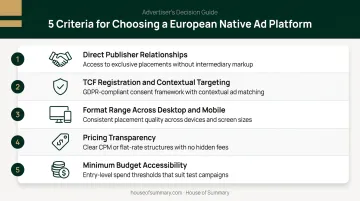
Five Criteria That Should Drive Your Decision
- Direct publisher relationships in your target market — genuine inventory partnerships with named publishers, not just programmatic access through an exchange
- TCF registration and contextual targeting — check the IAB Europe Global Vendor List and confirm the platform can run without third-party cookies in your target markets
- Format range across desktop and mobile — particularly whether outstream video and in-article placements are available alongside standard recommendation widgets
- Pricing transparency — platforms that won't share indicative CPC ranges before you commit budget are a red flag
- Minimum budget accessibility — some platforms require managed account minimums that make small tests impractical
The Format Most Advertisers Miss
Those five criteria cover how to evaluate platforms — but there's a format question worth asking before you even start that evaluation.
Open-web native widgets are the most common starting point, but they're not always the highest-performing option for European professional audiences. Newsletter-native advertising — where a sponsored placement appears inline with editorial content an opted-in subscriber has chosen to receive — consistently outperforms standard content widgets in attention and click-through for executive and decision-maker audiences.
Ad blockers don't reach the inbox. And unlike open-web placements, a reader engaging with a newsletter they signed up for is already in an attentive, low-distraction state — which changes how your message lands.
For brands targeting UK and European business professionals, House of Summary's London Summary offers this kind of placement: weekday sponsorships reaching decision-makers, policy professionals, and business operators in London, delivered directly to their inbox with no algorithmic layer in between. Reach out at sales@houseofsummary.com.
Conclusion
The right native advertising platform for a European campaign is the one whose publisher network, targeting infrastructure, and format options match your actual brief — not the one with the largest claimed reach.
A practical approach: run controlled tests on two or three platforms simultaneously before committing full budget. European CPCs and conversion patterns vary significantly by country. What performs in the UK may need a different platform or a different creative approach in Germany, and a completely different specialist in Sweden.
If those variables feel like too many unknowns, one option cuts through them: guaranteed inbox placement with a European audience that ad blockers can't reach, no recommendation widget competition, and no contextual matching uncertainty. House of Summary's London Summary offers exactly that. Reach out to the advertising team directly at sales@houseofsummary.com.
Frequently Asked Questions
What are native advertising platforms?
Native advertising platforms are ad platforms that deliver paid placements — sponsored articles, in-feed cards, newsletter spots — designed to match the look and feel of surrounding editorial content. Because they integrate rather than interrupt, they consistently outperform traditional display banners on engagement.
What is IAB Europe?
IAB Europe is the trade association for digital advertising across European markets, responsible for industry standards including the Transparency and Consent Framework (TCF) that governs how advertising platforms handle user consent under GDPR. TCF registration is a key compliance checkpoint for any European native platform.
Which native ad platforms are GDPR-compliant for European campaigns?
ADYOULIKE, Strossle, Teads, and Taboola are all registered on the IAB Europe Global Vendor List and use contextual or semantic targeting that limits cookie dependence. Always confirm a platform's current TCF vendor ID before launching. The GVL is updated regularly and registration status can change.
What is the minimum budget to start a native advertising campaign in Europe?
Taboola publicly states a minimum daily budget of $10 for self-serve campaigns, though meaningful optimisation typically requires enough conversion volume to train the algorithm. For managed-service options or specialist regional platforms like Plista or Strossle, contact each platform directly for current minimums.
How do native ads perform compared to display ads in European markets?
According to IAB Europe's native advertising guide, native ads achieve CTRs 8.8x higher than traditional banner ads, with case study CTRs ranging from 0.32% to 0.53%. The lift is strongest in premium editorial environments, where established publisher credibility carries over to sponsored placements.
Can newsletter advertising be considered a form of native advertising in Europe?
Yes — newsletter sponsorships qualify as a native format because the placement integrates into content the subscriber has opted into receiving. In European professional markets, where inbox engagement among executives tends to be high and ad blockers are irrelevant, newsletter-native placements frequently outperform open-web widgets on both CTR and brand recall.