Introduction
Multicultural healthcare advertising is the practice of designing health and pharma campaigns around the distinct cultural values, language preferences, trust dynamics, and media behaviors of specific ethnic and demographic communities — not simply translating general-market messaging into another language and calling it done.
The US is moving toward a minority-majority population by 2045. Black consumers now hold $2.1 trillion in buying power according to Nielsen's 2025 report, Asian Americans hold $1.3 trillion, and Hispanic buying power has grown 87% over the prior decade. These communities are the future mainstream — and their healthcare decisions reflect it.
Healthcare advertisers that treat multicultural strategy as optional are making a costly competitive mistake. The brands investing in culturally resonant, community-specific campaigns today are building audience trust that generic messaging simply cannot buy later.
Key Takeaways
- Black consumers hold $2.1T in buying power; Asian Americans $1.3T — healthcare advertisers ignoring these audiences are leaving the field to competitors. Brands that overlook these segments hand market share to competitors
- 49% of Hispanic adults and roughly one-third of Black adults use social media weekly for health information — compared to just 15% of White adults
- Historical distrust of healthcare institutions shapes how multicultural audiences respond to advertising — peer-centered messaging consistently outperforms institutional brand authority
- Transcreation has replaced direct translation as the creative standard for patient-facing health campaigns
- AI can scale multicultural content production, but human cultural expertise is essential for getting the nuance right
The Demographic and Economic Imperative
The economic case for multicultural healthcare advertising isn't speculative. According to Nielsen's 2025 Black audience report, Black buying power has grown 2.4x since 2000, reaching $2.1 trillion. Asian American buying power stands at $1.3 trillion. Hispanic buying power grew 87% over the prior decade. These figures represent total consumer economic power — and healthcare is a major spending category within all three groups.
The systemic cost of not engaging these communities is also measurable. A 2023 NIH-funded study found that racial and ethnic health disparities cost the US economy $451 billion in 2018 alone — a 41% increase from the 2014 estimate. Deloitte's analysis puts the annual cost of health inequities at approximately $320 billion today, potentially exceeding $1 trillion annually by 2040 if unaddressed.
Access Barriers Reveal the Opportunity
The engagement gap isn't about motivation. KFF's 2025 data shows that 23% of Hispanic adults and 16% of Black adults reported not seeing a doctor because of cost, compared to 12% of White adults. These aren't disengaged populations — they're underserved ones.
Multicultural consumers are demonstrably proactive about health. Survey data and real-world behavior back this up:
- Asian vaccination rates ranked among the highest nationally during the COVID-19 rollout
- Black, Hispanic, and Asian communities consistently report strong commitments to healthier habits in national surveys
- Cost barriers — not lack of interest — account for most of the healthcare engagement gap
That gap between health motivation and healthcare access is precisely where strategic advertising can intervene. For healthcare organizations, it represents both a public health obligation and a concrete patient acquisition opportunity. Brands that build community-specific outreach now establish trust that takes years — and significant spend — for later entrants to match.
Transcreation Replaces Translation as the New Creative Standard
Translation converts words with factual accuracy. Transcreation adapts the emotional intent, cultural context, and behavioral driver of a message so it achieves the same resonance in the target culture.
The difference matters in healthcare more than almost any other category. A diabetes management headline aimed at Hispanic audiences that frames control in terms of individual health metrics may land flat — but reframe that same message around being present for your family and you're speaking to familismo, a deeply held cultural value. The words change. The clinical goal doesn't. But the outcome does — measurably.
Where Each Approach Belongs
| Context | Appropriate Approach |
|---|---|
| Clinical documents, consent forms | Translation (accuracy-first) |
| Dosing instructions, legal disclosures | Translation (compliance-driven) |
| Patient-facing campaigns, emotional health messaging | Transcreation (resonance-first) |
| Brand advertising, community outreach | Transcreation (cultural context essential) |
Machine translation used in advertising signals inauthenticity immediately. It damages trust — particularly with audiences who already have reasons to be skeptical of healthcare institutions. That same failure of cultural judgment shows up in audience targeting, too.
Subgroup Specificity Is Non-Negotiable
"Asian American" is not a single audience. A 2021 peer-reviewed study found that Asian American health outcomes are heterogeneous across subgroups, and that research has focused primarily on the six largest groups — Chinese, Korean, Vietnamese, Filipino, Indian, and Japanese. Each has distinct languages, health burdens, media habits, and cultural frameworks.
Treating these communities as one group is one of the most common and costly multicultural marketing mistakes. The same principle applies to Hispanic audiences: a campaign that works for Mexican American families in Los Angeles may not connect with Cuban American communities in Miami.
Timing sharpens this further. Campaigns aligned to Hispanic Heritage Month, Black History Month, AANHPI Heritage Month, or Lunar New Year reach communities when cultural identity is most salient — and health messaging is more likely to be received, retained, and shared.
Social Media and Micro-Influencers as the Primary Healthcare Discovery Channel
The channel gap in multicultural health advertising is stark. KFF's 2023 research found that 49% of Hispanic adults use social media at least weekly for health information, and about one-third of Black adults do the same — compared to just 15% of White adults. General-market media plans built around the average American are systematically missing these audiences where health decisions are actually being made.
Platform Specificity by Community
Generic "social media" buys won't cut it. Channel selection needs to reflect actual behavior:
- Hispanic adults: Facebook is dominant across age groups; YouTube and Instagram reach most adults under 55; TikTok reaches 61% of Hispanic adults under 35; Spanish-speaking Hispanic adults use WhatsApp at 87% weekly
- Black adults: Facebook and YouTube are strong across age groups; among Black adults under 35, Instagram reaches 79% weekly and TikTok 62%
- Chinese immigrant communities: WeChat functions as both a social and healthcare communication channel — a 2023 hypertension intervention delivered via WeChat improved medication adherence and diastolic blood pressure outcomes over six months
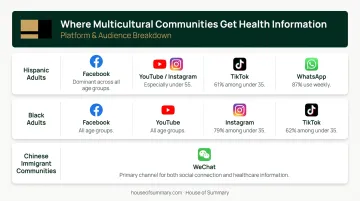
A healthcare brand relying solely on Instagram and Facebook will not reach Spanish-speaking Hispanic adults who get health information primarily through WhatsApp groups, or Chinese immigrant communities using WeChat. Getting the platform right is only half the equation — who delivers the message on those platforms matters just as much.
Why Micro-Influencers Outperform Institutions
Health influencer marketing in multicultural communities doesn't run on celebrity reach. The highest-performing voices tend to be:
- Community health workers with neighborhood-level credibility
- Bilingual nurses whose followers trust them on clinical questions
- Local figures with small but highly engaged audiences who generate genuine referrals
KFF's 2025 data shows 21% of Black social media users regularly get health information from social media influencers — well above the 14-15% general population average. In communities where institutional trust is low, a mid-size local account with authentic community ties will consistently outperform a verified brand with a larger following.
Rebuilding Trust Through Community-Centered Messaging
Institutional distrust in healthcare runs deep, rooted in documented experiences of mistreatment, miscommunication, and systemic neglect. MHQP's 2024 Patient Experience Survey found measurable trust gaps across every demographic studied:
- Hispanic/Latino adults scored 84.6 on trust versus 87.3 for non-Hispanic/Latino adults
- Black children scored 87.5 on trust versus 92.9 for White children
- Black adults scored 68.4 on behavioral health assessment versus 75.3 for White adults
- Asian adults scored 75.6 on ease of access versus 82.7 for White adults
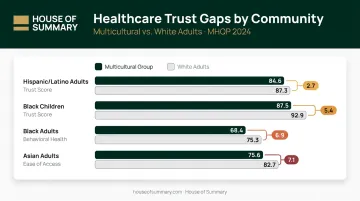
These gaps carry direct advertising implications. Campaigns that lead with hospital brand authority or institutional credentials will underperform in high-distrust communities. Messaging that builds credibility from the ground up works better — specifically:
- Real patients from the same community, not stock-photo representations
- Community health workers and providers who share the audience's cultural background
- Diverse providers, not just diverse patients — because substantive inclusion requires showing that care teams reflect the communities they serve
Cultural Concordance as a Competitive Differentiator
Research on cardiovascular disease medication adherence found that patient-physician concordance in race, ethnicity, and language is associated with improved medication adherence and reduced disparities. Healthcare marketers increasingly use provider diversity as an explicit differentiator in campaign messaging — not as a values statement, but as a measurable clinical and patient experience advantage.
AI-Powered Personalization Enabling Multicultural Campaigns at Scale
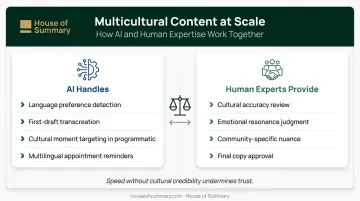
AI is beginning to address the historic cost barrier that prevented healthcare brands from producing culturally distinct content for multiple communities simultaneously. Current applications include:
- Language preference detection for patient communication routing
- AI-assisted transcreation — first drafts reviewed and refined by bilingual human experts
- Cultural moment targeting in programmatic media buying
- Multilingual appointment reminders and health education sequences
The critical limitation is well-documented. A 2024 peer-reviewed analysis of AI translation in healthcare flagged urgent concerns around accuracy and patient safety. Models trained primarily on general-market content produce culturally generic output — and in healthcare advertising, that generic output erodes trust with the communities you're trying to reach.
The practical framework is straightforward: AI manages scale, while bilingual copywriters, cultural consultants, and community health workers provide the accuracy and resonance that automated systems cannot. Production speed is valuable — but not at the cost of cultural credibility.
How Multicultural Trends Are Reshaping Healthcare Advertising
These trends aren't abstract — they're creating measurable operational and budget shifts across the industry.
Operational Impact
Campaign production workflows are changing at every stage. Multicultural campaigns now require:
- Transcreation rather than translation for all patient-facing content
- Community-specific creative assets (not resized versions of general-market ads)
- Platform-specific content strategies built around actual community behavior data
- Cultural review steps that don't exist in standard general-market pipelines
Agencies and in-house marketing teams are adding cultural review stages, bilingual creative review cycles, and community advisory feedback loops before campaigns go live. This adds time and cost — but it's the difference between content that builds trust and content that signals inauthenticity.
Business Impact
Healthcare advertising budgets are shifting away from broad-reach general-market channels toward community-specific, high-trust environments. This includes:
- Growth in social platform investment segmented by community behavior
- Micro-influencer partnerships replacing single large-account sponsorships
- Bilingual SEO investment as a primary patient acquisition strategy
- A clear move toward channels that guarantee direct, unblocked access to engaged readers
Newsletter advertising is part of this shift. Premium placements in curated newsletter networks — such as House of Summary — reach high-intent professionals who are actively tracking these decisions, with no algorithmic interference and no ad blockers in the way. For healthcare advertisers navigating FDA compliance requirements, the brand-safe editorial environment also provides a reliability that social platforms consistently struggle to match.
Workforce Impact
Healthcare marketing teams now require bilingual strategists, cultural consultants, and community liaison roles that most organizations didn't staff five years ago. The shortage of this expertise is driving demand for specialized multicultural healthcare marketing agencies. Brands that build this capability in-house gain a real edge — institutional knowledge of community relationships and cultural nuance doesn't transfer easily to competitors.
Future Signals for Multicultural Healthcare Advertising
Three near-term trends will shape the next 1–3 years:
Multilingual SEO as a front-line acquisition channel. Spanish-language and multilingual search optimization is moving from afterthought to primary strategy. Brands without bilingual SEO infrastructure are invisible at the point of intent as multicultural consumers make more healthcare decisions online.
Clinical trial diversity requirements reshaping pharma creative. FDA Diversity Action Plans now require pharmaceutical sponsors to plan enrollment of underrepresented populations in clinical studies. Regulatory pressure is becoming a direct driver of advertising targeting and representation strategy.
LGBTQ+ healthcare marketing: the widest trust gap. KFF's 2024 data found that 33% of LGBT adults reported poor treatment by health professionals due to their sexual orientation or gender identity, and 24% avoided healthcare entirely in the prior year due to fear of discrimination. Most healthcare brands haven't begun building advertising that closes these trust gaps.
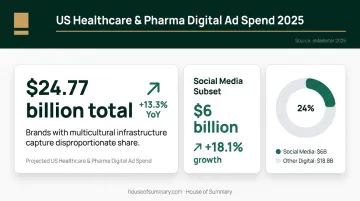
On the budget side, eMarketer projects healthcare and pharma digital ad spending will reach $24.77 billion in 2025, up 13.3% year over year, with social media ad spending growing 18.1% to nearly $6 billion. Brands that build multicultural infrastructure now — targeting, language, trust — are positioned to capture a disproportionate share of that growth as category spending scales.
Conclusion
Multicultural healthcare advertising is no longer a bonus effort — it's where the industry is moving, and demographic data, trust research, and digital behavior patterns all point in the same direction. Black, Hispanic, Asian, and LGBTQ+ consumers represent fast-growing healthcare spending power, high social media health engagement, and documented unmet needs that culturally resonant advertising can address.
The brands adapting early are building something that matters: audience relationships grounded in trust, earned familiarity with how communities think and make decisions, and genuine community relevance. Those relationships are very difficult to displace once established.
Strategic foresight here means investing in the specifics: transcreation instead of direct translation, community-level channels instead of broad reach, and trust-building campaigns that don't assume authority. The America healthcare advertisers will compete in looks different from the one most campaign playbooks were written for. Brands that update those playbooks now won't just reach new audiences — they'll hold them.
Frequently Asked Questions
What is multicultural healthcare advertising?
It refers to healthcare and pharma campaigns designed around the specific cultural values, language preferences, trust dynamics, and media habits of distinct ethnic and demographic communities. It goes well beyond translation — the goal is cultural resonance and community-specific engagement that drives real health behavior change.
Why is multicultural marketing no longer optional in healthcare?
The US is projected to become a minority-majority nation by 2045, and Black, Hispanic, and Asian consumers already hold a combined multi-trillion dollar economic footprint. Ignoring these audiences carries concrete costs: lost patient acquisition, brand trust deficits, and market share that competitors will claim.
What is the difference between transcreation and translation in healthcare advertising?
Translation converts words accurately — appropriate for clinical documents and legal disclosures. Transcreation adapts emotional intent and cultural context so the message connects authentically. Healthcare advertising requires transcreation; translation alone produces content that feels foreign to its intended audience.
Which multicultural communities are most underserved in healthcare advertising today?
Black, Hispanic, and Asian communities — particularly subgroups like Vietnamese, Korean, and Filipino communities — consistently report the largest trust gaps with healthcare institutions and the lowest representation in advertising. LGBTQ+ patients are the most underserved segment, with 33% reporting discrimination by health professionals and 24% avoiding care entirely.
How do healthcare brands measure ROI from multicultural advertising campaigns?
Core metrics to track include:
- Patient acquisition rates by demographic segment
- Language-specific conversion and appointment completion rates
- Social media engagement versus general-market benchmarks
Demographic segmentation of existing campaign data is the essential starting point. You can't optimize what you haven't disaggregated.
What role do health influencers play in multicultural healthcare advertising?
In communities with high institutional distrust, peer-to-peer endorsement carries more weight than brand authority. Among Black social media users, 21% regularly get health information from influencers — well above the general population average. Community figures with strong local presence often outperform large healthcare accounts in engagement and patient referral generation because their credibility is built on community relationships, not brand recognition.