At the same time, patients today arrive more informed than ever. According to a 2025 Tebra survey of nearly 4,000 U.S. adults, 79% read online reviews before choosing a provider, and 56% begin their search on Google. Healthcare organizations are being evaluated before anyone picks up the phone.
This creates a difficult balance for communications teams: you need to be credible, compliant, and emotionally resonant — simultaneously. Most general PR frameworks don't account for all three at once.
This article covers what makes healthcare PR distinct, a practical campaign-building framework, key best practices with evidence behind them, a real-world campaign example, and how to measure results that actually matter.
TL;DR — Key Takeaways
- Healthcare PR uses communications tools to build trust, educate audiences, and manage organizational reputation
- HIPAA compliance, FDA guidelines, and plain-language accuracy define the boundaries every healthcare PR campaign must work within
- Effective campaigns define audience, goals, and key messages before selecting tactics
- Strong campaigns lead with consented patient stories, credible expert voices, and language anyone can understand
- Track success through media placements, audience reach, sentiment shifts, and direct patient inquiry volume
What Is Healthcare PR and Why It Matters
Healthcare PR is the strategic use of communications — press releases, media placements, thought leadership, social media, and community engagement — to manage how the public perceives healthcare organizations, practitioners, and health-related initiatives.
It differs from general PR because the audience's relationship with the information is personal, not passive. When someone reads about a hospital's surgical outcomes or a health system's mental health services, they're often weighing that information against a real decision about their own care.
The primary goals healthcare PR serves include:
- Brand awareness: reaching the right audiences before they need care, not after
- Thought leadership: giving clinicians and executives a credible public voice in their specialty
- Patient trust: building confidence through transparent, accurate communication
- Crisis management: responding quickly when reputation or public health is at stake
- Earned media and SEO: generating coverage that compounds into organic visibility over time
Reputation management has never been more consequential. According to a 2024 survey by PatientPop, 74% of patients check online reviews before booking with a provider. Reviews, news coverage, and social content shape decisions well before any direct interaction occurs.
What Makes Healthcare PR Uniquely Challenging
Regulatory Complexity
Healthcare PR operates inside a compliance framework that most industries don't face. HIPAA's privacy rules restrict how patient information can be used in communications — and HHS defines "marketing" broadly, requiring written authorization before protected health information (PHI) is used in promotional content.
In 2025, Cadia Healthcare Facilities paid $182,000 to settle an HHS investigation after website "success stories" disclosed PHI for 150 patients without valid authorization. In 2019, Elite Dental Associates paid $10,000 after staff responded to Yelp reviews in ways that confirmed patient identities and treatment details.
On the claims side, FDA's Office of Prescription Drug Promotion requires that prescription drug communications be truthful, balanced, and risk-complete. Overstating benefits or minimizing risks in a press release or pitch creates real enforcement exposure.
Practical implication: Legal and compliance review should be built into the content approval process — before content reaches distribution, not after.
Heightened Emotional Stakes
Healthcare topics touch illness, recovery, mortality, and mental health. The tone of communications must reflect that weight. Promotional enthusiasm that works for consumer tech reads as dismissive or tone-deaf in a health context.
That gap between tone and subject matter carries regulatory weight too. Content that trivializes or sensationalizes health conditions can draw FDA or FTC scrutiny, particularly when it involves treatment claims.
Earned Media Unpredictability
Healthcare journalists are selective. Well-crafted pitches get modified, reframed, or declined. The message a PR team sends is not always the message that reaches the public — which makes precision in source materials essential. Ambiguous claims become simplified. Nuanced data becomes a headline.
A Step-by-Step Strategy for Healthcare PR Campaigns
Define Your Target Audience
Every strategic decision downstream depends on this one. A campaign speaking to patients managing chronic conditions looks nothing like one aimed at hospital procurement officers or healthcare investors.
Audience definition shapes:
- Channel selection — where your message will actually reach them
- Tone and vocabulary — appropriate medical literacy level
- Content format — long-form editorial for trade audiences, accessible short-form for patients
Map out who you're reaching, what they already know, and what they need to believe or do differently as a result of your campaign.
Set Clear, Measurable Goals
Vague goals produce vague results. Before selecting any tactic, establish SMART objectives: Specific, Measurable, Achievable, Relevant, and Time-bound.
Examples:
- Increase mentions in health trade publications by 25% within six months
- Generate 150 qualified patient inquiries attributable to earned media coverage by Q3
- Achieve message pull-through (key proof points appearing verbatim in coverage) in 70% of placements
Without defined benchmarks, there's no basis for deciding whether to stay the course or pivot mid-campaign.
Develop Your Key Messages
Two or three core messages should anchor every press release, pitch, and social post. These are clear, evidence-backed statements about what the organization does, for whom, and why it matters — not taglines.
Messaging must be:
- Audience-specific — patients prioritize safety and outcomes; investors prioritize innovation and ROI
- Authentic — not promotional in tone
- Jargon-free — accessible without being inaccurate
Every piece of content should trace back to these core messages. If it doesn't, question whether it belongs in the campaign.
Choose Your Tactics and Distribution Channels
Match channels to where your audience actually spends time and attention:
| Audience | Channel | Purpose |
|---|---|---|
| General public / patients | Local media, health publications | Awareness, trust |
| Industry peers | Trade journals, LinkedIn | Credibility, thought leadership |
| Investors / policymakers | Business press, conferences | Positioning, fundraising |
| Decision-makers / executives | Specialized newsletters | Targeted reach, B2B |
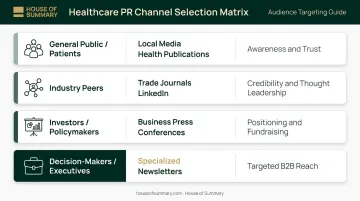
For healthcare brands targeting business professionals, executive-facing newsletters offer a direct route past the noise of social feeds and display ads. House of Summary, for instance, reaches 500,000+ subscribers across its network, with 254,866+ emails opened daily. Sponsored content lands directly in the inboxes of decision-makers, C-suite executives, and policy professionals — no algorithms filtering reach, no ad blockers stripping placements, no visual clutter competing for attention.
Build a Content Calendar
With channels mapped, the next step is converting that plan into a calendar. It specifies what goes out, to which outlets, and when — keeping teams accountable and ensuring messaging stays consistent throughout the campaign.
Good calendars also allow tactical flexibility. If a news cycle creates an opportunity for a reactive pitch, a calendar with buffer time can accommodate it without disrupting planned output.
Amplify Coverage Once Earned
Earning coverage is not the endpoint. Each placement should be actively extended:
- Share across owned social channels, tagging the journalist and outlet
- Include in email communications and investor updates
- Add to the organization's online newsroom
- Use strong placements as proof of credibility in follow-up pitches to other publications
One well-placed article, amplified properly, can generate multiple downstream opportunities.
Healthcare PR Best Practices That Actually Work
Lead with human stories. Patient-centered narratives consistently draw more emotional engagement than product-focused messaging. A meta-analysis of 25 health communication studies found narratives had a small but statistically significant persuasive effect across 9,330 participants. The story should center the patient's journey and real-world outcome — not the facility or technology that made it possible. Obtain documented consent before using any patient's name, image, or clinical details.
Use plain language, not medical jargon. Accessibility doesn't undermine credibility — it expands reach. Compare:
- Clinical: "Laparoscopic cholecystectomy reduces postoperative morbidity and shortens hospitalization duration."
- Plain: "Minimally invasive gallbladder removal means less pain and a faster recovery."
The second version communicates the same fact to a far wider audience. The CDC follows federal plain-language guidelines for this reason: clarity is a public health tool.
Anchor claims with expert voices. A January 2025 KFF tracking poll found 85% of U.S. adults trust their own doctor a great deal or a fair amount. Physician quotes, researcher perspectives, and public health official endorsements lend credibility that organizational statements cannot replicate alone. They also serve as a built-in accuracy check before content goes public.
Adopt a serious, empathetic tone. Patients making health decisions are often scared, uncertain, or overwhelmed. Messaging that reflects that reality — rather than glossing over it — builds trust. Casual informality can feel dismissive, and any tone that minimizes health conditions or overpromises outcomes invites regulatory scrutiny.
Think local to amplify relevance. A story tied to a regional health concern, a community partnership, or a local health authority carries more weight than a national abstraction. When an audience recognizes the setting, the faces, or the problem, the message lands as personally relevant — not just broadly applicable.
A Real-World Campaign Worth Learning From
NewYork-Presbyterian — "Stay Amazing"
NewYork-Presbyterian's "Stay Amazing" campaign, launched in November 2021 with Havas New York, built its communications platform entirely around documentary-style patient experiences.
The results speak for themselves: NYP has won five Emmy Awards across two consecutive New York Emmy cycles — including best commercial single spot, best editor short form, and recognition for individual stories like Jade's craniofacial surgery narrative.
A separate Univision partnership focused on women's health for Hispanic audiences generated 4.4 million+ impressions, 670,000+ video views, and 972,000+ reach — using NYP physicians alongside community voices and formats like Instagram Q&A and Facebook Live.

What the NYP approach demonstrates:
- Consent-based personal narratives create genuine emotional connection without promotional language
- High production quality, applied to real stories, earns recognition from peers and press
- Multi-format campaigns — video, social, editorial — extend reach across different audience attention contexts
What NYP never does: lead with the hospital. Credibility enters the frame only after the patient's story has already earned the audience's trust — and that sequencing is deliberate.
How to Measure the Success of Your Healthcare PR Campaign
Measurement should tie directly to the goals set at the outset. The core categories to track:
| Metric Category | What to Measure |
|---|---|
| Media placements | Volume, publication authority, estimated readership |
| Message pull-through | Whether intended proof points appear in coverage |
| Audience engagement | Social shares, website traffic from PR-driven sources |
| Sentiment | Positive, neutral, or negative tone across mentions |
| Business outcomes | Patient inquiries, lead attribution, appointment volume |
Measurement tools include media monitoring platforms (Muck Rack, Cision), Google Analytics for referral traffic, and social listening for sentiment tracking. The AMEC Integrated Evaluation Framework maps each phase of a campaign — from initial activities through outputs, outtakes, and outcomes — to measurable long-term impact.
Those tools only tell part of the story, though, if the timeline for review is too short. A campaign launched in January rarely shows full impact by February. Build review checkpoints into the plan — monthly output reviews, a mid-campaign outtake assessment, and a final impact audit — and use learnings from each cycle to refine strategy going forward.
Qualitative signals matter too. When journalists seek out your spokespeople for expert comment without any outreach on your end, that's credibility — not just coverage.
Frequently Asked Questions
What is PR in healthcare?
Healthcare PR uses strategic communications — press releases, media outreach, social media, thought leadership — to manage public perception of healthcare organizations, professionals, and products. The goal is to build trust, educate audiences, and protect or strengthen organizational reputation.
What makes healthcare PR different from other types of PR?
The main differentiators are strict regulatory frameworks (HIPAA, FDA), the deeply personal nature of health topics, and the requirement that all communications be both medically accurate and accessible. Balancing public interest with organizational goals adds a layer of complexity most other sectors don't face.
What are the 3 C's of PR?
The 3 C's are Clarity, Credibility, and Consistency. In healthcare, clarity means plain-language messaging patients can act on. Credibility comes from expert voices and verified claims, while consistency means maintaining trust-building communication over time — not just during campaigns.
How do you measure the success of a healthcare PR campaign?
Track media placement volume and quality, message pull-through in coverage, audience reach and engagement, sentiment shifts, and downstream outcomes like patient inquiries or appointment requests. Attribution tools and media monitoring platforms help connect PR activity to measurable business results.
What compliance rules should healthcare PR teams be aware of?
HIPAA restricts how patient information can be used in marketing and requires written authorization before PHI appears in promotional content. FDA guidelines govern health claims made about prescription drugs and medical products. Legal and compliance review should be a standard step in the content approval process.
Is PR going to be replaced by AI?
AI is increasingly used for research, drafting, media monitoring, and sentiment analysis — and it's genuinely useful for those tasks. But healthcare PR depends on judgment, relationship management, and ethical navigation that AI can't replicate, particularly when trust, compliance, and sensitive health topics are at stake.