This post addresses that gap. Drawing on verified channel data and paid newsletter sponsorship benchmarks, it maps out what realistic advertorial performance looks like — broken down by placement type, industry, and campaign goal — so brands can evaluate results against the right standard rather than guessing.
Key Takeaways
- Newsletter advertorial CTR ranges from 2.1% to 12.5% depending on category, based on Paved's paid sponsorship benchmarks
- Email channel conversion rates average 4.9% across industries for marketing emails — a useful reference point for newsletter-driven traffic
- Display ads average 0.46% CTR; newsletter advertorials bypass ad blockers and banner blindness entirely
- Performance hinges on audience alignment, how well the content fits the editorial context, and CTA specificity — not just placement volume
- Track CTR, landing page conversion rate, and downstream signals separately — one metric alone won't give you the full picture
What Counts as a Conversion for an Advertorial?
Before benchmarking performance, brands need to settle a more fundamental question: what are they actually measuring?
Unlike a product page — where a purchase is the obvious goal — advertorials can target several different actions:
- A click through to a landing page
- A form submission or lead capture
- A product page visit
- A newsletter sign-up
- A downstream sale attributed days or weeks later
Treating them as interchangeable produces meaningless benchmarks.
Upper-Funnel vs. Lower-Funnel Goals
The distinction matters most when setting expectations. An awareness campaign targeting finance executives reading a geopolitics newsletter has a completely different success definition than a direct-response ad pushing a free trial signup.
- Upper-funnel: Success looks like quality clicks, content engagement, and brand recall
- Lower-funnel: Success looks like purchases, demo requests, or form fills
Why Attribution Is Harder Than PPC
Advertorial attribution is messier than paid search by design. A reader who sees a sponsored piece in a newsletter may convert days later — or search for the brand directly, crediting a different channel entirely.
| Paid Search | Advertorial | |
|---|---|---|
| Conversion window | Hours to days | Days to weeks |
| Attribution path | Direct (last-click) | Indirect (multi-touch) |
| High-consideration buyers | Moderate fit | Strong fit |
Awareness-led campaigns in B2B, finance, or luxury categories rarely produce a clean last-click conversion — that's expected, not a failure signal.
Given that complexity, define the conversion action before launch. Without it, no benchmark comparison will tell you anything useful.
Advertorial Conversion Benchmarks: What the Numbers Look Like
Newsletter Advertorial CTR
The most granular current data comes from Paved's 2026 paid newsletter sponsorship benchmarks, which report click rates by category across thousands of sponsorship placements:
| Newsletter Category | Open Rate | Click Rate |
|---|---|---|
| Finance | 41.8% | 4.7% |
| Tech | 37.4% | 3.9% |
| News | 40.6% | 3.8% |
| Human Resources | 37.2% | 4.0% |
| Business | 39.3% | 3.0% |
| Marketing | 40.1% | 2.3% |
| Startups | 49.5% | 2.1% |
| Education | 44.8% | 12.5% |
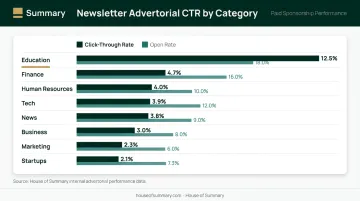
These are paid sponsorship click rates — not general email marketing benchmarks. For brands evaluating newsletter advertorial placements, Finance (4.7%), Tech (3.9%), and News (3.8%) categories represent realistic performance targets in their respective verticals.
Email Channel Conversion Context
For traffic that lands on a destination page after clicking from a newsletter, Ruler Analytics' 2026 benchmark — based on 110M+ sessions and 5M+ conversions — puts the email channel conversion rate at 4.9% on average across industries. This is a channel-level figure, not a newsletter-sponsorship-only benchmark, but it contextualizes what engaged email-referred traffic can deliver once it reaches a landing page.
For comparison, paid search converts at 7.52% (WordStream, 2025) — higher, but capturing a fundamentally different audience segment: people actively searching with purchase intent. Advertorials operate earlier in the funnel.
Native Web Advertorials
Web-embedded native ads tell a different story. Outbrain reports native CTR of up to 0.38% on mobile and 0.16% on desktop. IAB Europe's data (2018, so treat as directional) puts standard display at 0.12% and native formats at around 0.3%.
That gap — sub-0.4% for web native versus 2–12% for newsletter sponsorships — comes down to inbox structure: no ad blockers, no banner blindness, no competing visual noise.
Industry-Level Variation
Ruler's 2026 data shows meaningful variation by sector for overall conversion rates:
- Finance: 6.3%
- Professional Services: 6.1%
- Health & Social Care: 2.3%
- Travel: 1.9%
Finance and professional services post the strongest conversion rates, but both come with longer consideration cycles. The tradeoff: when a conversion does happen, the customer lifetime value typically dwarfs what a fast-moving consumer category generates per transaction.
Why Advertorial Performance Varies So Much
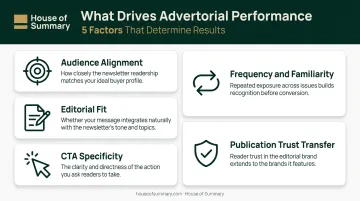
Benchmarks give you a range. What actually determines where you land within that range comes down to five factors.
Audience Alignment
This is the primary driver. An advertorial placed in a general-interest publication reaching 500,000 undifferentiated readers will almost always underperform one placed in a niche publication where the editorial content is topically adjacent to the advertorial's subject.
A finance brand advertising in a financial news newsletter is reaching readers who have already self-selected for that topic. That self-selection drives higher engagement than any amount of copy refinement.
Editorial Fit
Advertorials that match the tone and format of the host publication outperform those that feel imported. Research from a 2024 Journal of the Academy of Marketing Science study found that lower selling intent produces higher click rates — and that readers redirected from in-feed placements show higher annoyance and bounce intentions when the content feels promotional rather than editorial.
Write for the publication's readers, not for your product brief.
CTA Specificity
Vague calls-to-action consistently underperform specific ones. "Learn more" loses to "read the full analysis." "Visit our site" loses to "get the free guide." A single, outcome-oriented CTA outperforms multiple competing options — readers presented with one clear next step are more likely to take it.
Frequency and Familiarity
First exposure rarely converts. Multi-insertion campaigns in the same publication typically see conversion rates climb with each subsequent placement as brand familiarity compounds. The readers who ignored the first placement often act on the third.
Publication Trust Transfer
Outbrain-Savanta research found that 68% of consumers trust ads seen in editorial environments compared to 55% for social media ads. High-credibility publications transfer that trust directly to featured brands. Premium, editorially rigorous newsletters generate higher-quality clicks than anonymous display networks because readers arrive already primed to take the content seriously.
House of Summary's newsletters — covering global news, geopolitics, and city-specific business content — are specifically read by decision-makers and executives for professional relevance. That editorial credibility creates a meaningful attention environment for advertorial placements.
How Newsletter Advertorials Compare to Other Ad Formats
No single format wins across all objectives. The comparison depends on what you're trying to accomplish.
vs. Display Advertising
Display averages 0.46% CTR and 0.77% conversion rate (WordStream data, based on campaigns from 2017–2018, so treat as directional rather than current). Newsletter advertorials structurally outperform these figures because they bypass the two biggest problems with display: 42.7% of internet users worldwide use ad blocking software (Blockthrough, 2023), and banner blindness means many who don't use blockers still don't register the ads.
Newsletter placements arrive in the inbox — unreachable by ad blockers, embedded in the reading flow the subscriber chose.
vs. Social Media
Ruler Analytics' 2026 data puts organic social conversion at 2.23% and paid social at 2.11%. Social ads reach audiences at scale, but they compete for attention in crowded, algorithm-dependent feeds. Newsletter advertorials arrive in a distraction-free environment — no competing posts, no autoplay video, no notification interruptions — where the reader has already committed to reading.
vs. PPC/Paid Search
Paid search delivers strong conversion rates (7.52–8.18% per WordStream's 2025–2026 data) because it captures people actively searching with purchase intent. Newsletter advertorials don't compete on that dimension — they reach readers who aren't yet searching, building consideration before the search happens.
That pre-search reach translates to measurable results. BSH Hausgeräte, an advertiser with Dubai Summary, reported click-through rates 4x higher than their Google AdWords campaigns — which, at an average AdWords CTR of 3.17%, puts newsletter CTR in a range consistent with Paved's finance and tech category benchmarks above.
PPC wins for bottom-of-funnel immediacy. Newsletter advertorials win for reaching engaged audiences before they've reached the search stage — when brand familiarity still shapes which results they click.
How to Improve Your Advertorial Conversion Rate
Three levers matter most.
1. Match publication to audience, not just reach. A larger subscriber count is irrelevant if those subscribers aren't your buyers. Prioritize publications where the editorial content is topically adjacent to your offer. For brands targeting business decision-makers or finance professionals, a newsletter covering global news and geopolitics — verified readers, not algorithmic traffic — delivers pre-qualified attention that mass-reach publications can't match. House of Summary, for example, reaches 500,000+ subscribers across four specialized newsletters, with 66% based in the US.
2. Write for the reader, not the product. The highest-performing advertorials provide genuine value — a useful framework, relevant data, a clear insight — rather than functioning as thinly veiled product announcements. Content written in the publication's editorial voice, addressing something readers actually care about, converts better than content that reads like an ad wearing editorial clothes.
3. Define and track the right goal from the start. Set a specific, measurable conversion action before launch. Use UTM parameters to track advertorial traffic separately from other channels. Evaluate performance against benchmarks that match your funnel stage — newsletter CTR against newsletter norms, landing page conversion against email channel averages — not against search ad conversion rates.

Frequently Asked Questions
What is a realistic click-through rate for a newsletter advertorial?
Based on Paved's 2026 paid sponsorship data, newsletter advertorial CTR ranges from 2.1% (Startups) to 4.7% (Finance) for most business categories, with outliers like Education reaching 12.5%. Well-targeted placements in relevant categories consistently outperform both display (sub-0.5%) and social benchmarks.
How do advertorial conversion rates compare to banner ads?
Banner ads average around 0.46% CTR and 0.77% conversion rate on the Google Display Network, and ad blockers eliminate a further share of that reach entirely. Newsletter advertorials reach opted-in readers directly in their inbox, producing click rates that are typically 5–10x higher — the placement is native to a reading environment, not an interruption.
What metrics should brands prioritize when evaluating an advertorial campaign?
Track CTR from the advertorial, conversion rate on the destination landing page, and (for brand-awareness campaigns) qualitative signals like time-on-page and downstream branded search volume. The right primary metric depends on the campaign goal: CTR for awareness and traffic objectives, landing page conversion rate for lead generation.
How long does it take for an advertorial to show measurable conversion results?
Single placements generate immediate clicks, but most brands see meaningful conversion lift after 2–4 weeks of multi-insertion campaigns. Repeated exposure builds reader familiarity with the brand, and results tend to compound across touchpoints rather than peak at first placement.
Does the industry or niche of the advertiser affect conversion rates?
Yes, significantly. Finance and professional services show higher overall conversion rates (6.1–6.3% per Ruler's data), but involve longer consideration cycles and higher per-conversion value. Consumer products may convert faster at lower individual value. Ultimately, audience-to-offer alignment predicts advertorial success more reliably than industry category alone.
What is the difference between an advertorial CTR and a conversion rate?
CTR measures the percentage of readers who click the advertorial's link. Conversion rate measures the percentage of those clickers who then complete a defined action on the destination page. Both need to be tracked separately — high CTR with low landing page conversion points to a landing page problem, while low CTR with high conversion suggests the creative or placement needs work.