Introduction
Banner ads are broken. Users have spent years training themselves to ignore anything that looks like an advertisement — a pattern so consistent that Nielsen Norman Group's research on banner blindness confirmed users actively avoid content that resembles or sits near ad placements. Add to that the 42.7% of global internet users now running ad-blocking software (per Blockthrough's 2023 industry report), and the reach problem becomes undeniable.
Advertorial landing pages solve this directly. They deliver promotional intent wrapped in editorial structure — pages that read like articles, build trust before making any ask, and reach readers that conventional display units never touch.
This guide breaks down what advertorial landing pages are, how they outperform traditional ads, and four real-world formats you can use — including why newsletter placements remain one of the most underused options available to advertisers today.
Key Takeaways
- An advertorial landing page is a pre-sell page that reads like editorial content and bridges your ad to your sales page
- They work because they educate before they sell, lowering reader resistance before the CTA even appears
- Four formats dominate: news article, listicle, comparison, and social proof-led story
- Newsletter advertorials bypass ad blockers entirely and reach self-selected, already-engaged audiences
- Strong advertorials share three constants: a pain-point headline, a narrative arc, and a low-friction CTA that appears at least twice
What Is an Advertorial Landing Page?
An advertorial landing page is a hybrid format that blends the persuasive intent of an advertisement with the informational structure of editorial content. The word itself is a portmanteau — "advertising" plus "editorial" — and that's what it delivers: a paid piece that reads like an article rather than a product pitch.
In a marketing funnel, it sits between the initial ad click and the sales or product page. Its job is to warm up cold traffic. A reader clicks a native ad or sponsored post, lands on the advertorial, and reads something genuinely useful about their problem. By the time they reach the sales page, they're already primed to buy.
Advertorial vs. Traditional Landing Page
Traditional landing pages are conversion-focused by design: short copy, one CTA, minimal narrative. They assume the reader is already sold on the problem and just needs to act. Advertorial landing pages take the opposite approach — longer, story-driven, education-first. The conversion ask comes after the reader has been moved through a narrative arc.
That distinction in page structure points to a broader difference in content format — which is where advertorials, native ads, and sponsored posts tend to get conflated.
Advertorial vs. Native Ads vs. Sponsored Posts
All three are paid content formats, but they operate differently:
- Native advertising is the broad category — any paid content formatted to match its platform context
- Sponsored posts are short-form placements (social, influencer, newsletter) with a clear CTA and minimal editorial depth
- Advertorials are specifically long-form editorial pieces — articles, guides, transformation stories — that happen to promote a product
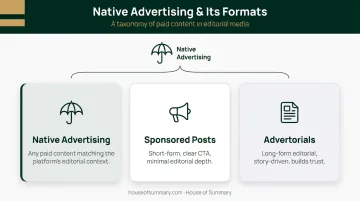
Advertorials sit within the native advertising umbrella, but the editorial depth is what makes them effective at a specific job: moving a skeptical reader from curiosity to conviction before they ever see a sales page.
Best use cases for advertorials:
- Top-of-funnel campaigns targeting cold traffic
- High-consideration products that require education before purchase (finance, health, SaaS, insurance)
- Any market where trust must be established before a reader will engage with a sales page
Why Advertorial Landing Pages Outperform Traditional Ads
The performance gap between advertorials and traditional ads is documented, measurable, and rooted in how readers actually behave.
The Attention Gap
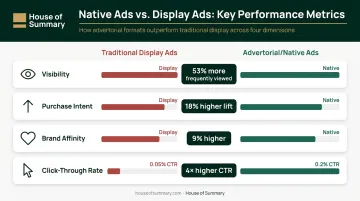
Research from IPG Media Lab and Sharethrough found that native ads were viewed 53% more frequently than display ads, with 18% higher purchase-intent lift and 9% higher brand-affinity scores. Outbrain's platform benchmarks show native ad CTR averaging 0.2% versus 0.05% for display — a 4x difference.
The mechanism isn't mysterious. Advertorials present content in a familiar editorial format that doesn't trigger the automatic-ignore response users have developed for anything that looks like an ad unit.
The Trust-Building Mechanism
Claude Hopkins articulated this principle in Scientific Advertising a century ago: the best advertising functions as useful service, not as a pitch. Advertorials deliver on this by explaining the "why" and "how" behind a reader's problem before ever naming the product. By the time they encounter the CTA, the brand has already demonstrated it understands their situation — and earned genuine credibility with the brand.
The Ad Blocker Problem
With 42.7% of global internet users using ad-blocking tools, web display inventory is reaching a shrinking audience. Because advertorials are embedded as editorial content rather than served as display units, they aren't flagged or filtered by blocking software — the content loads as a page, not as an ad script.
That distribution advantage compounds when you factor in what happens to the readers who actually see the content.
The Warmed-Up Reader Effect
A reader who finishes an advertorial has already:
- Self-identified as experiencing the problem
- Spent time with content that positions the product as a solution
- Formed genuine trust with the brand
That reader arriving at your sales page is a entirely different prospect than cold traffic from a banner ad. Advertorial-sourced traffic routinely converts at 2–5x the rate of equivalent display traffic — a difference that compounds across the full funnel.
The SEO Upside
Because advertorials are structured as editorial content, they attract organic backlinks and generate strong time-on-page signals. Targeting specific audience pain points and relevant keywords, well-built advertorials rank for mid- and long-tail queries that product pages rarely capture — creating inbound traffic that compounds well beyond the paid campaign window.
Advertorial Landing Page Examples: Real Formats That Convert
Advertorials aren't one-size-fits-all. The format should match the product's complexity, the audience's awareness level, and the conversion goal. These four formats have proven themselves across categories and campaign types.
News Article Format
This style is written as if a journalist discovered and reported on the product — newsy headline, byline attribution, journalistic prose with a subtle promotional angle underneath.
Authority and credibility transfer from the editorial frame to the product. Readers approach news-style content with less defensive posture than they bring to overt advertising.
Real example: Bills.com ran an article lander headlined "The Secret to Paying Off Credit Card Debt If You Own a Home" — framing a public financial concern before positioning the product as the resolution. LowerMyBills used a similar approach, educating readers about the HARP mortgage refinancing program before introducing the service.
Best for: Financial services, health products, insurance, any category where authority matters.
Listicle Format
A numbered or bulleted structure where each point covers a distinct product benefit, use case, or feature — supported by visuals and leading naturally to a CTA at the end.
Listicles are easy to scan and easy to follow. The numbered structure creates a natural pull toward the end — readers feel compelled to finish what they started.
Real example: The Earthling Co. and Jones Road Beauty both use listicle landing pages cataloged on ConvertFlow — clear headline, vibrant product images per point, embedded testimonials mid-list, and a CTA banner at close.
Best for: Ecommerce, beauty, wellness, consumer products with multiple differentiated benefits.
Comparison Format
The product is positioned against older alternatives, competitor tools, or the reader's current situation — with clear contrast markers that make the preferred option feel like the obvious rational choice.
In an editorial context, a well-framed comparison reads like research, not a pitch. That distinction matters: readers extend trust they'd withhold from a straightforward product page.
Best for: SaaS, fintech, any category where switching costs or feature differentiation drive the buying decision.
Social Proof and Story-Led Format
Opens with user-generated content, testimonials, or a single customer transformation story. The product enters mid-narrative as the explanation for the transformation.
In consumer categories, peer validation moves purchasing decisions more than product specs. The story creates identification with the reader before the product is even named.
Real examples: Crown & Paw and Reggie both use this structure — open with customer quotes or UGC, introduce the product briefly, layer in benefit sections with CTAs, close with extensive testimonials before the final conversion ask.
Best for: DTC consumer brands, pet products, supplements, any category where "someone like me" proof drives trust.
Key Design Elements Across All Formats
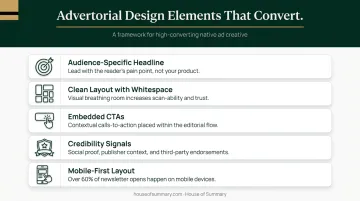
Each format takes a different angle, but the underlying structure is consistent. High-performing advertorials share these design elements regardless of which approach they use:
- Audience-specific headline that promises an outcome, not a product name
- Clean layout with enough whitespace to avoid the visual density of a hard sell
- Embedded CTAs that don't interrupt reading flow — sticky sidebars, mid-content buttons, final CTA banner
- Credibility signals — author attribution, social proof, publication branding, or data citations
- Mobile-first layout, because most readers arrive on phones
How to Write a High-Converting Advertorial Landing Page
Step 1: Map the Pain Point to the Product
Identify the specific problem your target reader experiences and map the product as its natural resolution. That connection is the premise everything else builds on.
The headline should promise a specific outcome or insight tied to that pain point, not the product name. "How to Stop Losing Sleep Over Your Mortgage Rate" outperforms "Introducing [Product]: The Best Refinancing Tool."
Step 2: Build the Narrative Arc
Structure the body using a story arc:
- Open with tension — the problem, made specific and relatable
- Develop understanding — explain why the problem exists, what makes it hard to solve
- Introduce the resolution — the product enters as the logical answer, not an interruption
The balance to strike: enough education to build trust, not so much that the reader loses the thread before reaching the offer.
Step 3: Place CTAs Strategically
CTAs should appear at least twice:
- Early-to-mid section — for high-intent readers who decide quickly
- At the close — after the full argument has been made
Make the next step frictionless. The CTA copy, the destination page design, and the messaging should all match. A jarring transition from editorial tone to hard-sell sales page undoes the trust the advertorial spent paragraphs building.
Step 4: Include FTC-Compliant Disclosure
Any advertorial must carry a clear disclosure label — "Sponsored," "Paid Content," or "Advertisement" — prominently near the headline. The FTC specifies that disclosures should appear immediately in front of or above the native ad's headline.
Transparent labeling builds trust rather than undermining it. The FTC's 2016 action against Lord & Taylor — which reached 11.4 million users through undisclosed paid content — shows what's at stake when brands skip disclosure.
Step 5: Test and Iterate
After publishing, track:
- Engagement metrics: time on page, scroll depth, bounce rate
- Conversion metrics: CTA click rate, form submissions, downstream sales page visits
The three elements that typically drive the largest performance differences are headline variants, hero visuals, and offer framing. Test one at a time to isolate what's driving results.
Newsletter Advertorials: The Channel Most Brands Overlook
Web advertorials compete for attention against browser tabs, sidebars, pop-ups, and whatever else is on a reader's screen. Newsletter advertorials don't. They land directly in an inbox that the reader chose to open.
Why the Channel Is Different
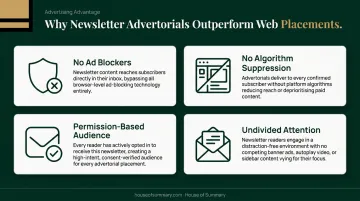
The structural advantages of newsletter advertorials over web-based placements:
- No ad blockers — email content isn't filtered by browser-based blocking software
- No algorithm suppression — there's no feed to compete in, no reach penalty for low engagement scores
- Permission-based audience — readers opted in, meaning they've already self-selected as interested in the topic
- Undivided attention — when someone opens a newsletter, they're reading it, not half-watching something else
The trust layer that web advertorials work hard to establish is already partially built into the newsletter relationship before the sponsored content appears. That structural advantage only compounds when the publication's audience closely matches the advertiser's target customer.
Reaching the Right Audience
Newsletter advertorials deliver the most value when there's a tight fit between the publication's readership and who the brand actually needs to reach. A finance brand placing a sponsored article in a geopolitics newsletter reaches exactly the kind of executive reader who makes financial decisions — without relying on programmatic targeting that regularly misses at the income and seniority level.
This is the model House of Summary's network is built on. Across Presidential Summary, Geopolitical Summary, Dubai Summary, and London Summary, the combined readership exceeds 500,000 subscribers with more than 254,000 emails opened daily.
The audience skews heavily toward decision-makers, executives, and high-income consumers: 66% US-based, concentrated in New York and Los Angeles, with significant presence in London and Dubai.
For brands in finance, luxury, professional services, or any high-consideration category, that combination of scale and audience quality is difficult to replicate through programmatic channels. Sponsored editorial placements within these publications appear within content readers already rely on for accuracy and clarity — inheriting the editorial trust each newsletter brand has built over time.
Frequently Asked Questions
What is an advertorial landing page?
An advertorial landing page is a narrative-driven page that sits between an ad click and a sales page in a marketing funnel. It combines editorial storytelling with promotional intent, warming up cold traffic before the conversion ask is made.
What is an advertorial?
An advertorial is a paid piece of content designed to read like an editorial article: informative, story-driven, and written to educate the reader about a problem and its solution, with the product positioned naturally as the answer.
What is the format of an advertorial?
The four main formats are news article style, listicle, comparison, and social proof-led story. All share a value-first headline, narrative body, embedded credibility signals, and a low-friction CTA placed at least twice.
What is the difference between an advertorial and a sales page?
A sales page is direct and conversion-focused. It presents the product, pricing, and CTA with minimal narrative. An advertorial is educational and story-driven, designed to build trust and awareness before the reader reaches the sales page.
Are advertorials trustworthy?
Well-executed advertorials are trustworthy when they carry clear disclosure labels and deliver genuine educational value. They build trust by informing rather than hard-selling. Disguising paid content as independent editorial, without disclosure, is both unethical and potentially illegal under FTC guidelines.
Is an advertorial a landing page?
An advertorial can function as a landing page when it's the destination after an ad click. It differs from a conventional landing page in structure and intent: it reads like editorial content first, with conversion as a secondary goal. In practice, it's a blog post structure with landing page elements woven in.