Introduction: The Cybersecurity Advertising Challenge
Cybersecurity is one of the most competitive B2B markets on the planet. Gartner forecasts global information security spending to reach $211.5 billion in 2025 — up 15.1% year over year — and every vendor in that market is competing for the same buyer's attention.
The real problem is credibility.
Cybersecurity buyers are technically literate, deeply skeptical of vendor claims, and operating under genuine pressure. They've seen the dark-palette ads, the "total protection" promises, and the abstract platform pitches. Generic messaging doesn't just underperform — it signals that a vendor doesn't understand the buyer.
This article covers what actually works: the buyer personas that determine your targeting, six advertising tips grounded in real campaigns, the channels worth your spend, and the creative rules that separate credible ads from forgettable ones.
Key Takeaways
- Cybersecurity buyers distrust broad claims — specificity and third-party proof are non-negotiable
- Different stakeholders (CISOs, engineers, boards) need completely different messages
- Funnel stage should dictate ad format: education early, demos late
- LinkedIn dominates B2B cybersecurity spend, but newsletters and niche communities reach buyers where algorithms can't
- Creative differentiation — unconventional angles, humor, unexpected analogies — consistently outperforms the category's dark-palette default
Why Cybersecurity Advertising Requires a Different Playbook
Three realities make cybersecurity advertising genuinely harder than standard B2B.
The buyer is skeptical by profession. Security professionals evaluate vendor claims the same way they evaluate threat intelligence — with scrutiny. According to Demand Gen Report's 2024 Content Preferences Benchmark Survey, 54% of B2B buyers reject content they consider too sales-oriented, and 51% say content is too generic to be useful. In cybersecurity, those percentages likely run higher.
The buying committee is large and slow. The average B2B buying group involves 11 people and takes 11.3 months to complete a purchase. In cybersecurity, you're typically navigating CISOs, IT directors, compliance officers, and CFOs — each with different definitions of "good enough."
The market is also saturated with lookalike messaging. Organizations already manage an average of 83 security tools from 29 vendors. When every vendor runs dark imagery and talks about "unbreakable protection," the ads blur together. That sameness is the failure mode most cybersecurity marketers never notice they've fallen into.
Fear-based messaging is a major driver of that blur. Dark Reading has reported that CISO-vendor relationships deteriorate when vendors lean on FUD rather than actionable data — and it's easy to see why. An audience trained to detect threats isn't moved by manufactured urgency. What cuts through is proof: specific claims, real numbers, and creative that treats the reader as the expert they are.
Understanding the Cybersecurity Buyer: Who You're Really Talking To
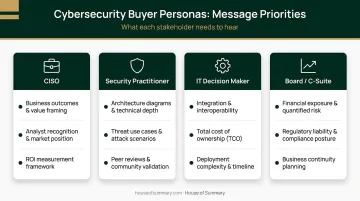
Effective cybersecurity advertising requires understanding the specific fears and decision criteria of each stakeholder. One ad cannot speak to all of them — and trying to do so dilutes the message for everyone.
CISOs and Security Leaders
CISOs are under real pressure: 57% report understaffing and 47% say their programs are underfunded, according to ISACA's 2024 global survey of 1,832 cybersecurity professionals. They're not looking for feature lists.
Ads targeting CISOs should lead with:
- Business-outcome framing (risk reduction, not technical specs)
- Analyst recognition — Gartner Magic Quadrant placements, Forrester Wave positions
- ROI language that supports internal budget justification
Security Practitioners and Implementers
Engineers and SOC analysts respond to technical depth, not marketing polish. Surface-level claims lose them immediately. What works for this audience:
- Architecture diagrams or feature comparisons
- Real-world use cases with specific threat scenarios
- Peer credibility — community recognition, practitioner reviews
IT Decision Makers and the C-Suite
IT decision makers sit at the intersection of security and operations. They want to know about integration friction, total cost of ownership, and deployment complexity. Case studies with quantified outcomes resonate; hype does not.
Boards and non-technical executives focus on business exposure, not security architecture. With 85% of CEOs now saying cybersecurity is critical for business growth (Gartner, 2025), board-level messaging should address:
- Financial exposure from breaches and downtime
- Regulatory liability and compliance gaps
- Business continuity and reputational risk
Technical specifications don't belong in this conversation.
6 Essential Cybersecurity Advertising Tips
These tips come from real campaigns run by cybersecurity brands. Each addresses a specific failure mode common in the category.
Tip 1: Lead With Specificity — One Persona, One Pain Point, One Ask
Vague targeting kills performance. Darktrace's CISO-targeted email security ads worked because they called out one audience and one problem explicitly. The ad excluded most viewers — and that was the point. High specificity means lower reach but higher intent.
Before you write an ad, answer: What is the most precise piece of value you can offer your exact buyer, right now?
Tip 2: Build Credibility Through Third-Party Proof
Cybersecurity buyers distrust vendor claims and actively seek external validation. More than a third of B2B buyers sought third-party content in 2024, with analyst reports influencing 53% of purchase decisions.
CrowdStrike's use of Gartner Magic Quadrant placement as an ad centerpiece is a textbook example: low production cost, instantly recognized, high trust signal. Take stock of every third-party validation you hold:
- Analyst rankings (Gartner, Forrester, IDC)
- Industry certifications and compliance badges
- Customer reviews and case study pull quotes
Make whichever is strongest the visual centerpiece of your next ad.
Tip 3: Lead With Value, Not Your Product
CyberArk's most effective ads didn't open with product features. They opened with a frustration buyers recognized — time lost to compliance overhead — before connecting that pain to a solution. Lead with the problem your buyer is already complaining about in internal meetings. The product reveal lands harder when the audience already feels seen.
Tip 4: Use Data Visualization to Educate and Engage
Early-stage buyers respond well to infographics (59%) and research reports (58%), per Demand Gen Report's 2024 survey. A10 Networks used peer benchmarking data to draw viewers in — but the lesson isn't to pack in charts. One sharp, provocative statistic outperforms a cluttered data visualization every time.
Find the single number that would make your audience want to know more. Make that the visual centerpiece.
Tip 5: Match Ad Format and Offer to Funnel Stage
Mismatched format and funnel stage is one of the most common reasons cybersecurity ads underperform.
| Funnel Stage | Content Type | Examples |
|---|---|---|
| Top (Awareness) | Education | White papers, research reports, infographics |
| Mid (Consideration) | Trust-building | Webinars, case studies, LinkedIn lead gen forms |
| Bottom (Conversion) | Conversion | Demo requests, consultation calls, remarketing |
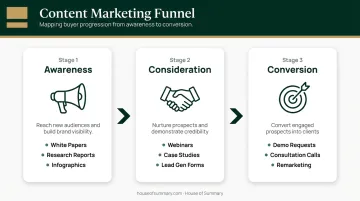
CrowdStrike's lead gen form campaigns and A-LIGN's bottom-funnel remarketing approach both work because the offer matches where the buyer is. Late-stage buyers want demos — Demand Gen Report confirms 77% of late-stage buyers value them above all other content types.
Tip 6: Use Creativity and Unexpected Angles to Break Through Sameness
Most cybersecurity ads follow the same template: dark palette, technical copy, generic "protection" messaging. Carbonite's visual analogy approach and Dashlane's humor-driven Super Bowl campaign proved that unexpected creative hooks earn more attention and brand recall than category convention.
LinkedIn and MAGNA Media Trials research found that B2B decision-makers are 40% more likely to consider a purchase when they perceive an ad as creative. Ask yourself: what analogy, unexpected visual, or relatable frustration could your audience recognize before you've mentioned your product? That's where creative differentiation starts.
Choosing the Right Channels for Cybersecurity Advertising
LinkedIn dominates B2B cybersecurity advertising for a clear reason: it captured 47.2% of US B2B display ad spending in 2024, according to eMarketer. Its targeting by job title, seniority, company size, and industry makes precise persona targeting possible at scale.
Ad formats map to funnel stages: sponsored content and carousels for awareness, lead gen forms for consideration, and retargeting for conversion. The platform works — but it's also where every cybersecurity competitor is running ads.
Webinars and Co-Hosted Events
Webinars operate differently from standard ads. Buyers feel they're learning, not being sold to. Demand Gen Report found that 60% of early-stage buyers and 58% of mid-stage buyers actively value webinars as research resources. Multi-vendor formats reduce skepticism further by offering multiple perspectives. Post-event automated follow-up extends the value of a single event across weeks.
Niche Communities and Forums
Security practitioners gather in places where promotional language gets immediately rejected — Reddit security subreddits, closed Slack groups, specialized forums. Ads placed here need to earn their place through genuine usefulness. The reach is smaller; the trust level is higher.
Newsletter Advertising
Newsletter advertising is underutilized in cybersecurity. That gap is an opportunity.
Newsletter readers have opted in for focused content. They're in an active reading mindset, not scrolling past competing distractions. Newsletter ads bypass ad blockers entirely — ad-blocking software stops ads on websites but has no effect on email.
For cybersecurity brands targeting the buying committee — CISOs, C-suite executives, senior IT decision-makers — newsletters that reach those personas represent a direct path to the inbox with no algorithm friction.
House of Summary's network reaches 500,000+ subscribers with 254,866+ emails opened daily. The audience maps directly to cybersecurity buying committees: decision-makers, C-suite executives, founders, senior professionals, and policy experts across New York, Los Angeles, London, and Dubai. Presidential Summary and Geopolitical Summary in particular draw the senior decision-makers who overlap with enterprise security purchasing — a natural fit given how closely geopolitical developments now intersect with enterprise cybersecurity risk.
For brands running coordinated campaigns, the network offers:
- Sponsored content and native ads
- Display placements and full-issue takeovers
- Multi-newsletter bundles across US, UK, and UAE markets

Cybersecurity Ad Creative: Do's and Don'ts
Do's
- Speak to one persona per ad — never try to satisfy CISO, engineer, and board in a single message
- Include third-party validation — analyst placement, customer quote, or certification badge
- Write with technical accuracy — one wrong claim tanks credibility with practitioners
- Align creative to buyer journey stage — the offer must match where the buyer is, not where you want them to be
- Prioritize clarity over polish — overly designed "marketing-looking" assets read as insincere to technical audiences
Don'ts
- Never overpromise — "total protection" and "unbreakable security" invite regulatory scrutiny and buyer distrust. The FTC's actions against Zoom (2020) and GoDaddy (2025) for misleading security claims are direct warnings for the category
- Don't use generic templates — if your ad could belong to any of your 29 competitors, it belongs to none of them
- Don't make the buyer connect the dots — name the specific threat, the specific user, and the specific outcome your product delivers
- Don't skip proof — in a comparison, the vendor with evidence wins
Refreshing Creative Without Losing Momentum
Ad creative fatigues. When engagement metrics begin declining, rebuilding from scratch feels like the logical fix — but it discards the brand familiarity your audience has already built.
A better approach is to refresh the surface while protecting the core:
- Update the visual and headline to restore novelty and click-through rate
- Keep the core message and offer so existing audience familiarity carries forward
- Test one variable at a time to isolate what actually drove the performance drop
Frequently Asked Questions
What makes cybersecurity advertising different from regular B2B advertising?
Cybersecurity buyers are more skeptical, more technically literate, and more risk-averse than typical B2B buyers. They distrust vendor claims by default and require proof, specificity, and education-first messaging before they'll engage — broad promotional claims actively damage credibility rather than building it.
Which ad formats work best for cybersecurity campaigns?
Format depends on funnel stage: short video and carousels for awareness, gated content and lead gen forms for consideration, demos and consultation CTAs for conversion. LinkedIn dominates paid social, but webinars and newsletter placements reach buyers at the stages paid social misses — particularly consideration and late-funnel.
How do you write ad copy that resonates with a CISO or technical buyer?
They require completely different copy. CISOs respond to business outcomes, ROI framing, and analyst validation. Technical buyers want accurate product detail and specific use cases grounded in how the product actually works. Writing for both simultaneously means writing effectively for neither — choose one and tailor accordingly.
Should cybersecurity ads use fear-based messaging?
Fear creates awareness but rarely converts on its own. The most effective approach names the threat clearly, then pivots immediately to how the product reduces that specific risk — leaving the buyer feeling informed rather than alarmed.
What channels deliver the best ROI for cybersecurity advertisers?
LinkedIn, webinars, niche community platforms, and newsletter advertising consistently outperform generic display and search for this audience. Each channel serves a distinct role in the buyer journey, so combining them produces better results than any single channel alone.
How often should cybersecurity ad creative be refreshed?
Refresh visuals or headlines when CTR drops 20–30% from your established baseline — that's typically the signal performance is declining. Refreshing the surface elements — imagery, headline, CTA — while maintaining the core strategic message preserves brand recognition while restoring performance.