Introduction: What D2C Companies Need to Know About Global Sports Partnerships
D2C brands were built on a simple premise: cut out intermediaries and own the customer relationship directly. Yet today, that direct connection faces erosion from rising digital ad costs, widespread ad-blocker adoption, and social media algorithms that throttle organic reach. The channels that once delivered predictable growth now extract higher costs for diminishing returns.
Sports partnerships offer a different kind of access: emotional connection with loyal audiences that no algorithm controls. When your brand appears inside a live sporting moment, it cannot be skipped, blocked, or buried by an algorithm.
This guide is for D2C founders, marketing directors, and media buyers evaluating sports sponsorships as a serious growth channel. We'll cover partnership types, market selection, activation quality, budget entry points, and D2C-specific ROI measurement. Whether you're scaling past seven figures or entering new geographic markets, this is a practical framework for making that decision well.
Key Takeaways
- Sports partnerships deliver emotional reach and brand trust that paid digital ads cannot replicate
- Athlete and digital content partnerships offer D2C brands the best balance of authenticity, engagement, and attribution
- Choose sports based on customer demographic alignment, not prestige or popularity alone
- Logo placement alone won't move the needle — creative activation and a distinct brand identity are what drive results
- Measure ROI directly with unique promo codes, UTM-tracked links, and brand search lift monitoring
Why Sports Partnerships Are a Growth Channel D2C Brands Can't Afford to Ignore
Sports fandom operates on emotional mechanics that programmatic advertising cannot replicate. Loyalty to a team or athlete transfers to associated brands in measurable ways. According to a 2025 Elevent Sports Sponsorship Performance Survey of over 5,000 U.S. adults, 66% of consumers are more likely to purchase from companies that sponsor sports they like, up from 59% in 2022. A further 20% of respondents have chosen to do business with a company specifically because it sponsors a sport they follow.
The D2C-Specific Case
Sports partnerships bypass the two biggest threats to D2C growth: ad blockers and algorithmic throttling. Ad blockers filter out paid placements on websites and social feeds. Social media algorithms deprioritize brand content unless you pay for distribution. When your brand appears inside a live sporting broadcast, stadium signage, or athlete-generated content, it cannot be skipped or suppressed.
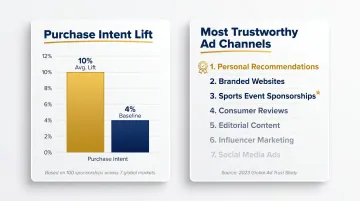
Nielsen's analysis of 100 sponsorships across seven markets found that sponsorships drive an average 10% lift in purchase intent among exposed fanbases. Consumer trust in brand sponsorships at sporting events ranks as the third most trustworthy advertising channel, behind only personal recommendations and branded websites.
Global Scale Advantage
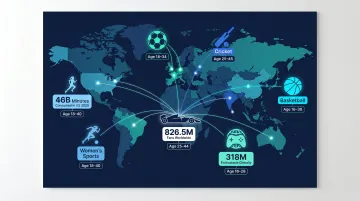
Mega-events like the FIFA World Cup, Olympic Games, and Formula 1 deliver cross-border audience exposure that would take years of paid social campaigns to approximate. Formula 1's global fanbase reached 826.5 million in 2025, an increase of 90 million over the 2023 season. For D2C brands expanding into new geographic markets, a well-placed sports partnership delivers immediate audience scale and cultural credibility that paid media alone cannot buy.
Trust-Building Dimension
Sports partnerships shift a brand from advertiser to participant in something fans genuinely care about. Castore, a digitally-native premium sportswear brand founded in 2015, demonstrates this shift clearly.
Its sports partnership strategy — spanning Red Bull Racing (F1), Everton FC, Rangers FC, the England and Wales Cricket Board, and athlete Andy Murray — drove revenue growth from £49M in 2022 to £115M in 2023, while doubling profits.
That momentum translated directly into investor confidence. Castore reached a £950M valuation after raising £145M in December 2023.
Timing Advantage
Brand results like Castore's reflect a broader market shift that's still accelerating. The market data underscores the opportunity:
- The global sports industry is forecast to grow at 7.4% annually over the next three to five years, with sponsorship rights revenue growing at 6.5% annually
- The global sports sponsorship market is projected to reach $195.50 billion by 2032, up from $106.44 billion in 2024
D2C brands that establish partnerships now do so before pricing reflects that scale.
The Four Main Types of Sports Partnerships (and Which Suit D2C Best)
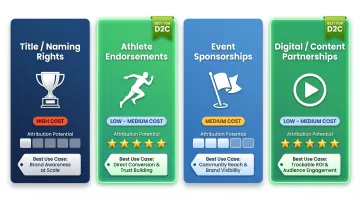
Sports partnerships fall into four main categories: title/naming rights, athlete endorsements and ambassador programs, event sponsorships and activations, and digital or content partnerships. These vary widely in cost, exposure type, and attribution potential.
Title and Naming Rights
Stadium naming and league title sponsorship sit at the top of the investment pyramid. Brands spend nearly $891 million annually across seven major U.S. professional leagues on venue naming rights alone. Costs are enormous, brand impact is broad but diffuse, and there is almost no mechanism for direct conversion attribution. Best suited to large legacy brands building long-term awareness at scale — not D2C brands seeking measurable growth.
Athlete Endorsements and Ambassador Programs
This is one of the most accessible and effective partnership types for D2C brands. Athletes produce authentic social content, reach highly engaged niche audiences, and can be contracted across a wide budget range. Sports micro-influencers (10K–100K followers) typically charge $250–$1,500 per post, compared to $100,000+ for celebrity-tier athletes.
Authenticity is the real differentiator here. D2C brands should look for athletes whose lifestyle genuinely intersects with the product — not just athletes with reach.
Google Pixel's partnership with Liverpool FC and Arsenal FC is a useful benchmark. The campaign centered on pitchside "Shot on Pixel" content and women's football visibility. The Liverpool partnership alone generated 717M impressions and $23.9M in earned media value — numbers that reflect creative alignment, not budget size.
Event Sponsorships and Activations
Sponsoring a race, tournament, or league match gives D2C brands a physical and digital presence at the point of peak fan emotion. The key advantage is the direct consumer touchpoint: brands can drive immediate product trial and purchase when fan attention is highest.
This works best when the activation has a clear fan-facing offering rather than passive logo placement. Effective formats include:
- On-site sampling tied to product use cases relevant to the sport
- Pop-up experiences that let fans interact with the product in context
- Exclusive event promotions with short redemption windows to drive urgency
- Digital extensions (QR codes, AR activations) that bridge physical presence to online conversion
Digital and Content Partnerships
This is the most attribution-friendly option for D2C brands. Co-created content series, branded documentaries, behind-the-scenes access, and social collaborations with sporting entities can all be tracked precisely through links, promo codes, and engagement metrics.
FC Barcelona's partnership with Spotify shows what this looks like at scale. The deal is valued at up to €460M ($536M) by 2034, covering €65M/year for front-of-shirt rights and €20M/season for stadium naming rights.
What makes it notable for D2C thinking isn't the budget — it's the mechanic. Spotify uses the jersey as a content platform, replacing its own logo with artist logos for major matches. Drake, Rosalía, Coldplay, Ed Sheeran, and The Rolling Stones have all appeared on the shirt, turning each fixture into a media moment with its own audience pull.
Choosing the Right Sport and Market for Your D2C Brand
The prestige of a sport is irrelevant if its fanbase doesn't match your customer profile. Map your existing customer demographics — age, geography, income, lifestyle interests — against the verified audience profiles of the sports properties you're considering. A performance nutrition brand targeting men 25-40, for instance, will find far stronger alignment in endurance sports than in golf.
Practical Global Market Guide
- Football/soccer: Europe and Latin America
- Cricket: South Asia and the UK
- Basketball: U.S. and increasingly China
- Formula 1: Global affluent audiences — F1's 826.5 million global fans grew by 90 million in one season
- Women's sports: Younger, digitally-native demographics — 46 billion minutes of women's sports were consumed in 2025 in the U.S. alone
- Esports: Global esports enthusiasts exceeded 318 million by 2025, with interest among 18-29 year-olds rising from 27% in Q1 2021 to 31% in Q2 2024
Cultural Alignment Test
A D2C activewear brand sponsoring a marathon series makes intuitive sense to fans. The same brand sponsoring a darts tournament would create cognitive dissonance. Misaligned partnerships don't just look odd — they signal inauthenticity to exactly the customers D2C brands depend on for repeat purchases and word-of-mouth growth.
Before signing any sponsorship, run this quick check:
- Does the sport's audience overlap with your core buyer persona?
- Would your product be used or valued at this sporting event?
- Does the sport's cultural image reinforce your brand values?
- Can you activate meaningfully, not just put a logo on something?
Start Regional Before Going Global
Regional or niche sports properties offer lower entry costs, stronger community engagement, and a real testing environment — without the pressure of a seven-figure commitment. A direct-to-consumer skincare brand, for example, might sponsor a regional women's triathlon series before approaching a national athletics federation. The learning compounds; the risk stays contained.
What Separates Successful Partnerships from Expensive Logo Placements
A logo on a jersey, perimeter board, or event banner — without surrounding activation — delivers minimal brand value. Fans have learned to tune out passive brand presence — they respond to brands that actively add something to their sporting experience.
What Activation Means in Practice
The brand creates a fan-facing moment, campaign, or offering that exists because of the partnership. LEGO's Formula 1 Miami Grand Prix activation sets the benchmark. On May 4, 2025, LEGO and Formula 1 staged a Drivers' Parade featuring 10 fully drivable life-size LEGO cars. Each car comprised nearly 400,000 LEGO bricks, weighed 1,500 kg, and was driven by all 20 F1 drivers for a full lap of the 5.4 km circuit. The activation earned widespread organic coverage across social platforms — driven entirely by the spectacle itself, not paid amplification.
Purpose-Driven Partnerships Earn Disproportionate Brand Equity
When the partnership is anchored to a genuine social or environmental mission, it earns media coverage, fan loyalty, and long-term recall. Xylem's partnership with City Football Group reached over 1 billion people through water awareness campaigns while tying the mission directly to the clubs' global platforms.
That kind of mission-led credibility is where D2C brands hold a structural edge. Unlike legacy companies working through retail intermediaries, D2C brands own their customer relationships and data directly. This makes co-creation with athletes and sporting entities feel genuine rather than contractual. In practice, that advantage shows up in a few specific ways:
- Using first-party purchase and behavioral data to shape campaign messaging around real fan behavior
- Building limited-edition drops or exclusive offers tied to sporting moments without retailer approval chains
- Activating athlete partnerships through owned channels — email, app, DTC site — rather than relying on media buys
How D2C Brands Can Enter Sports Partnerships at Any Budget Level
Micro-Athlete Partnerships
D2C brands can work with nano or micro-level athletes — competitors with 10,000 to 100,000 highly engaged followers in niche sports. Average athlete engagement is 5.6% vs. 2.4% for general influencers. Top-performing niche athlete campaigns return $11-$18 per $1 spent — up to 7x higher than traditional influencer deals.
Emerging and Undervalued Properties
Women's sports leagues, esports teams, and regional competitions offer premium audience engagement at lower sponsorship fees than established men's leagues. In the U.S., $244 million was spent on women's sports in 2024, a 139% increase year-over-year. Brands entering these spaces now are building early brand equity in audiences that are growing rapidly.
In the UK, 30% of consumers (16.4 million people) think more favourably of companies that sponsor women's sport, compared to 20% for men's sport.
Complement Sports Partnerships with High-Intent Media Channels
Extend reach beyond game day through newsletter platforms like House of Summary, which deliver verified content directly to global executives and marketing decision-makers. Unlike web and social ads, newsletter placements bypass ad blockers entirely — each placement reaches thousands of inboxes directly, putting brand messages in front of high-intent readers in major business hubs.
Start with Event-Level or Single-Season Commitments
Short-term commitments let D2C brands test the waters before locking in larger spend. Track promo code redemptions, landing page conversions, and social engagement lift during the event window. These signals tell you whether the audience converts — and what activation format deserves a bigger budget next season.
Measuring Sports Partnership ROI the D2C Way
D2C brands have a measurement advantage that traditional brands lack. Owning the end-to-end customer journey means they can deploy unique promo codes, partnership-specific landing pages, and UTM-tracked links across athlete content and event signage. That infrastructure enables direct attribution from sports channels that most brand advertisers simply can't replicate.
Key Metrics D2C Brands Should Track
- Compare incremental customer acquisition cost from sports channels against existing paid channels
- Track brand search volume lift during and after the partnership period
- Measure social engagement rate on co-created partnership content
- Monitor direct conversions from each tracked activation touchpoint
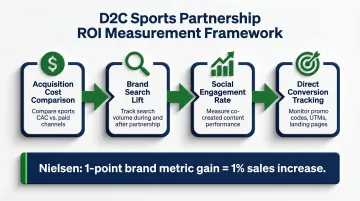
Nielsen's framework establishes that a 1-point gain in brand metrics (awareness, consideration) drives a 1% increase in sales, providing a direct link between sponsorship-driven brand lift and revenue.
Longer-Horizon Metrics
Direct attribution captures only part of the picture. Brand equity building — tracked through brand recall surveys, net promoter score changes, and share of voice — represents the larger long-term return. Before launch, build a measurement framework that separates short-term conversion from longer-term equity impact. This prevents the common mistake of judging a partnership's full value on first-quarter conversion data alone.
Only 19% of sponsorship professionals are confident they can measure business value return on their sponsorship investments. For D2C brands with strong attribution infrastructure already in place, that gap is an opening — most competitors are flying blind on the same spend.
Frequently Asked Questions
What are the 4 types of brand sponsorships?
The four main types are title/naming rights sponsorships (stadium and league naming), athlete endorsements and ambassador programs, event sponsorships and activations, and digital or content partnerships. Each differs in cost, audience reach, and attribution potential, with athlete and content partnerships offering the best entry points for D2C brands.
Who are the top 5 sports sponsors?
Globally recognized sports sponsors include Visa, Coca-Cola, Adidas, Samsung, and Allianz. These brands invest across multiple global properties including the Olympics, FIFA World Cup, and Formula 1. Their multi-channel strategies offer a playbook smaller brands can adapt to their own budgets.
What are the top 5 sports brands in the world?
The world's leading sports-specific brands by revenue are Nike (over $49 billion in sales), Adidas (€24.8 billion in 2025), lululemon, Puma, and Under Armour. These are sports product companies, not cross-industry sponsors — they compete through product innovation, athlete partnerships, and distribution.
What is the difference between a sports sponsorship and a sports partnership?
Sponsorship is a financial transaction in exchange for brand placement rights. A partnership implies deeper co-creation, shared objectives, and collaborative activation. The industry has moved toward partnerships because passive sponsorships deliver diminishing returns, while active partnerships generate measurable fan engagement and stronger brand recall.
How much does sports sponsorship cost for a small brand?
Costs vary widely. Micro-athlete collaborations can begin at $250–$1,500 per post, regional event sponsorships run in the tens of thousands, and league or stadium naming rights reach tens of millions annually. Entry-level D2C brands should focus on athlete and content partnerships first to build attribution systems before scaling.
How do D2C brands measure the ROI of a sports partnership?
D2C brands measure ROI through unique promo codes, UTM-tracked links on athlete content, partnership-specific landing pages, and brand search lift data. This enables direct attribution of sales to specific activations — something traditional brands struggle with — because D2C brands own the full customer journey and first-party data.