
Introduction
Running a D2C brand right now means navigating a genuinely difficult advertising environment. Meta CPMs hit $17.70 on Cyber Monday 2024 — 138% above the annualized average — while organic reach continues to shrink and consumers have grown increasingly numb to display formats.
Build awareness, drive conversions, and acquire customers profitably — all without a retail partner absorbing any of the risk. That's the operating reality for most D2C brands today.
Sponsored content offers a different path. Instead of interrupting readers mid-scroll, it earns attention by appearing inside the publications, newsletters, and creator channels they already chose to follow.
When placed correctly, it doesn't just generate clicks. It moves buyers from first discovery through to purchase consideration, often with stronger recall than any banner ad can produce.
This guide breaks down how to use sponsored content to solve that exact problem: which formats work at each funnel stage, which channels fit D2C economics, and how to measure results without inflating the numbers.
Key Takeaways
- Sponsored content is paid placement designed to match its editorial environment, earning attention rather than interrupting it
- D2C brands benefit most because they must build consumer trust without retail intermediaries doing any of the work
- Newsletter placements and editorial features tend to drive the strongest high-intent conversions
- Social and influencer content works better for building broad awareness
- Audience alignment matters more than audience size — a niche, engaged publication will outperform a massive misaligned one
- Track brand recall, engaged sessions, and cost per acquisition alongside click-through rate
What Is Sponsored Content for D2C Brands?
The IAB defines native advertising as paid content that is cohesive with page content, assimilated into the design, and consistent with platform behavior — so the ad feels like it belongs in the surrounding experience.
For D2C brands, the working definition is simpler: paid content placed inside a trusted media environment where the format matches what the audience is already consuming.
The distinction from display advertising is straightforward. A banner ad sits beside content. Sponsored content is the content — or at least reads like it.
Why D2C Brands Need This More Than Most
Traditional retailers give D2C brands something invaluable: borrowed credibility. When a product sits on Sephora's shelves or Amazon's homepage, the retailer's brand trust transfers to the product by proximity. D2C brands skip that middleman entirely — which means they need to build consumer trust from scratch, through every channel they touch.
Sponsored content solves this by borrowing credibility from a different source: the publisher. When a newsletter that readers trust every morning features a product, that established audience relationship extends to the brand. The same applies to creators with loyal followings — their recommendation carries weight that a display ad simply cannot replicate.
The Three Core Formats D2C Brands Use
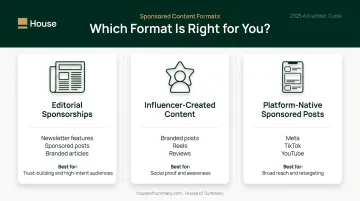
| Format | What It Is | Best For |
|---|---|---|
| Editorial sponsorships | Newsletter features, sponsored blog posts, branded articles | Trust-building, category education, high-intent audiences |
| Influencer-created content | Creator-produced branded posts, reels, or reviews | Social proof, awareness, community-driven categories |
| Platform-native sponsored posts | Paid social content on Meta, TikTok, YouTube | Broad reach, retargeting, creative-driven campaigns |
On disclosure: the FTC requires clear, prominent labeling of sponsored content — placed near the headline, not buried in a footer. Transparent labeling protects conversion rates too. Hidden sponsorship erodes the exact trust that makes native formats work.
Why Sponsored Content Outperforms Traditional Ads for D2C
The conditions that made traditional ads reliable have eroded — and D2C brands, which depend on efficient acquisition economics, absorb that erosion faster than established players with brand equity to coast on.
The Ad Blocking and Attention Problem
Blockthrough's 2022 PageFair report measured 290 million desktop ad-blocking monthly active users globally, with an average ad block rate of 21% across 9,453 measured websites. For D2C brands running display campaigns, that's roughly 1 in 5 potential impressions that never render at all.
Even when ads do load, they face an attention deficit. Research from Sharethrough and IPG Media Lab found native ads were looked at 53% more frequently than display ads, with 18% higher purchase-intent lift — meaning readers who see native content are more likely to actually consider buying.
The Trust Transfer Mechanism
For an established brand, a display ad is a reminder. For a D2C brand entering a new market without name recognition, it's often noise. Sponsored content changes this dynamic because the publisher or creator acts as an implicit endorser.
Nielsen's 2023 analysis found that branded content produced 81% aided recall and 63% unaided recall. Brand recall was the single biggest driver of total brand lift, contributing 38.7% of lift in emerging media.
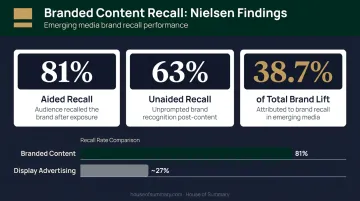
The implication is direct: readers who encounter a brand inside content they already trust are primed to remember it — and that recall is what moves them toward purchase consideration.
The Algorithm Problem
Paid social has become simultaneously more expensive and less predictable. Skai reported paid social CPMs rising 8% year-over-year in 2024, with auction volatility spiking dramatically around seasonal periods. For D2C brands that front-load acquisition spend around launches or gifting seasons, that volatility directly threatens unit economics.
Newsletter and editorial sponsored content bypasses algorithmic distribution entirely. A placement in a newsletter goes to the inbox of every subscriber who opens that issue: no auction, no feed competition, no reach throttling.
The Pre-Qualified Audience Advantage
When a reader has opted into a publication that covers topics directly relevant to a product category, they're not a cold prospect. A supplement brand sponsoring a longevity-focused newsletter is reaching people who already care about the category. That pre-qualification is why a smaller, topic-aligned audience routinely outperforms a larger, broadly targeted one — audience fit moves the needle more than audience scale.
Types of Sponsored Content Channels (and How Each Performs)
Different channels serve different jobs in the funnel. Here's how to think about each one.
Newsletter Sponsorships
Email-based sponsored content is the highest-attention format available to D2C brands. Readers chose to subscribe, there are no ad blockers in email, no algorithmic feeds competing for attention, and no surrounding visual clutter.
Mailchimp's e-commerce email benchmarks show average open rates of 29.81% and unique click rates of 1.74% for the category — but engaged niche newsletters consistently outperform those averages.
House of Summary's network illustrates what this looks like at scale. Across Presidential Summary, Geopolitical Summary, Dubai Summary, and London Summary, the combined network reaches 500,000+ subscribers with 254,866+ emails opened daily — with readers concentrated in high-income metros across the US (New York, Los Angeles), UK (London), and UAE (Dubai).
A testimonial from BSH Hausgeräte's CEO cited click-through rates 4x higher than Google AdWords from a Dubai Summary placement, attributing it specifically to audience quality and editorial alignment.
For D2C brands targeting affluent professionals, that demographic profile is hard to replicate through paid social at any CPM.
Influencer-Created Branded Content
Creator sponsorships generate authenticity at scale — and the recall data supports the format. Nielsen found influencer marketing produced 79% aided recall, while Influencer Marketing Hub reported 71% of consumers make a purchase within a few days of seeing creator-led content.
The practical distinction for D2C brands:
- Macro-influencers offer broad reach but lower per-follower engagement
- Micro and nano-influencers deliver tighter communities, higher purchase intent, and typically lower cost-per-placement
For most D2C conversion goals, micro-influencers with a highly relevant following outperform larger creators with diluted audiences.
Editorial and Publisher Features
Long-form sponsored articles or branded editorial features on relevant publications deliver two compounding benefits: immediate brand credibility through the publisher's halo, and ongoing SEO value if the piece lives permanently on the publisher's site.
Native ads in editorial environments were rated as shareable by 32% of respondents versus 19% for standard display units — meaning good editorial sponsorships generate organic distribution beyond the initial placement.
Podcast Sponsorships
Podcasts have a distinctive advantage: the host reads the ad, lending their voice and credibility directly to the message. Nielsen studies found podcast advertising generates up to 4.4x better brand recall than other digital ads — making it one of the highest-recall formats available.
This works best for D2C brands with a story to tell or a product that benefits from narrative explanation: supplements, subscription services, wellness devices, or anything where "what it is" requires more than a visual.
Attribution requires extra work here because listeners often convert hours or days after hearing an ad, not through a trackable click. Standard methods include:
- Promo codes tied to the episode
- Vanity URLs for direct tracking
- Post-purchase surveys asking how customers heard about you
Platform-Native Sponsored Posts
Unlike the high-recall formats above, Meta, TikTok, and YouTube are better positioned for awareness than conversion — particularly when creative is strong. With CPMs rising and attribution growing more complex under privacy changes, pure paid social is increasingly expensive as a D2C acquisition channel.
It works better as part of a channel mix — driving awareness that newsletter and editorial placements then convert — rather than as a standalone performance channel.
How to Build a Sponsored Content Strategy That Converts
Align Format to Funnel Stage First
Before selecting a publisher, decide what you need the campaign to do.
- Awareness campaigns (cold audiences): editorial placements, broad influencer content, podcast sponsorships
- Conversion campaigns (warm or pre-qualified audiences): niche newsletter placements, micro-influencers with aligned followings, targeted editorial features
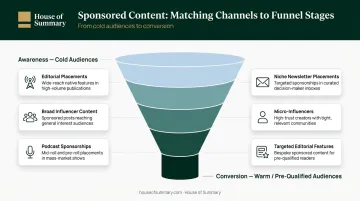
A D2C skincare brand might use a health-and-wellness newsletter for top-of-funnel awareness and a beauty-focused micro-influencer for conversion-focused campaigns. Same brand, different audiences, different asks.
Vet Publishers on Audience Fit, Not Size
When evaluating a publication or creator for sponsorship, the questions that matter:
- What's the audience's demographic profile — age, income, geography, profession?
- Does the editorial tone match the brand's voice and category?
- What are the engagement rates (open rates, click rates, comment activity)?
- Is there topical alignment between the publication's content and the product category?
A newsletter reaching 50,000 engaged professionals in the right vertical will consistently outperform a million-subscriber platform whose audience has no real connection to the product — because relevance drives response, not raw reach.
Write a Brief That Gives Creative Latitude
Once you've found the right publisher, the brief becomes your handoff document. Over-scripting kills the native feel that makes sponsored content work — publishers and creators know their audiences better than most brand teams do. Give them enough to represent the brand accurately, not a word-for-word script.
A strong creative brief includes:
- The target buyer profile and what problem the product solves for them
- Product positioning and key differentiators (not just features)
- Tone guidelines and any hard restrictions
- The exact disclosure language required
- UTM parameters, landing page URL, and promo code (if applicable)
Test Before Scaling
Run initial campaigns with clear hypotheses. Test two publishers in the same category before deciding which to scale. Or test two different content angles with the same publisher. Keep the testing budget tight — enough to generate 200–300 clicks per placement, which is typically sufficient to read conversion patterns without overcommitting spend.
When one placement hits a cost per acquisition that fits your unit economics, that's your signal to scale — increase frequency, negotiate a longer run, or expand to adjacent publications in the same niche.
Measuring What Matters: Sponsored Content KPIs for D2C
Set Up Attribution Before Launch
UTM parameters, dedicated landing pages, and promo codes are non-negotiable for isolating sponsored content performance. Google Analytics requires campaign parameters to identify sources, medium, campaign name, and content variant.
Key UTM fields for every sponsored content placement:
utm_source— the publication or creatorutm_medium— the format (newsletter, podcast, editorial)utm_campaign— the campaign nameutm_content— the specific creative or placement
Without these, sponsored content traffic gets lumped into "direct" or misattributed to another channel, making ROI impossible to evaluate.
Measure by Funnel Stage
For awareness campaigns:
- Reach and new audience acquisition
- Brand recall lift (survey-based, using tools like Google Brand Lift — note that Google's Brand Lift studies have minimum budget requirements starting around $5,000)
- Engaged session time from referred traffic
For conversion campaigns:
- Conversion rate from sponsored referral traffic
- Cost per acquisition versus paid social baseline
- First-order AOV and, where data allows, LTV:CAC
Compare sponsored content performance against your own paid social CAC, not a generic industry benchmark. No reliable public benchmark exists for D2C CAC across these channels, so your campaign-level data is the reference point that actually means something.
Account for Attribution Lag
Sponsored content, particularly podcast and editorial placements, often drives delayed conversion. A reader might encounter a brand through a newsletter on Tuesday and convert through a Google search on Friday. Last-click attribution undercounts awareness-heavy channels by a measurable margin.
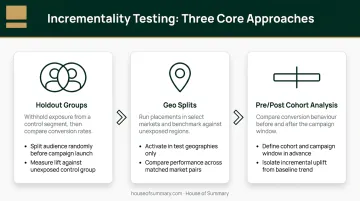
Where budget allows, incrementality testing gives a more accurate picture of true contribution. Common approaches include:
- Holdout groups — withhold exposure from a control segment and compare conversion rates
- Geo splits — run the placement in select markets and benchmark against unexposed regions
- Pre/post cohort analysis — compare conversion behavior before and after the campaign window
Frequently Asked Questions
What is D2C content?
D2C content is any marketing material — from product pages and email campaigns to sponsored editorial features — created by or on behalf of a direct-to-consumer brand to reach customers without relying on retail partners or intermediaries.
What is the difference between sponsored content and traditional ads?
Traditional ads interrupt the consumer experience (banners, pre-rolls, display units), while sponsored content is designed to match the look, tone, and format of the platform where it appears — earning attention rather than demanding it.
Which sponsored content channel works best for D2C brands?
The best channel depends on funnel stage and audience. Newsletter placements and editorial features tend to perform best for high-intent conversion; social and influencer content excels at building broad awareness. Podcasts perform well for products that need narrative explanation.
How do I measure the ROI of sponsored content?
Use UTM tracking, dedicated landing pages, and promo codes to isolate sponsored content traffic. Then track conversion rate, customer acquisition cost, and brand recall lift, rather than relying solely on click-through rate, which understates awareness-driven performance.
Is sponsored content effective for new D2C brands with small budgets?
Yes. New D2C brands can start with micro-influencer partnerships or smaller niche newsletter placements, both of which offer lower entry costs and more targeted reach than large media buys. Audience alignment matters more than audience size at the early stage.
How do I choose the right publisher for a D2C sponsored content campaign?
Evaluate publishers on audience demographics, topical relevance, engagement rates, and editorial tone. A highly engaged niche publication consistently outperforms a large but loosely aligned platform. When the goal is actual conversion, audience fit matters more than raw impression volume.