Introduction
Luxury brands have long understood that environment shapes perception. The physical store, the magazine editorial page, the gallery event — each setting communicates something before a single product is shown.
Digital channels have made this principle harder to enforce. Programmatic display places luxury brands alongside commoditized content. Social feeds interrupt rather than invite. Algorithms decide whether a carefully crafted message ever reaches its intended audience.
Premium editorial newsletters have emerged as one of the few digital channels that can credibly hold a luxury brand without diluting it. According to the 2025 Edelman Trust Barometer, media is now actively distrusted as an institution — 61% of respondents across 28 countries reported moderate or high grievance toward institutions.
Yet email holds. 59% of executives cite it as their primary professional touchpoint, and 77% of B2B buyers name it as their preferred form of contact. Where broad media has lost credibility, the inbox has retained it.
Most luxury marketing professionals understand experiential activations — pop-ups, immersive events, curated launches. Fewer have a clear picture of how the same principles of exclusivity, context, and emotional precision translate into a premium editorial newsletter. This guide covers the formats, placement logic, and audience dynamics that make newsletter activations work for luxury brands.
Key Takeaways
- A luxury activation is a purposefully designed brand placement that uses editorial context and reader trust to deliver an experience, not just an ad impression
- Newsletter activations operate inside an established editor-reader relationship, transferring credibility to the brand
- Key stages: editorial alignment, format selection, message crafting, and performance measurement
- Premium newsletters attract high-intent, senior, affluent readers — the core audience luxury brands want to reach
- Success is measured by engagement quality — click-through depth, reader response, brand recall — not raw reach
What Is a Luxury Activation Inside a Newsletter?
A luxury activation inside a newsletter is a structured brand presence — whether a sponsored section, native editorial, or dedicated send — placed within a premium publication that reaches a curated, high-quality readership. It differs from a standard ad unit because it is built around context, tone, and editorial trust.
Luxury brands face a persistent problem in digital advertising: most channels commoditize their message. The Drum reports that 60% of digital display advertising was already automated by 2015, with industry experts warning that programmatic placements "kill brand equity" by placing luxury names alongside downmarket competitors. A premium newsletter solves this by providing a controlled environment — no competing ad units, no algorithmic noise — that matches brand standards.
Unlike a banner ad, a boosted post, or a performance-marketing impression, a newsletter activation does not interrupt the reader. It sits alongside content the reader has actively chosen to receive — a meaningful distinction for brands where context defines perception.
That context advantage also explains why newsletter advertising keeps growing. There is no algorithm deciding whether a reader sees the message, and no ad blocker that strips it out. 52% of consumers across 48 markets have installed ad blockers on browsers or mobile devices — email bypasses this entirely. The inbox remains one of the last genuinely direct relationships in digital media.
Not every newsletter qualifies as a premium editorial environment. The ones that do share a consistent set of characteristics:
- Verified niche readership — executives, finance professionals, global decision-makers
- Consistent editorial voice with human-written content
- Low advertiser-to-content ratio
- Reader loyalty measured in open rates, not just list size
House of Summary's network — including Presidential Summary, Geopolitical Summary, Dubai Summary, and London Summary — reaches 500,000+ subscribers with 254,866+ daily email opens across key luxury markets: 66% in the United States, 18.2% in the UAE, and 10.47% in the UK.
How Luxury Newsletter Activations Work
A luxury newsletter activation follows a defined sequence: each stage determines whether the brand lands with impact or gets treated as noise.
Alignment and Brief
A successful activation begins before a single word is written. The brand and the newsletter publisher establish editorial fit — the brand's tone, audience demographics, and message objective are mapped against the publication's reader profile, content pillars, and editorial calendar.
This is where many activations either succeed or fail. A luxury watch brand placed in a general lifestyle newsletter reaches numbers but misses intent. Placed in a newsletter serving senior executives and finance professionals, it reaches precisely the person making the decision. House of Summary evaluates brand suitability based on:
- Audience fit: Decision-makers, executives, high-net-worth individuals
- Category relevance: Luxury goods, premium hospitality, fintech, healthcare
- Geographic targeting: Campaigns can be tailored to US, UK, or UAE markets
- Brand safety and editorial alignment: Human-written, fact-checked content that avoids sensationalism
Publishers provide detailed demographic data during briefing — seniority levels, industry composition, income brackets, and geographic concentration — ensuring the brand knows exactly who will encounter the message.
Format and Message Construction
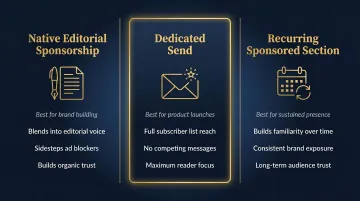
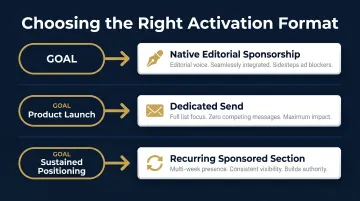
The activation format is selected based on campaign objective:
- Brand awareness: Native editorial segment written in the newsletter's voice
- Product launch: Dedicated send reaching the full subscriber list
- Sustained positioning: Recurring sponsored section across multiple issues
Message construction in luxury newsletter activations differs from standard copywriting. Brevity, precision, and restraint signal quality. The message should feel like it belongs, not like it paid to appear.
House of Summary's editorial team assists advertisers in crafting or reviewing sponsored messages to ensure they match the publication's editorial voice. Sponsored content is written in the natural tone of the newsletter, maintaining editorial integrity while clearly disclosing the advertiser's involvement. For brands that communicate value through storytelling, provenance, and heritage, this editorial alignment is what makes the placement work.
Publication and Reader Encounter
With format and message locked, the activation moves to delivery. The newsletter lands in the reader's inbox unfiltered by algorithm and unblocked by ad technology. The reader encounters the brand message inside content they requested and trust.
This moment is structurally different from every other digital touchpoint. The reader chose to open this email. They are not scrolling passively or absorbing a served impression; they are reading content from a source they respect. Research by Sharethrough and IPG Media Labs found that consumers looked at native ads 53% more frequently than display ads, with 25% more consumers viewing in-feed native placements compared to standard display units.
Average time spent reading a newsletter after opening is 51 seconds. This creates a state of genuine attention that is increasingly rare in digital media.
Output and Brand Carry
A well-executed luxury newsletter activation produces not just a click, but a brand impression formed in a high-trust context. IAB-Edelman Berland research found that sponsored content placed on a credible website receives an 82% boost in perceived credibility. That credibility boost persists well beyond the read — passive ad exposure simply does not produce the same recall.
This output integrates into broader brand strategy. A newsletter activation reinforces other touchpoints — events, retail, social — reaching the right person at the right moment in their information consumption, with the editorial trust those other channels cannot replicate.
Why Premium Editorial Newsletters Are the Right Environment for Luxury Brands
Editorial Credibility Transfer
When a trusted newsletter publishes a brand message — in native or sponsored editorial format — the reader's existing trust in the publication extends to the brand. This does not happen in programmatic display or social advertising, where the platform's credibility is neutral or negative.
The IAB-Edelman study quantified this effect: an 82% credibility boost for sponsored content on credible platforms, with 54% of consumers reporting increased favourability when the sponsored content was relevant.
Audience Composition Advantage
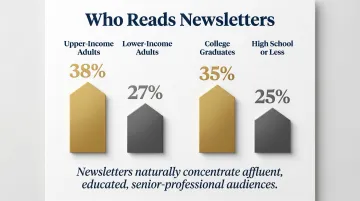
Premium editorial newsletters self-select for the kind of reader luxury brands actually want. Pew Research Center data shows clear demographic skew:
- 38% of upper-income adults get news from newsletters, versus 27% of lower-income adults
- 35% of college graduates use newsletters, versus 25% with a high school education or less
These patterns mean newsletters naturally concentrate affluent, educated, senior-professional audiences — without any additional targeting required.
Environment Quality
Luxury brands invest heavily in physical environments — stores, events, packaging — to match their positioning. The newsletter environment deserves the same standard. A premium editorial newsletter with a distinct voice, low ad frequency, and an engaged niche readership is the digital equivalent of a well-chosen venue.
House of Summary as an Example
House of Summary's publications reach business professionals, global executives, and finance-sector readers across key luxury markets. The audience includes C-suite executives, founders, entrepreneurs, and high-net-worth individuals in wealth-dense metros: New York, Los Angeles, London, and Dubai.
Advertisers reach readers who opted in specifically for clarity and substance — with click-through rates running 4x higher than Google AdWords benchmarks.
Common Formats for Luxury Activations in Newsletters
Three formats dominate luxury newsletter advertising, each suited to a different campaign goal:
Native editorial sponsorship: Brand messaging written in the newsletter's editorial voice, integrated into the content flow. Best for brand building and positioning — it sidesteps banner blindness and ad blockers because it reads as editorial, not inventory.
Dedicated send: A full newsletter issue devoted to the brand, sent to the publisher's subscriber list. Best for product launches or major announcements, with no competing messages sharing the reader's attention.
Recurring sponsored section: A consistent placement across multiple issues that builds familiarity and authority over time. Best for sustained brand presence. Multi-week packages offer discounted pricing compared to single-issue placements.
Choosing the right format is only part of the equation. Two quality signals separate premium placements from low-value ones:
- Ad-to-content ratio: Publications running multiple sponsor placements per issue dilute each one. Industry guidance suggests one to two ads per 1,000 words of content. A newsletter that limits advertising to one or two placements per issue preserves the scarcity that makes each appearance meaningful.
- Creative restraint: Keep copy clean, the message singular, and the call to action direct. Replicating the visual complexity of a web page inside an email works against the format. Campaign Monitor reports that CTA buttons increase click-through rates by 28% compared to text links.
How to Evaluate Whether a Luxury Newsletter Activation Worked
Metrics that matter:
Open rate: Reflects publisher health, not brand performance. Premium publishers achieve substantially higher open rates — Vox Media newsletters reach 50-65%, Axios consistently achieves approximately 45%, compared to a 34% industry average.
Click-through rate (CTR): Reflects message relevance and audience fit. GetResponse data analyzing 4.4 billion messages shows newsletter CTR averaging 3.84%, with publishing industry CTR at 5.76%. Compare this to display advertising CTR of 0.05%-0.08% — newsletters deliver 30x-75x higher engagement.
Post-click behaviour: Reflects whether the audience was genuinely qualified. House of Summary tracks ad clicks, emails opened, and provides detailed geographic and demographic distribution reporting to advertisers.
Newsletter activations are not always direct-response tools. For luxury positioning, the value sits in brand recall, audience quality, and the halo effect of being associated with a trusted editorial publication. Native ads drive 18% higher purchase intent lift and 9% higher brand affinity lift compared to banner ads.
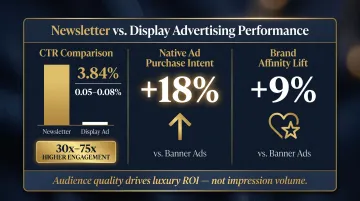
Measuring that lift requires qualitative signals — reader surveys, brand lift studies, or follow-up engagement tracking — alongside the quantitative metrics above.
That combination of depth and precision is what makes audience quality the defining ROI variable. A single well-placed newsletter activation reaching 50,000 senior executives can deliver more qualified brand exposure than a programmatic campaign reaching 5 million general consumers. Luxury newsletter ROI should be evaluated on engagement depth, not raw impression volume.
Frequently Asked Questions
How much does a brand activation cost?
Costs vary widely by format and publication scale. Newsletter activations are generally more cost-efficient than physical experiential campaigns. Premium newsletter placements range from sponsored segments (typically £15–£30 CPM) to full dedicated sends, with pricing reflecting audience quality and engagement rates rather than raw list size.
What is a brand activation company?
A brand activation company is any organization that helps brands create intentional audience experiences — from experiential agencies running live events to premium newsletter publishers placing brand messages inside trusted editorial content.
What are the 7 stages of the branding process?
The branding process moves from research and positioning through identity development, messaging, channel selection, execution, and measurement. Newsletter activations become relevant at the channel selection and execution stages — specifically where a brand message needs to reach a targeted, high-trust audience without algorithmic interference.
What is an example of a luxury brand activation?
A concrete example: BSH Hausgeräte ran a campaign within House of Summary's Dubai Summary newsletter, achieving click-through rates four times higher than Google AdWords while reaching affluent decision-makers in the UAE market through native editorial sponsorship integrated within trusted, curated content.
What are the 8 P's of luxury brand marketing?
Rohit Arora's 8 P's framework (published in American Marketer, 2013) covers Performance, Pedigree, Paucity, Persona, Public Figures, Placement, Public Relations, and Pricing. Premium newsletters speak most directly to Placement and Persona — the channel itself signals curation, and placement within trusted editorial content carries the same intentionality as the product.