Introduction
Social feeds scroll past in seconds. Display ads get blocked at a 29.5% rate. Influencer saturation has eroded trust. Yet executives who book premium travel are making decisions somewhere else entirely—in their inboxes, where attention is focused and no algorithm decides what they see.
Executive newsletters remain one of the strongest channels for reaching decision-makers who actually book premium travel. Unlike passive social impressions or blocked display ads, newsletter placements deliver brand messages directly to opted-in readers—senior professionals and C-suite leaders with real purchasing authority—in a focused, uninterrupted mental state.
What follows is a practical look at why the inbox outperforms every other channel for premium travel marketing—and what it takes to get your placement in front of the right readers at the right moment.
Why Executive Newsletters Are a Different Channel for Travel Marketing
The Inbox Delivers Structural Advantages Display Advertising Cannot Match
Executive newsletters operate in a different environment than social media or display advertising. The inbox has no algorithms to game, no ad blockers intercepting placements, and no visual clutter competing for attention. When a travel brand's message appears in a newsletter, it reaches the reader directly on their terms, signaling higher intent and receptivity.
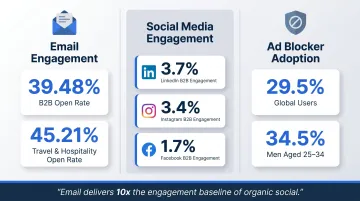
The data confirms this advantage. B2B email open rates average 39.48%, with hospitality and travel emails reaching 45.21%. Compare this to social media: LinkedIn averages 3.7% engagement, Instagram 3.4%, and Facebook just 1.7%. Even conservative email performance represents 10x the engagement baseline of organic social posts.
Those engagement gaps widen further when ad blockers enter the picture. Nearly 29.5% of internet users globally deploy ad blockers, with adoption among men aged 25–34 hitting 34.5% — precisely the demographic of rising executives. Newsletter advertising sidesteps this entirely because ads are embedded in message content, not served by blockable ad networks.
Brand Safety Matters More for Travel Than Any Other Vertical
Luxury travel brands have strict positioning requirements. A five-star resort or business-class airline cannot afford placement next to low-quality content or controversial topics. Executive newsletters with verified editorial standards offer a controlled, premium environment that social platforms cannot guarantee.
When House of Summary's Dubai Summary features a luxury hospitality brand alongside verified UAE business coverage, the brand benefits from editorial context that reinforces premium positioning — rather than competing with unrelated or off-brand content for the same reader's attention.
The Executive Reader as a High-Value Travel Consumer
Who Reads Executive Newsletters—and Why They Matter to Travel Brands
Executive newsletter readers are senior professionals, C-suite leaders, media buyers, finance sector decision-makers, and globally mobile business professionals. They book travel regularly, and their income brackets and decision-making authority make them significantly more valuable than general audiences.
Global business travel spending will reach $1.57 trillion in 2025, with executives taking multiple trips annually. Trip frequency breaks down as follows:
- 77% of business travelers took 1–5 trips in 2023
- 15% took 6–10 trips
- 7% took 11 or more
66% of business travelers extend trips for leisure, turning a single corporate booking into dual-purpose spending. Executives reading newsletters about global affairs or city-specific business news are often planning both work and leisure accommodations in the same session.
One Reader, Dozens of Bookings
A single CFO or travel manager reading an executive newsletter may control travel decisions for dozens or hundreds of employees. SAP Concur's 2025 survey found 41% of CFOs are the primary influencer of corporate travel program changes, nearly matching travel managers at 43%.
Reaching these readers means influencing corporate travel budgets, venue selections, and team travel policies — not just a single booking.
The Trust Dynamic Creates Borrowed Credibility
Executive readers develop loyalty to newsletters they rely on for accurate, useful information. When a travel brand appears in that trusted editorial context, it benefits from the editorial authority that context carries — something cold advertising can't manufacture. House of Summary's newsletters reach over 500,000 subscribers with more than 254,000 emails opened daily, all within an editorial environment that fact-checks before anything reaches the inbox. Travel brands placing within this context inherit that credibility by association.
Why Focused Attention Converts
An executive reading their curated morning newsletter is in a different mental mode than someone scrolling social media. This focused attention state increases the likelihood that a well-placed travel offer is actually read, considered, and acted upon. The average email engagement time is 8.97 seconds — focused, distraction-free time in a single-content environment.
What Makes Travel Partnerships Work in Newsletter Contexts
Audience-Content Alignment Determines Everything
A partnership only works when the travel brand's offering fits naturally within the editorial world the newsletter inhabits. A luxury hotel in Dubai belongs in a newsletter covering UAE business and lifestyle news—not in a generic mass-market digest. Misalignment here is the single biggest reason partnerships underperform.
Consider House of Summary's network: Dubai Summary reaches affluent professionals and HNWIs in the UAE; London Summary targets decision-makers engaged with UK metropolitan markets; Presidential Summary and Geopolitical Summary reach internationally mobile executives who follow world affairs. Each newsletter's editorial focus creates a context where relevant travel brands fit naturally.
Relevance Over Reach: Why 50,000 Targeted Readers Beat 500,000 General Ones
A list of 50,000 senior finance professionals will outperform a list of 500,000 general consumers for a business-class airline upgrade offer. The subscriber base is smaller—but the intent is orders of magnitude higher.
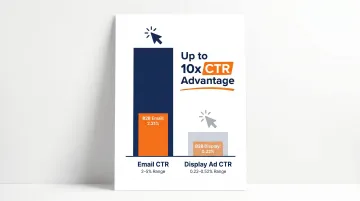
The data supports precision over reach. Email CTAs average 2-5% click-through rate versus display advertising's 0.22-0.52%—a 4x to 10x advantage. For B2B audiences specifically, email achieves 2.21% CTR while display manages just 0.22%, approaching a 10x gap.
Editorial Tone Must Match or Performance Suffers
Travel brands need to adapt their messaging to the newsletter's voice—direct and useful rather than promotional and salesy. Lead with a concrete offer or insight, not brand imagery.
The difference in practice:
- Generic ad copy: "Experience luxury redefined at our Dubai resort"
- Executive newsletter placement: "Dubai-based executives: Access our corporate rate at 40% below standard pricing, valid through Q2 2025"
The second version is useful information presented in the reader's context. The first is easy to ignore.
Single-Action CTAs Convert at 371% Higher Rates
Emails with a single CTA generate 371% more clicks and 1,617% more sales than multi-CTA emails. For travel brands, this means featuring one destination, one booking incentive, or one experience per placement—not a catalog of options.
The most effective placements present one clear next step: book a rate, access an exclusive offer, or request information. Anything more dilutes the action.
Timing and Contextual Triggers Amplify Results
Travel brands can align partnerships around editorial moments: budget season when executives plan corporate travel, major global events the newsletter is already covering, or seasonal travel windows. Placements timed to these triggers outperform those dropped in without editorial logic.
A geopolitical newsletter covering a major economic summit, for instance, creates an obvious context for business-class airline promotions or executive hotel packages in the summit city. The content does half the selling work.
Partnership Formats That Deliver Results in Executive Newsletters
Sponsored Destination Spotlights Build Awareness and Trust
A branded editorial segment covering a destination in journalistic style—with the travel brand woven in as a recommendation or partner—performs better than traditional ad placements because it provides genuine value to the reader while giving the brand natural placement within relevant content.
This format might look like: "Dubai's New Business District: What Executives Need to Know," sponsored by a luxury hotel group with properties in the area. The content delivers useful information about the district's development, accessibility, and business relevance, naturally positioning the hotel as the logical accommodation choice.
Exclusive Reader Offers Drive the Highest Direct Response
Partnerships built around genuine benefits for subscribers—a negotiated hotel rate, complimentary lounge access, a room upgrade, a priority booking window—drive the highest direct response rates.
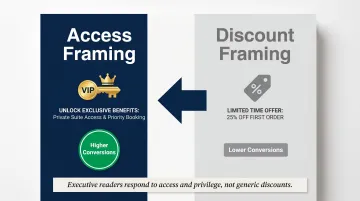
"Exclusive" framing matters. Executive readers respond to access and privilege, not discounts. Compare these two approaches:
- Access framing: "Presidential Summary readers receive complimentary executive lounge access and late checkout"
- Discount framing: "Save 20% on your next stay"
The first converts better. Every time.
Native Editorial Features Build Brand Recognition Over Time
Not every partnership needs to drive an immediate click. Longer-form sponsored content written in the newsletter's voice—profiling a new property, a travel program, or a destination relevant to the editorial beat—builds recognition and credibility over time. This format suits brand-building goals, not direct-response ones.
A Geopolitical Summary feature on "Five Emerging Business Travel Destinations for 2025" sponsored by a global hotel chain positions the brand as the natural choice for internationally mobile executives — even when immediate bookings aren't the goal.
Event-Tied and News-Linked Promotions Feel Timely and Editorially Relevant
Travel brands can partner around editorial events—a geopolitical summit covered in a global affairs newsletter, a major business conference in a city covered by a local newsletter, an economic announcement that triggers travel interest. When the placement aligns with what the reader is already thinking about, it stops feeling like advertising.
When London Summary covers a major financial services conference, a sponsored placement from a business hotel near the venue or a corporate car service feels editorially relevant — not an interruption, but a useful extension of the content.
Loyalty and Rewards Integrations Convert High-Value Members
For travel brands with points programs, airline miles, or membership benefits, executive newsletter partnerships can serve as enrollment or activation channels—offering subscribers a bonus or upgrade for joining a loyalty program.
Executives are high-conversion targets for loyalty programs specifically because their travel frequency and spending make membership benefits quickly valuable. "Join [Airline] Executive Club through this link and receive 25,000 bonus miles" converts well because the audience recognizes the value immediately.
Matching Your Travel Niche to the Right Newsletter Audience
Look Beyond Subscriber Count to Audience Composition
Travel brands should evaluate newsletters based on audience composition (job titles, industries, geographies), editorial focus, and reader behavior (open rates, click rates, engagement patterns)—not raw subscriber count. The right newsletter for a luxury hotel chain in Dubai is different from the right newsletter for a transatlantic business-class airline.
Key evaluation criteria include:
- Job titles and decision-making authority: Are readers booking travel themselves or influencing corporate programs?
- Income brackets: Does the audience match your price point?
- Travel frequency: Are these occasional travelers or weekly road warriors?
- Geographic concentration: Where do subscribers live and work?
How House of Summary's Network Maps to Travel Niches
House of Summary's specialized newsletters map directly to specific travel verticals:
- Dubai Summary: Luxury Middle East hospitality and UAE tourism brands targeting affluent professionals and HNWIs in Dubai (18.2% of network readership)
- London Summary: UK-based travel and hospitality targeting decision-makers engaged with London's business and cultural markets (10.47% of network)
- Presidential Summary and Geopolitical Summary: Global travel brands targeting internationally mobile executives who follow world affairs and politics (66% US readership, concentrated in NY/LA)
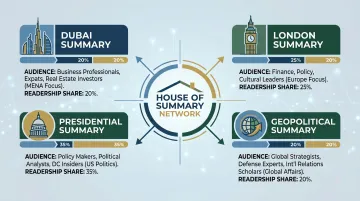
The network's 4x CTR advantage over broader digital formats stems from this precise audience matching combined with algorithm-free inbox delivery.
Premium Travel Niches Command the Highest Returns
The most profitable travel niches for newsletter partnerships serve high-income, high-frequency travelers: luxury hospitality, business-class aviation, corporate travel management, and premium experiences.
The economics reflect the opportunity:
- Business and first-class passengers make up just 3% of travelers but generate 15% of airline passenger revenue, with per-seat earnings 3.4x economy class
- The luxury travel market reached $1.4 trillion in 2023, outpacing every other hospitality segment in growth rate
These are the readers executive newsletters are built around — which is precisely why travel brands targeting them see stronger returns through newsletter placements than through display or social formats.
Common Mistakes Travel Brands Make in Newsletter Partnerships
Treating Newsletter Placements Like Display Ads
Submitting a banner image, a generic tagline, and a homepage link will underperform consistently. Newsletter readers expect text-forward, value-led content—and brands that adapt their creative to the medium see measurably stronger results than those who repurpose social assets.
Display creative emphasizes visual impact; newsletter creative emphasizes informational value. The format difference matters.
Ignoring Editorial Alignment and Subscriber Fit
Choosing a newsletter based on subscriber volume rather than audience composition leads to poor conversion even with high open rates. A mismatch between the brand's target traveler and the newsletter's reader profile will always produce weak results regardless of placement size or frequency.
Segmented campaigns achieve 100.95% higher CTR and generate 760% more revenue than broadcast sends. The inverse is equally true: audience-mismatched placements forfeit this performance advantage entirely.
Measuring the Wrong Metrics
Travel brands sometimes evaluate newsletter partnerships on impressions alone — the same way they measure display advertising. That's the wrong framework for the channel.
The metrics that actually reflect newsletter performance:
- Click-through rate — measures engaged reader response, not passive exposure
- Offer redemption rate — ties placement directly to traveler intent
- Downstream booking attribution — connects newsletter spend to revenue
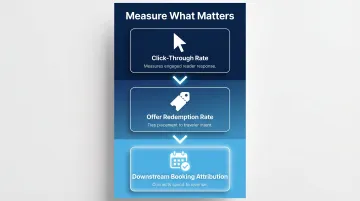
Reach and CPM measure eyeballs. Newsletter advertising's value is opted-in attention that converts. Treating it like display inventory misses the point entirely.
Frequently Asked Questions
What are partnerships in travel and tourism?
Travel and tourism partnerships are collaborative arrangements between complementary brands—such as a hotel and an airline, or a travel brand and a media outlet—where both parties deliver mutual value: expanded reach, enhanced product offerings, or access to new audiences.
What travel niche is most profitable?
Luxury and business travel consistently rank among the highest-revenue niches due to high per-booking value and repeat frequency. Executive newsletter partnerships are particularly effective here because the audience matches the traveler profile exactly.
What are the 5 P's of tourism marketing?
The 5 P's are Product, Price, Place, Promotion, and People. Newsletter partnerships operate primarily within Promotion and Place — placing a travel brand's message directly in an executive's inbox, bypassing algorithms and delivering undivided attention.
Why do travel brands advertise in executive newsletters?
Executive newsletter readers arrive with high intent, elevated purchasing power, and no algorithm standing between them and your message. That combination drives stronger conversion rates than most digital channels — especially for premium travel brands.
How do you measure the success of a travel marketing partnership in a newsletter?
Click-through rate, exclusive offer redemption rate, and booking attribution are the primary KPIs. Open rate alone is not a sufficient measure of partnership performance—downstream conversions matter most.
What types of travel partnerships work best for executive audiences?
Exclusive access offers, business lounge partnerships, premium hotel placements, and first-class upgrade promotions consistently outperform generic travel ads. Executive readers respond to offers that match their status and save them time — not discounts designed for mass-market audiences.