Introduction
Brands no longer need to guess who their audience is. Collecting demographic information and behavioral signals has never been easier — yet most marketers face a persistent gap: they're data-rich but insight-poor.
The real challenge is activation. Companies collect thousands of data points but fail to transform them into segments that align with campaign objectives, channel context, or real customer intent. The result is campaigns that technically use audience data but still miss the mark, wasting budget on impressions that never convert.
This article covers:
- The types of audience data available to marketers
- A step-by-step framework for turning raw data into targeting decisions
- The key variables that determine whether your targeting actually works
- Common mistakes that undermine even well-resourced campaigns
Key Takeaways
- Targeted marketing works when segmentation, channel alignment, and continuous optimization work together — data collection alone isn't enough
- First-party data collected directly from your audience is the highest-value and most privacy-compliant data type, especially as third-party cookies phase out
- Targeting quality depends on data recency, segment size, channel fit, and audience intent level
- Avoid over-relying on demographic data, skipping audience validation, and running campaigns without measurable outcome benchmarks
What Is Audience Data and Why It Matters for Targeted Marketing
Audience data is the collection of demographic, behavioral, psychographic, and contextual signals that describe who a brand's actual or potential customers are. Without it, marketing defaults to broad messaging that wastes budget and misses intent. With it, brands can identify who is most likely to engage, when they're ready to act, and what message will move them.
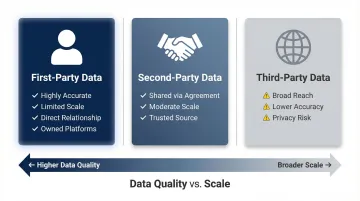
Not all audience data is created equal. There are three core types:
- First-party data: Information you collect directly from your customer base across your owned platforms—website visits, CRM records, email engagement, online transactions
- Second-party data: Someone else's first-party data, typically shared through a contractual agreement for a defined purpose
- Third-party data: Aggregated information sourced from external companies who are not the original collectors
Each type involves a tradeoff. First-party data is highly accurate but limited in scale. Third-party data offers breadth but lacks direct customer relationships and faces increasing privacy restrictions.
The personalization payoff from getting this right is measurable: McKinsey research shows a 10% to 15% revenue lift from personalization, with company-specific gains ranging from 5% to 25% depending on sector and execution. Companies that lead in personalization generate 40% more revenue from those activities than average players.
First-party data has become the strategic priority. Although Google reversed its forced deprecation of third-party cookies in Chrome, 34.9% of US browsers already block third-party cookies by default, and 62% of brand marketers say first-party data will become more important over the next two years. With GDPR, CCPA, and growing consumer privacy expectations, relying on third-party data introduces compliance risk and eroding data quality.
How to Leverage Audience Data for Effective Targeted Marketing
Step 1: Define Your Targeting Goals and Audience Hypothesis
Before touching any data, establish what the campaign needs to achieve: brand awareness, lead generation, conversion, or retention. The goal determines which audience signals matter most and which segments to prioritize.
Build an initial audience hypothesis:
- Who is the most likely buyer?
- What problem are they trying to solve?
- What data signals would confirm they are in-market or receptive to your message?
Identify what data you already have versus what you need to acquire. This avoids the trap of collecting everything and analyzing nothing. If your goal is lead generation for a B2B product, behavioral signals like recent content downloads or webinar attendance matter more than broad demographic data. If your goal is retention, engagement recency and purchase frequency become the priority signals.
Step 2: Collect and Organize Your Audience Data
Primary data collection sources include CRM records, website analytics, email engagement data, social media insights, and direct customer feedback. Each provides different layers of behavioral and demographic insight.
Centralizing data from these sources into a unified view is essential. A CRM, customer data platform (CDP), or data warehouse allows segments to be built from complete audience profiles rather than fragmented snapshots. 67% of marketers have adopted a CDP, yet they estimate using only 47% of the total capabilities available.
Compliance requirements must be addressed at the collection stage:
- Obtain consent where required
- Implement data storage policies aligned with applicable privacy regulations
- Maintain audit trails for data usage
Regulators are aggressively enforcing data privacy laws. In 2025, European Data Protection Authorities issued over €1.14 billion in fines. Meta received a €1.2 billion fine for systematic transfers of personal data without proper safeguards. Compliance isn't optional—it's foundational.
Step 3: Segment Your Audience Based on Intent and Behavior
Effective segmentation goes beyond demographics. The most actionable segments are built around behavioral signals (what someone has done) and intent signals (what they appear ready to do next), not just age or location.
Practical segmentation approaches include:
- Purchase stage: Awareness vs. consideration vs. ready-to-buy
- Engagement level: Active vs. lapsed vs. dormant
- Respond to content by topic or format — use this to match message to interest
- Show up on specific channels (email, social, direct) — route them accordingly
Customers engaged via active behavioral personalization are 2.3x more likely to confidently complete critical purchase decisions. Passive demographic personalization generates negative experiences for 53% of customers, making them 3.2x more likely to regret a purchase.
Segment size matters. Overly narrow segments lack statistical significance for optimization. Overly broad ones dilute message relevance. Test with tighter segments to validate messaging, then scale to looser but still behaviorally qualified segments once the message is proven.
Step 4: Activate Audience Data Across the Right Channels
Activation means deploying your audience segments in the channels where those specific people actually pay attention. Channel fit is as important as segment quality. A well-defined audience reached through the wrong medium will underperform.
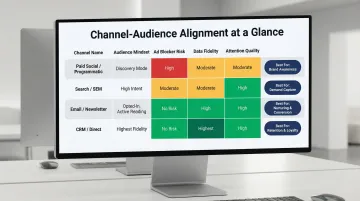
Channels differ significantly in audience transparency and attention quality:
- Paid social and programmatic: Broad targeting parameters, but audiences are passive — ad blockers prevent 29.5% of users worldwide from seeing the message at all
- Search/SEM: High intent at the keyword level, but competitive CPCs and limited audience profile depth
- Email and newsletter placements: Opted-in audiences with demonstrated active interest — no algorithmic gatekeeping, no ad blockers
- CRM and direct outreach: Highest data fidelity, but limited scale outside existing relationships
Of these, newsletter advertising stands out for one reason: the audience data driving the placement actually reaches the intended reader. Platforms like House of Summary place brand messages inside specialized publications covering global news, geopolitics, and business — content readers actively chose to receive. There's no algorithm filtering delivery and nothing blocking the message from landing in the inbox.
The result is measurable: House of Summary delivers click-through rates 4x higher than Google AdWords, driven by readers who open the newsletter to stay informed — not to scroll past ads.
What You Need Before Leveraging Audience Data
The quality of targeting decisions is only as good as the quality of inputs. Poor data hygiene, incomplete records, or unvalidated segments will produce misdirected campaigns regardless of strategy sophistication.
Data Infrastructure Requirements
Minimum tools and systems needed before running data-driven targeting:
- A CRM or customer database with segmentation capability
- Web analytics tracking behavior and conversion events
- A campaign reporting platform that ties performance back to specific audience segments
Without these systems, you can't build complete audience profiles, track which segments convert, or refine targeting based on results.
Data Readiness and Compliance Checks
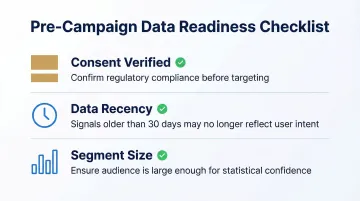
Before activating any audience data for targeting, verify:
- Consent has been obtained where required by regulation
- Data is current — behavioral signals from even 30 days ago may no longer reflect a user's intent
- Segments are large enough to yield meaningful results without hitting platform minimums or privacy thresholds
Data recency matters more than most marketers expect. Audience segments built on outdated behavioral data push ads to users whose interests, job titles, or purchase intent have already shifted. Running these three checks before launch prevents wasted spend on audiences you no longer understand.
Key Parameters That Affect Targeting Quality
Two campaigns using identical audience data can produce dramatically different results — the gap usually comes down to how well these four variables are managed.
Data Recency
Behavioral signals decay fast. Someone who showed purchase intent three months ago may have already converted with a competitor or shifted priorities entirely — targeting them means messaging based on who they were, not who they are now.
The urgency is real: companies that respond to leads within 5 minutes are 100x more likely to make contact than those that wait 30 minutes, and leads are 60x more likely to qualify when contacted within 1 hour versus 24 hours.
Audience Intent Level
Not all audience data reflects the same proximity to a purchase decision. Demographic data describes a person — behavioral and contextual signals (recent searches, content engagement, newsletter subscriptions) reveal what they're actively thinking about right now.
High-intent signals include:
- Opting into a specialized newsletter on finance, business, or geopolitics
- Engaging with editorial content rather than passively scrolling a feed
- Returning readership across multiple issues
The difference shows in the numbers: B2B email audiences average open rates of 39.48% and click-through rates of 2.21%. House of Summary readers are self-selected professionals actively reading editorial content — a different quality of attention than an algorithmically-served impression.
Segment Specificity vs. Scale
The more specific a segment, the more relevant the message — but specificity has a floor. Below a certain audience size, there's not enough data to optimize against or reach with statistical confidence.
The practical approach: test with tighter segments to validate messaging first, then scale to broader but still behaviorally qualified segments once the message is proven. Relevance and reach don't have to be in conflict.
Channel-Audience Alignment
Channel determines mindset. A social feed puts users in discovery or entertainment mode; a specialized professional newsletter puts them in active, information-seeking mode. Deploying the same audience segment across misaligned channels wastes the targeting precision you've built.
The data supports the distinction: brand recall is the most critical driver of brand lift in emerging media, accounting for 38.7% of brand lift, and newsletter placements average aided brand recall above 70%. Newsletter environments also bypass the ad avoidance that undermines display advertising — readers opted in, so attention is already present before the brand message arrives.
Common Mistakes When Using Audience Data for Targeted Marketing
Treating Data Collection as the End Goal
Many marketers over-invest in collecting data and under-invest in building actionable segments from it. Raw data has no targeting value until it is organized, validated, and mapped to a specific campaign objective. The gap between data availability and data activation is where most campaigns fail.
Relying Exclusively on Third-Party Data
With increasing privacy restrictions and cookie deprecation, campaigns built primarily on third-party data face growing accuracy and compliance risks. Up to 51% of ad targeting data is inaccurate, with accuracy rates ranging between 32% and 69%. Poor contact data compounds the problem — 85% of respondents say it negatively impacts operational efficiency.
Shifting to first-party and second-party data sources produces more reliable and durable targeting. House of Summary's advertising model relies on first-party subscriber data — readers who opted in to receive specialized content — giving advertisers access to verified, engaged audiences without the accuracy degradation that comes with third-party data.
Skipping Performance Feedback Loops
Audience data strategies that don't close the loop degrade. 52% of US brand and agency marketers now use incrementality testing to measure campaigns, moving away from flawed multi-touch attribution. Incrementality testing uses controlled experiments to isolate the causal effect of advertising.
Continuous optimization means treating every campaign as a data collection exercise that improves the next one. Organizations using closed-loop adtech solutions consistently report measurable gains:
- 240% ROI over three years
- 30–65% reduction in advertising costs
- 30–50% increase in return on ad spend

Frequently Asked Questions
How does data contribute to customer targeting strategies?
Audience data enables marketers to move beyond demographic guesswork by identifying behavioral and intent signals that indicate who is most likely to engage and convert. This makes targeting decisions evidence-based rather than assumption-based, improving both relevance and ROI.
What are the 5 C's of marketing analysis?
The 5 C's are Company, Customers, Competitors, Collaborators, and Climate. Each element shapes how audience data is interpreted and applied — from segmentation to channel selection.
What types of audience data are most valuable for targeted marketing?
Behavioral data (actions taken), intent data (signals of purchase readiness), and first-party demographic data are most valuable — together, they reveal not just who someone is, but what they're actively doing and considering.
What is the difference between first-party and third-party audience data?
First-party data is collected directly from your own audience with their consent and reflects real interactions. Third-party data is aggregated externally and increasingly constrained by privacy regulations and reduced accuracy, making it the less reliable option.
How do you segment an audience for a targeted marketing campaign?
Effective segmentation layers behavioral signals (past actions), intent signals (readiness to act), and channel preference — rather than relying on demographics alone. Prioritizing actions and context over static attributes improves both message relevance and conversion rates.
What metrics should I track to measure targeted marketing effectiveness?
Track click-through rate, conversion rate, cost per acquisition, and return on ad spend as primary indicators. For content-driven formats like newsletters, add audience engagement rate to measure how effectively your message resonates with the intended segment.