
Key Takeaways
- The IAB defines native advertising as paid ads cohesive with page content, matched to design, and consistent with platform behavior.
- Playbook 2.0 (2019) reduced native ad formats from six to three: In-Feed/In-Content, Content Recommendation Ads, and Branded/Native Content.
- Four previously recognized formats were removed or reclassified, reflecting how the market had matured since 2013.
- The IAB Evaluation Criteria (Design, Location, Behavior, Disclosure) gives buyers and sellers a shared language to assess any native ad unit.
- Disclosure is non-negotiable: the IAB and FTC both require labels that are clear, prominent, and impossible to miss.
What Is the IAB Native Advertising Playbook?
Digital advertising has a trust problem. Banner blindness is real, ad blockers are widespread, and most display formats get scrolled past before they register. Native advertising emerged as a response — but its definition remained contested for years. The industry had no shared answer for where sponsored content ended and editorial began.
The Interactive Advertising Bureau (IAB) stepped in to answer that question. Founded in 1996, the IAB is the US-based trade organization that sets standards and guidelines for the digital advertising industry. Its Native Advertising Playbook, first published in December 2013, gave the industry a formal taxonomy and shared vocabulary for a format that had been defined differently by every platform selling it.
The original Playbook identified six native ad categories:
- In-Feed Units
- Paid Search Units
- Recommendation Widgets
- Promoted Listings
- In-Ad (IAB Standard) with Native Element Units
- Custom / Can't Be Contained
These categories held for several years, but the market outgrew them. By 2019, new formats and platform behaviors had blurred enough of the original lines to require a formal reassessment. A working group of 69 IAB members from leading publisher and technology companies convened to determine which definitions still held. The result was Native Advertising Playbook 2.0, published in May 2019 — a consolidated framework that dropped outdated distinctions and aligned definitions with how the industry actually operated.
The core definition of native advertising remained unchanged across both versions: native is a concept encompassing both an aspiration and a suite of ad products — delivering paid ads that are cohesive with page content, assimilated into design, and consistent with platform behavior, so the viewer feels the ads belong.
How Native Advertising Evolved From 2013 to 2019
The IAB's "Then and Now" framing in Playbook 2.0 reflects a decade of measurable change — and the numbers make the scale of that shift concrete.
In 2013, native advertising was experimental. Only a handful of publisher studios were attempting it. By 2019, nearly every major publisher had a dedicated native content studio — what started as a novelty had become standard industry practice.
The market shifts driving that change were substantial:
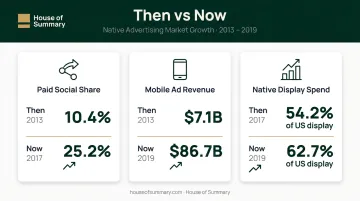
- Paid social grew from 10.4% of total digital ad revenue in 2013 to 25.2% by FY2017, according to the IAB/PwC Internet Advertising Revenue Report cited directly in Playbook 2.0.
- Mobile ad revenue climbed from $7.1B in 2013 to $86.7B in 2019 — nearly a 12x increase — per IAB/PwC primary reports.
- Native display spend grew to represent the majority of overall display spend. According to eMarketer, US native advertising already accounted for 62.7% of total US display ad spending by 2019 — up from 54.2% in 2017.
That growth came with a cost: more formats and more platforms created real confusion about what actually qualifies as native. The IAB's revised playbook addressed this directly, tightening the definition and cutting categories that had drifted too far from the core principle of format-matched, non-disruptive advertising.
The 3 IAB-Recognized Native Ad Formats Explained
Playbook 2.0 consolidated native advertising into three primary formats. Each has distinct placements, characteristics, and use cases.
In-Feed and In-Content Ads
In-feed ads appear within a user's content feed — a news feed, social media timeline, or content listing — blending visually with editorial content around them. In-content ads sit within a specific piece of content, such as between paragraphs of a news article. The format is the same; only the placement context differs.
This is the most common native format, and a large share of in-feed placements are now transacted programmatically through real-time bidding.
Newsletter advertising is a high-performing variant of this format. Sponsored content placed natively inside a curated editorial email reaches readers without algorithmic interference or ad blockers — two of the most persistent problems that undermine web and social native placements.
House of Summary's newsletter network, which delivers 254,866+ emails opened daily across Presidential Summary, Geopolitical Summary, Dubai Summary, and London Summary, demonstrates this model in practice. Sponsored content appears inline with editorial content, written in each newsletter's natural voice, with clear advertiser disclosure — matching the core criteria for in-feed native without the filtering risk of open-web or social placements.
Content Recommendation Ads
Content recommendation ads are the widgets that typically appear below or alongside articles, surfacing "recommended," "sponsored," or "you may also like" content. Clicking takes the user off-site to an external destination.
The IAB recognizes several synonyms for this category:
- Content Discovery Ads
- Sponsored Content Ads
- Content Recommendation Widgets
Major platforms in this space include Outbrain, Taboola, Dianomi, and Revcontent. While these are classified as native, they differ meaningfully from branded content — the user always leaves the publisher's environment, and the content is not created in partnership with the host publication.
Branded and Native Content
Branded/native content is paid content from a brand published in the same full editorial format as a publisher's regular content — typically produced in collaboration with the publisher's own content team. Unlike the other two formats, when a user clicks, the content lives on a page hosted and served by the publisher.
This format goes by several names: sponsored content, partner content, publisher-partnered content, and brand content. Forbes BrandVoice, for instance, is one of the more established examples — a model where brands gain a subsite within Forbes' own domain, with content produced through Forbes' Content & Design Studio. That level of brand-publisher integration goes beyond a single placement, giving brands sustained editorial presence within a trusted media environment.
The IAB Evaluation Criteria: How to Assess Any Native Ad
Not every ad fits neatly into one of three categories. The IAB acknowledged this in Playbook 2.0 by including an Evaluation Criteria framework — a shared vocabulary for buyers and sellers to assess whether a specific ad unit meets the strategic goals of a native campaign.
The four criteria:
| Criterion | What It Asks |
|---|---|
| Design | Does the ad match the visual style of its surrounding content? |
| Location | Is it placed where users naturally engage with content? |
| Behavior | Does the ad behave the same way the platform's organic content does? |
| Disclosure | Is the commercial nature of the ad clearly communicated? |
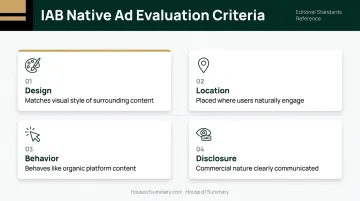
These criteria don't function as a rigid scoring system. Because native operates across platforms with vastly different formats, there is no universal standard. Each native ad unit should be evaluated on its own merits against these four criteria — context matters.
The IAB also raises a notable tension: native advertising is both an aspiration and a suite of products. If the only criterion for calling something "native" becomes visual design — with no regard for content quality or relevance — the industry risks creating "native blindness," where users tune out ads that look editorial but deliver nothing of value.
All four criteria need to hold simultaneously. An ad that matches the design but ignores disclosure, or sits in the right location but behaves like a banner, fails the framework — and the audience.
Disclosure and Transparency Requirements
Transparency is not optional under the IAB framework. Every native ad must be clearly labeled as paid or sponsored content — regardless of how seamlessly it integrates with editorial.
The IAB's specific guidance: disclosure labels must use language that conveys the content has been paid for, and they must be large and visible enough for a consumer to notice them in context, whether on desktop or mobile.
The FTC's Native Advertising Guide for Businesses reinforces this with binding standards. The FTC requires disclosures to be clear and conspicuous, placed as close as possible to the native ads they relate to, and understandable before the consumer receives the advertising message. An ad's format is deceptive, according to the FTC's 2015 policy statement, if it materially misleads consumers about its commercial nature.
The regulatory risk is real. In 2016, the FTC finalized an order against Lord & Taylor after the retailer failed to disclose that a Nylon magazine article and related social posts were paid promotions. The final order prohibited Lord & Taylor from misrepresenting paid commercial advertising as content from an independent or objective source — proof that the FTC will act when brands skip disclosure.
For publishers and brands operating in the native space, three rules apply:
- Label every sponsored placement with clear, visible language
- Do not rely on visual integration alone to satisfy disclosure obligations
- Ensure labeling is legible and prominent on both desktop and mobile
Frequently Asked Questions
What is a native ad format?
A native ad format refers to the specific type and placement structure of a native advertisement — such as in-feed, content recommendation, or branded content. Each format is designed to match the look, feel, and behavior of the platform where it appears, making the ad feel like a natural part of the surrounding content.
What does IAB stand for in advertising?
IAB stands for the Interactive Advertising Bureau, a US-based trade organization founded in 1996 that sets standards, guidelines, and best practices for the digital advertising industry — including the widely referenced Native Advertising Playbook.
How is IAB Native Advertising Playbook 2.0 different from the 2013 version?
The 2019 update streamlined native ad types from six to three, removing paid search, promoted listings, in-ad with native elements, and custom formats. It reflected how significantly the market had matured, particularly with the rise of paid social, mobile, and programmatic buying.
What are the IAB's disclosure requirements for native advertising?
The IAB requires all native ads to be clearly labeled as paid or sponsored, with labels large and visible enough for users to notice regardless of device. This aligns with FTC enforcement guidance, which requires disclosures to be clear, conspicuous, and placed upfront before the ad content is consumed.
What is the difference between in-feed ads and branded native content?
In-feed ads appear within content or social feeds and typically send users to an external destination when clicked. Branded native content is editorially formatted, created in partnership with the publisher, and hosted directly on the publisher's own platform.